
Three-spot gourami
Trichopodus trichopterus
14 views
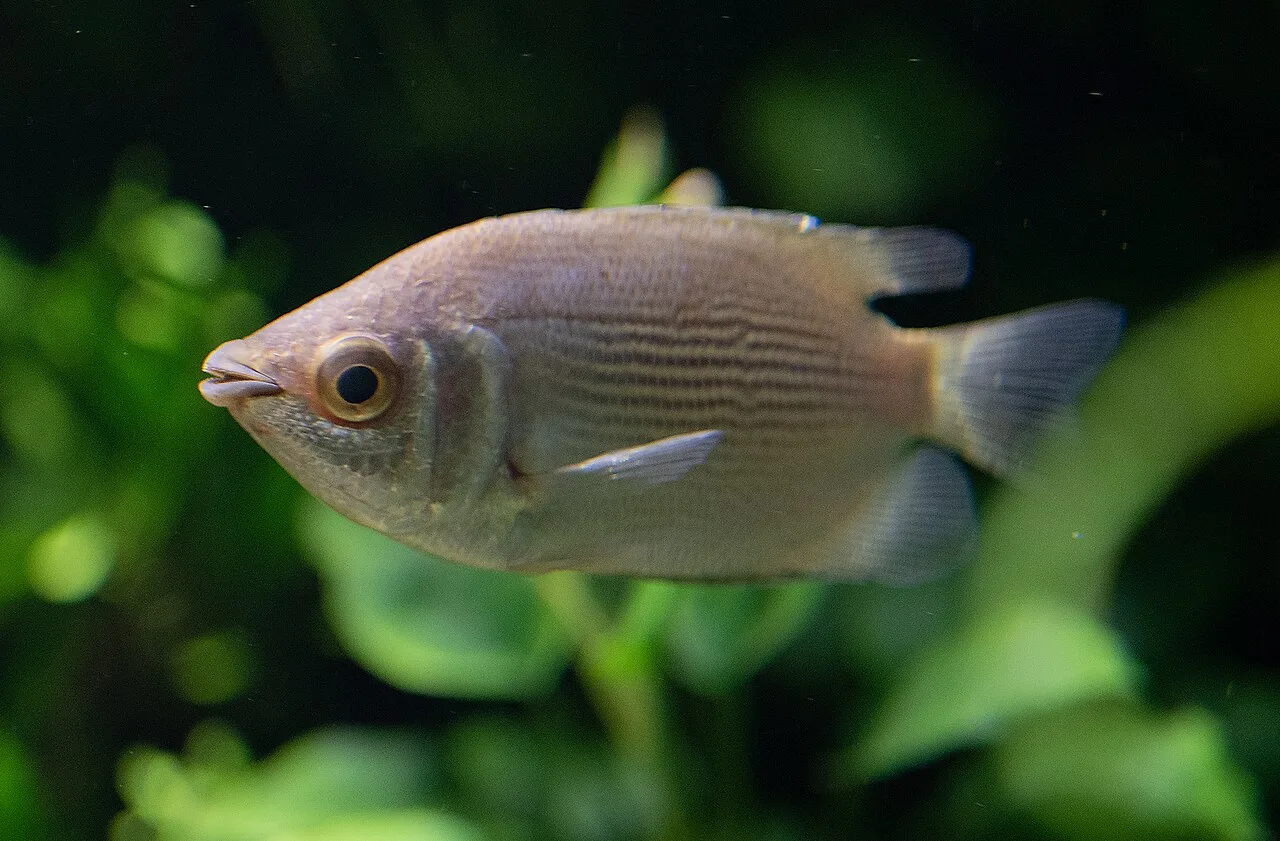
A labyrinth fish with two dark spots and the eye as a third point. It grows larger and more decided than a dwarf gourami.
3 min read · 411 words
Quick facts
The profile values are backed by one source.
Home & range
Every named country gets a frame and a circle around known waters in or near that area. Hotspots are orientation, not collection sites. A filled area is the range only when the source names a particular water body.
Overview
Trichopodus trichopterus reaches about 12 to 15 cm. The blue form, the gold form and the marble form are cultivated colours of the same species. Two black spots on the flank and the eye make the three spots of the English name. The pelvic fins are long threads. Males have the more pointed dorsal.
Juveniles look peaceful. With maturity the males hold a corner while courting and drive off whatever swims there. The tank has to give up that corner and still leave room for the rest of the stock.
Origin & habitat
This describes the origin, not how to furnish the aquarium.
Plant-rich, slow and still waters of Southeast Asia, from Myanmar through Thailand and Malaysia to the Greater Sunda Islands. The species is also widely introduced and must not be released from the aquarium into natural waters. The countries of the home range stay a coarse origin.
The habitat is warm, often low in oxygen and full of plants. The labyrinth is therefore not an extra. It is breathing at the surface.
Care
Tank
24 to 28 °C, pH 6 to 8. From about 150 litres and 100 cm for a pair or one male with several females. Floating plants, dense planting at the edges, an open surface, little current. The air above the water stays warm. Two adult males need a clearly longer tank with visual barriers.
Company
Calm fish that are not too small. Tiny tetras and shrimp are eaten or hunted. Other male labyrinth fish on the same run fight. Tiger barbs nip the threads. Corydoras and larger tetras fit better.
Diet
Omnivore. Flakes, granules, frozen food and a plant share. The fish feed from the surface down into the middle. A pure meat diet is unnecessary. Several smaller feeds stop the male from defending the whole portion at the nest while the rest go hungry.
Behavior
Mostly calm outside courtship, clearly territorial when breeding. The male spreads the fins, builds under floating plants and darkens in the pattern. A female that is not ready to spawn needs a second zone, or courtship becomes a chase.
The thread fins feel plants and tankmates. Torn threads regrow and show nippers or a coarse net.
Reproduction
Bubble nest at the surface. The male guards the clutch and then drives the female off. The larvae are tiny and need infusoria before they take brine shrimp. Little of that survives in a community tank. A breeding setup is a separate, shallow, warm tank with floating plants.
The gold and marble forms spawn the same way. The colour does not breed true in every brood.
More species in this group

Sources & assertions 1
Wikipedia (deutsch)
Texte in Aquarisma sind eigenständig formuliert. Zahlenbereiche folgen den verlinkten Wikipedia-Artikeln, Lizenz CC BY-SA.
- Haltungsbereich nach https://de.wikipedia.org/wiki/Blauer_Fadenfisch