
Compressiceps cichlid
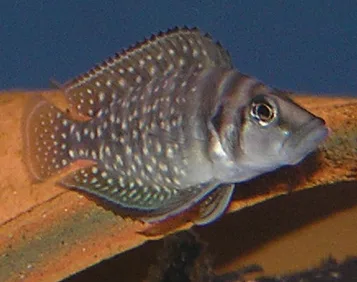
Altolamprologus compressiceps
15 views
A strongly compressed cichlid from Lake Tanganyika. It hunts in rock cracks and needs hard water and caves of its own.
3 min read · 384 words
Quick facts
The profile values are backed by one source.
Home & range
Every named country gets a frame and a circle around known waters in or near that area. Hotspots are orientation, not collection sites. A filled area is the range only when the source names a particular water body.
Overview
Altolamprologus compressiceps reaches about 12 cm, females stay smaller. The body is so flat that it enters cracks that are too tight for other cichlids. The ground colour is beige to gold-brown with dark bars. There are several shore populations. They should not be bred on as random mixes.
The species eats mainly small animals that it takes from crevices. It is not an aufwuchs feeder and not a Malawi mbuna, even though both stand in hard water.
Origin & habitat
This describes the origin, not how to furnish the aquarium.
Rocky coasts of Lake Tanganyika. Clear, alkaline, oxygen-rich water, cracks and overhangs. The lake is the origin. Individual stretches of shore are not a reviewed point map here.
In the rock the fish hunts sideways into the crevice. A smooth rock tank without tight cracks takes away exactly that hunt.
Care
Layout
24 to 28 °C, pH 8 to 9, hard. From about 200 litres and 100 cm for a pair, with a layout of flat stones that form real cracks. Sand in front. Several pairs need clearly more length and separate territories. A single fish is possible.
Company
Other Tanganyika species that use other zones, such as shell dwellers on the sand, if the tank offers both. Soft-water fish and mbuna do not belong. Shrimp and very small fish are prey. The compressiceps digs little and is more likely to leave tough epiphytes standing.
Diet
Animal food that falls into the cracks and onto the sand. Brine shrimp, mosquito larvae, small pieces of frozen food, a granule. The fish do not feed hurriedly at the surface. A feeding only there misses them.
Pieces that are too large are ignored or spat out. The mouth is built for small bites from the crevice.
Behavior
Quiet, until another fish wants the same crack. Then the body itself is the weapon: it turns sideways and blocks the entrance. Losing fish need a second crack out of sight.
The species is active by day, but not hectic. It often stands for minutes sideways in a crevice and watches the tank.
Reproduction
Cave spawner. The female, clearly smaller, fits into tighter cracks than the male and guards the clutch there. The young stay nearby for a long time. In a species tank with enough cracks a brood can remain. Constantly taking the layout apart destroys it.
Maturity takes time. A juvenile of 4 cm is not a breeding pair.
More species in this group


Sources & assertions 1
Wikipedia (deutsch)
Texte in Aquarisma sind eigenständig formuliert. Zahlenbereiche folgen den verlinkten Wikipedia-Artikeln, Lizenz CC BY-SA.
- Haltungsbereich nach https://de.wikipedia.org/wiki/Altolamprologus_compressiceps