
Sardine cichlid
Cyprichromis leptosoma
16 views
A slender mouthbrooder from the open water of Lake Tanganyika. It swims as a group and needs length, not a rock territory on the bottom.
3 min read · 368 words
Quick facts
The profile values are backed by one source.
Home & range
Every named country gets a frame and a circle around known waters in or near that area. Hotspots are orientation, not collection sites. A filled area is the range only when the source names a particular water body.
Overview
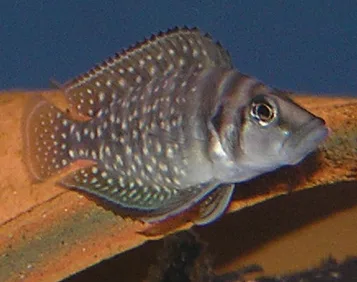
Cyprichromis leptosoma reaches about 8 to 10 cm. The body is spindle-shaped. Males wear yellow, blue or a dark dorsal pattern depending on the population. Females stay silvery. The forms should not be mixed if a line is to be kept. The fish stand at an angle in open water and in that resemble herrings, not rock mbuna.
They feed in open water on what drifts past. A pure bottom tank without a swimming run does not show them. Neither does a Malawi tank with a different water chemistry.
Origin & habitat
This describes the origin, not how to furnish the aquarium.
Open water above the rock walls of Lake Tanganyika. Clear, alkaline, oxygen-rich. The lake is the origin. The colour populations have tighter shores that are not drawn here as points.
Care
Size
24 to 27 °C, pH 8 to 9, hard. From about 250 litres and 120 cm for a group from eight, with several males. Open above. Below, other Tanganyika species can use the rocks if the tank is high enough. Moderate current. Bright light bothers them less than hidden species, because these fish want the open water.
Company
Shell dwellers and other bottom species below, the leptosoma above. No mbuna that push into the same column. No tiny fish that fit in the mouth. The group has to be large enough from the start.
Diet
Small animal food in open water. Brine shrimp, cyclops, mosquito larvae, a granule that sinks slowly. Several feeds a day. A tablet on the bottom is the food of the other species, not of this fish.\n\nThe males court in the water column. Anyone who feeds only once a day hardly sees the courtship, because afterwards the fish only wait for the next portion.
Behavior
A group with a rank order of the males in open water. That is display and a short chase, as long as the length is right. In a short tank one male is pushed into a corner. Females need the group as cover, not one male on one female.
Reproduction
Mouthbrooder in open water. The female takes up the eggs while the pair stands in the column. The carrying time is about three weeks. In a dense group the released young are often eaten. Anyone who wants to keep them catches the carrying female out calmly.
More species in this group


Sources & assertions 1
Wikipedia (deutsch)
Texte in Aquarisma sind eigenständig formuliert. Zahlenbereiche folgen den verlinkten Wikipedia-Artikeln, Lizenz CC BY-SA.
- Haltungsbereich nach https://de.wikipedia.org/wiki/Cyprichromis_leptosoma