
Madagascar rainbowfish
Bedotia madagascariensis
11 views
The type species of the genus, not Bedotia geayi. The trade names Madagascar rainbowfish and red-tailed silverside have been used for both.
1 min read · 118 words
Quick facts
The profile values are backed by one source.
Home & range
Every named country gets a frame and a circle around known waters in or near that area. Hotspots are orientation, not collection sites. A filled area is the range only when the source names a particular water body.
Coarse origin
The circle sits around the country or, a little wider, around known waters there. The points are orientation, not collection sites.
- Eastern Madagascar From the Ivoloina to the Manambolo, plus the introduction in the Betsiboka. The island is not filled. Wikipedia deutsch
- Eastern Madagascar Coarse region of origin
Overview
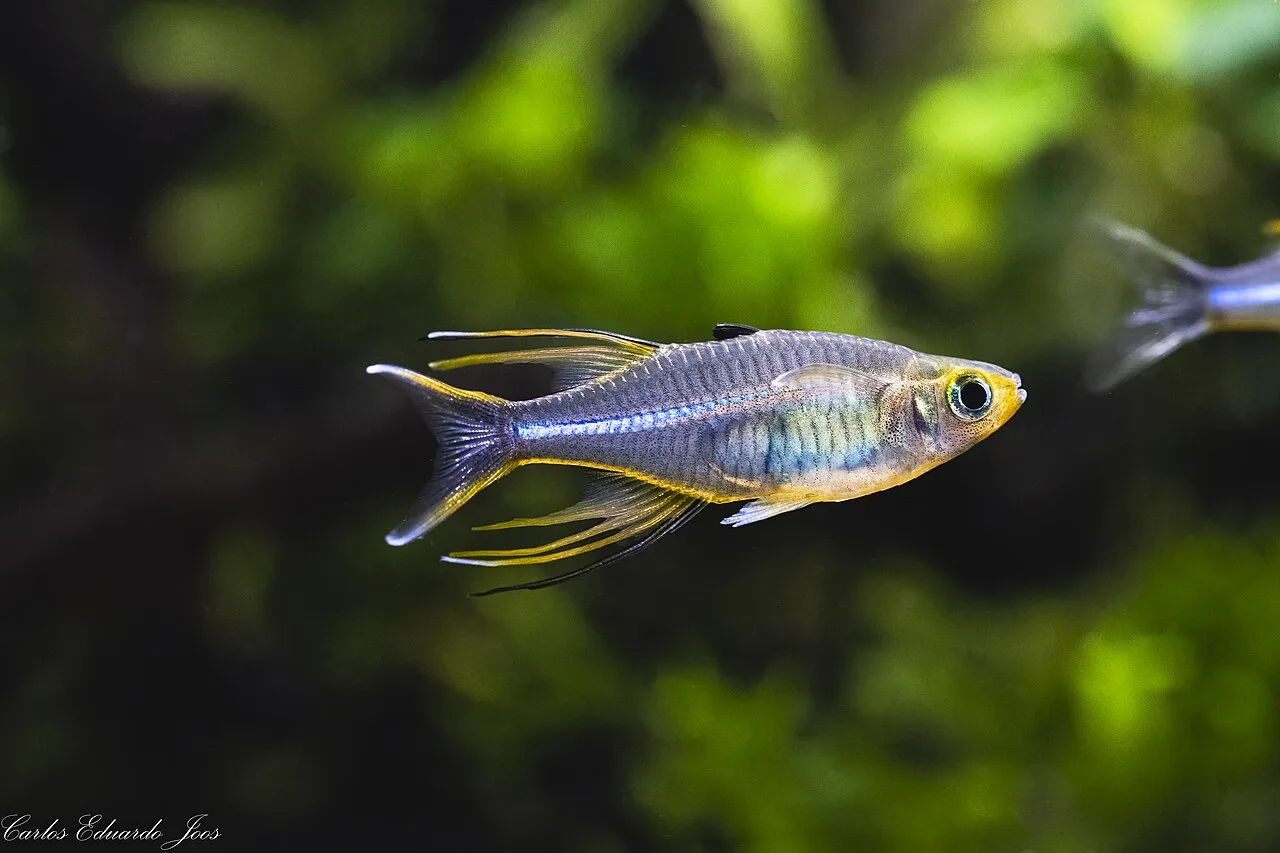
In captivity to 10 cm standard length, wild fish probably usually smaller. Two dorsal fins. Loose schools of several dozen, graded by size. An age of ten years is reachable in captivity, not stored as a span.
Origin & habitat
This describes the origin, not how to furnish the aquarium.
Eastern Madagascar from the lower Ivoloina north of Toamasina south at least to the Manambolo near Vatomandry. An introduction on the upper Betsiboka. Clear shaded streams, very soft under 17.1 ppm, in swamps down to pH 4.8. Those are habitat figures, not care optima. Brackish water is avoided. Madagascar stays coarse and is not filled as an island.
Behavior
Younger fish in the shallows, adults also deeper.
Reproduction
Little is known about reproduction in the wild. A long breeding season is inferred from the size classes.
More species in this group
Sources & assertions 1
Wikipedia (deutsch)
Texte in Aquarisma sind eigenständig formuliert. Zahlenbereiche folgen den verlinkten Wikipedia-Artikeln, Lizenz CC BY-SA.
- Haltungsbereich nach https://de.wikipedia.org/wiki/Bedotia_madagascariensis