
Daisy ricefish
Oryzias woworae
10 views
A small ricefish from Sulawesi, the males with a blue and red sheen. It swims as a group near the surface.
2 min read · 304 words
Quick facts
The profile values are backed by one source.
Home & range
Every named country gets a frame and a circle around known waters in or near that area. Hotspots are orientation, not collection sites. A filled area is the range only when the source names a particular water body.
Overview
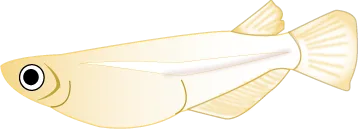
Oryzias woworae stays at about 3 cm. The males show a blue body sheen and red fin edges, the females plainer olive. The eyes are large. The species is not the medaka Oryzias latipes, which stays paler and tolerates cooler water. Both are listed as ricefish and have different temperatures.
The colour comes in the group and against a dark bottom. A single male in a bright tank looks grey. That is the place, not a pale strain.
Origin & habitat
This describes the origin, not how to furnish the aquarium.
Streams and small waters on Sulawesi, clear, with plants and light. The island stays the coarse origin. The natural area is small. Aquarium fish should be captive-bred. The species jumps.
Care
Size
23 to 27 °C, pH 6.5 to 7.5. A school from eight, tanks from about 40 litres, densely planted at the edges, open above, with a firm cover. Not a permanent stay below 22 °C and not an unheated pond fish like some medaka. Floating plants give cover without closing the whole surface.
Company
Other very small, quiet fish, or the species alone. Shrimp fit. Large tetras, barbs and every cichlid do not. The ricefish lose every feeding to faster mouths and are also eaten.
Diet
Fine food at the surface and in the upper midwater. Brine-shrimp nauplii, cyclops, dust-fine flakes. Several small feeds. Bottom tablets miss the species.
Behavior
A loose group near the surface. The males show each other the red fins. Too few fish stand singly and lose the colour. Within the species they stay peaceful. A cover is not caution. It is the keeping, because they go through narrow gaps.
Reproduction
The eggs hang as a small cluster on the belly of the female and are stripped off onto fine plants. The parents do not guard them. In moss a few young survive. Deliberate breeding means moving the plants with the eggs and feeding the larvae dust food.
More species in this group
Sources & assertions 1
Wikipedia (deutsch)
Texte in Aquarisma sind eigenständig formuliert. Zahlenbereiche folgen den verlinkten Wikipedia-Artikeln, Lizenz CC BY-SA.
- Haltungsbereich nach https://de.wikipedia.org/wiki/Oryzias_woworae