
Pearl cichlid
Geophagus brasiliensis
11 views
A pearly cichlid from south-eastern South America. It grows large, digs and needs sand.
3 min read · 378 words
Quick facts
The profile values are backed by one source.
Home & range
Every named country gets a frame and a circle around known waters in or near that area. Hotspots are orientation, not collection sites. A filled area is the range only when the source names a particular water body.
Overview
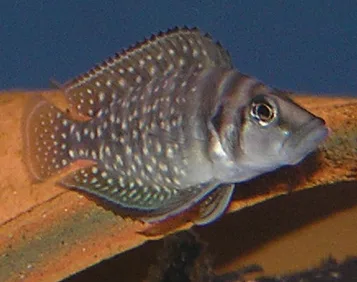
Geophagus brasiliensis reaches 20 cm and more. The body is oval, the scales carry pearly spots, the males a nuchal hump and longer fins when courting. Juveniles in the trade are often under 6 cm and do not suggest the adult size. The tank has to be planned for the adult.
The species chews through the bottom. Sand is taken up and given out again through the gills. Coarse gravel injures the gills. Plants that do not sit firm or are not tied on are uprooted.
Origin & habitat
This describes the origin, not how to furnish the aquarium.
Rivers, lakes and coastal lagoons in south-eastern Brazil and in Uruguay. The water there is often harder and not extremely acidic. Both countries stay a coarse origin. The species is adaptable, and that is not a licence for a small community tank.
Care
Size
20 to 26 °C, pH 6.5 to 7.5. From about 300 litres and 140 cm for a pair of adults. Fine sand, roots and stones that do not tip when the fish dig underneath. Plants only tied on or very firm. A pair. Further conspecifics need clearly more length.
Company
Robust fish that are not too small. Tetras the size of a neon are eaten. While breeding a territory on the bottom is closed. Calm fish in the upper water cope better than further bottom breeders on the same area.
Diet
Omnivore, searching the sand for small animals and taking added food. Sinking granules, frozen food, blanched vegetables. Food that only drifts at the surface misses the species. Too much fattening food makes the fish fat without replacing the search in the sand.
Behavior
A pair with a territory, often tolerable outside breeding, decided at spawning time. The digging is the normal behaviour and not a sign that the substrate is wrong. A fish that no longer feeds and stands in a corner with clamped fins is driven off or ill.
The pearly spots come with age and with good water. Juveniles are plain olive.
Reproduction
Substrate spawner with brood care. The pair digs, spawns on a stone and guards eggs and young. In a community tank this fails as soon as other fish reach the clutch. A breeding setup is the established pair in a tank of its own with sand.
The young are numerous. Without a plan for where they go, a brood becomes an overcrowded tank.
More species in this group


Sources & assertions 1
Wikipedia (deutsch)
Texte in Aquarisma sind eigenständig formuliert. Zahlenbereiche folgen den verlinkten Wikipedia-Artikeln, Lizenz CC BY-SA.
- Haltungsbereich nach https://de.wikipedia.org/wiki/Geophagus_brasiliensis