
Striped panchax
Aplocheilus lineatus
9 views
A surface hunter from India and Sri Lanka. It grows larger than a dwarf rasbora and eats what comes to the surface.
2 min read · 313 words
Quick facts
The profile values are backed by one source.
Home & range
Every named country gets a frame and a circle around known waters in or near that area. Hotspots are orientation, not collection sites. A filled area is the range only when the source names a particular water body.
Overview
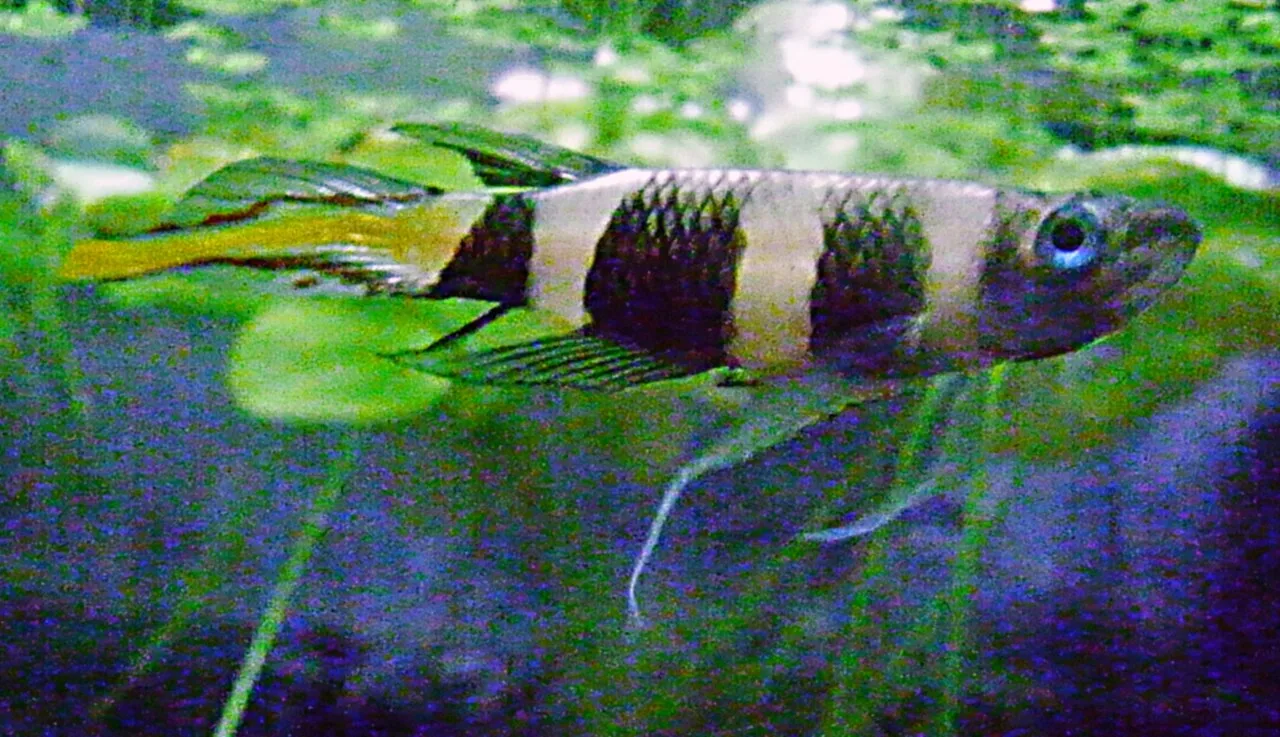
The striped panchax reaches about 10 cm. The body is elongate, the mouth upturned. Males are more colourful, with rows of dark spots and often yellow fins. Females are plainer and deeper. Golden fish are a cultivated form. The species stands just under the surface and shoots at food and at smaller fish.
It jumps accurately. A gap in the cover is enough. Keep the tank closed, even when the fish are standing quietly.
Origin & habitat
This describes the origin, not how to furnish the aquarium.
Ditches, rice fields and planted banks in India and Sri Lanka. Warm shallows, cover from above, a clear view of the surface. Both countries stay a coarse origin.
Care
Size
22 to 28 °C, pH 6 to 7.5. From about 100 litres and 80 cm for a small group, with floating plants but an open run at the surface. Weak current. Several females, not a crowd of males on a short run.
Company
Only fish that do not fit in the mouth and do not fight for the same food at the surface. Neons, Boraras and shrimp disappear. Corydoras can live below. Above, the panchax is the hunter.
Diet
Live and frozen food from the surface, plus a granule that does not sink at once. Mosquito larvae, brine shrimp, small insects. Flakes that fall to the bottom it hardly sees. Several feeds, because one male holds the surface.
Behavior
A surface fish with a territory among the males. Short chases are normal. A fish that is driven off all the time needs more length or has to come out. The species is active by day and stands visible as long as there is cover from above. With no floating plants at all the fish become shy.
Reproduction
The eggs are laid in fine plants near the surface and are not guarded. The parents eat them. A breeding setup is a shallow tank with a spawning substrate, from which the adults are removed. The larvae need fine food and a cover.
More species in this group
Sources & assertions 1
Wikipedia (deutsch)
Texte in Aquarisma sind eigenständig formuliert. Zahlenbereiche folgen den verlinkten Wikipedia-Artikeln, Lizenz CC BY-SA.
- Haltungsbereich nach https://de.wikipedia.org/wiki/Streifenhechtling