
Lake Kutubu rainbowfish
Melanotaenia lacustris
11 views
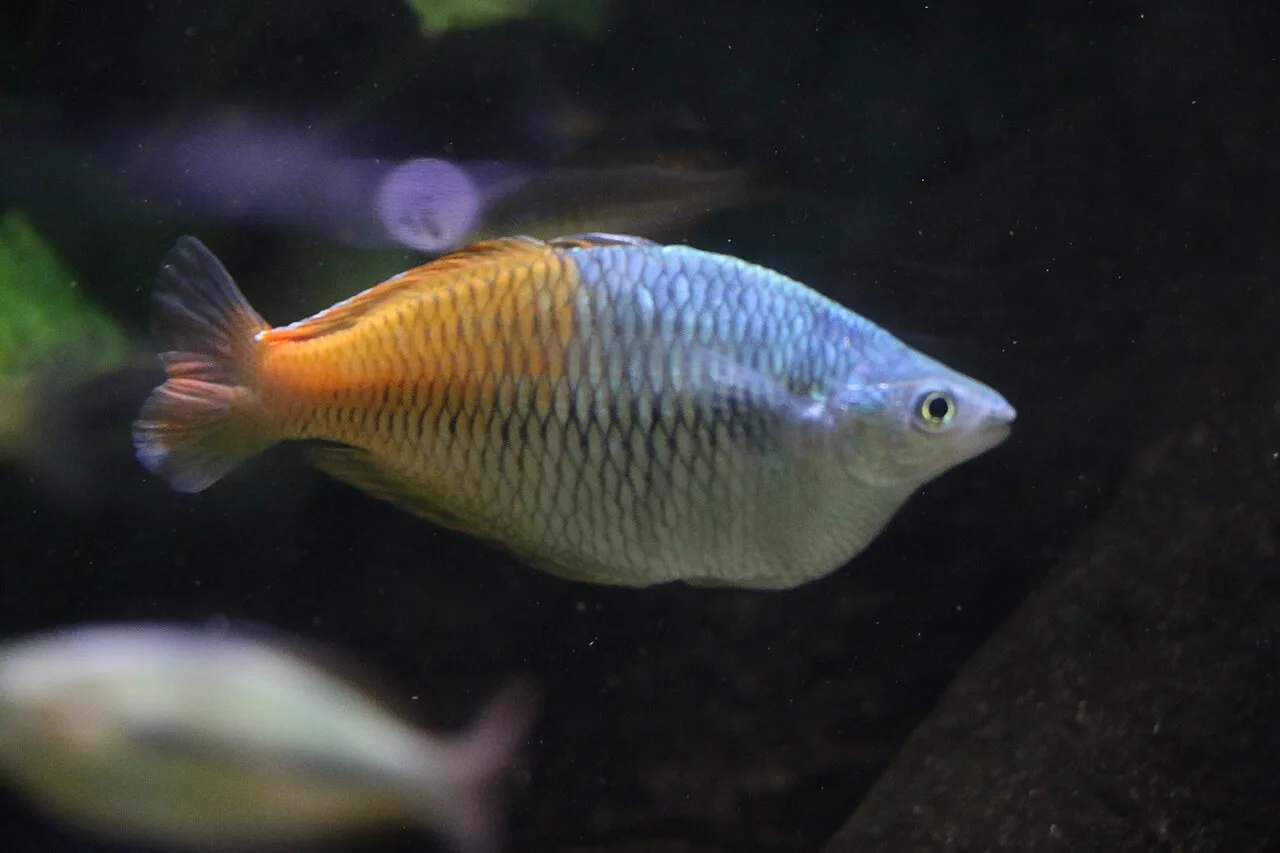
A deep-bodied rainbowfish from a small lake in New Guinea. The turquoise colour arrives with age, a group and tank length, not on a single juvenile.
3 min read · 445 words
Quick facts
The profile values are backed by one source.
Home & range
Every named country gets a frame and a circle around known waters in or near that area. Hotspots are orientation, not collection sites. A filled area is the range only when the source names a particular water body.
Overview
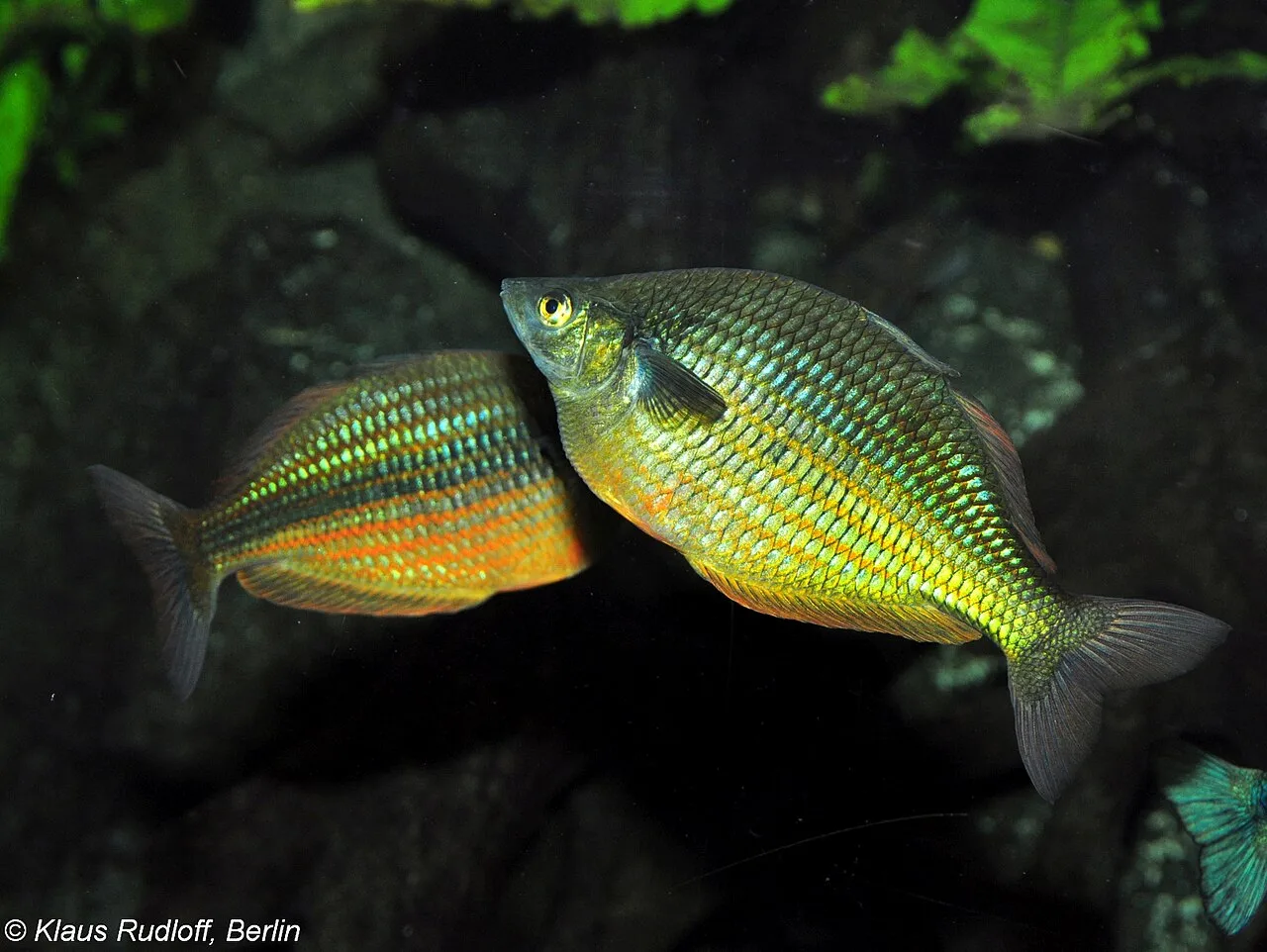
Melanotaenia lacustris reaches about 10 to 12 cm and is clearly deeper-bodied than many slender rainbowfish. Adult males are turquoise to blue-green with a warm yellow zone that shifts with mood. Females stay paler and less deep. Juveniles are silvery and disappoint anyone who expects the catalogue colour on the day of purchase.
The colour is a group effect. A male without rivals and without a run stays pale, even on good food. Several males in a long tank display to each other.
Origin & habitat
This describes the origin, not how to furnish the aquarium.
The species is native to Lake Kutubu and the waters immediately connected with it in Papua New Guinea. The natural range is small. The lake water is clear, hard and alkaline, not acidic blackwater. A coarse origin is New Guinea. The lake is not an invitation to expect wild fish from a narrow endemic area. Aquarium fish should be captive-bred.
The small range is a reason not to wear the species out as a mass fish in unstable tanks.
Care
Size
22 to 26 °C, pH 7.5 to 8.5, rather hard. Tanks from about 200 litres and 120 cm long. Height is secondary. The swimming run is not. A group from six, mixed sexes, with several males. An open middle, planting at the edges, a quiet surface. They do not jump as extremely as some rasboras. A cover is still sensible.
Company
Other calm fish that are not tiny. Very small shrimp and tiny rasboras are harassed or eaten. Aggressive barbs destroy the calm from which the colour comes. Rainbowfish are on the move all day. Anyone who wants a still tank of dusk fish is in the wrong place.
Diet
Omnivore with a strong appetite. Flakes, granules, frozen food and a plant share. The portions must not be taken only by the leading males. A second feeding spot further back brings the females in.
Colour does not come from colour food alone. It comes from age, light, water and the chance to court without being driven off.
Behavior
An active school with a constant small rivalry among the males. That is spreading fins and circling, not biting to a wound, as long as the length is right. In an 80 cm tank the same rivalry becomes stress.
The fish stand in the upper and middle water. Bottom fish bother them little if those fish do not themselves claim the whole column.
Reproduction
A continuous spawner. The eggs hang on fine plants or a spawning mop and are given over several days. The parents eat them. Anyone who wants to breed moves the mop and rears the eggs apart. The young are small and need fine food and very clean water.
In a community tank young are the exception, not a plan.
More species in this group
Sources & assertions 1
Wikipedia (deutsch)
Texte in Aquarisma sind eigenständig formuliert. Zahlenbereiche folgen den verlinkten Wikipedia-Artikeln, Lizenz CC BY-SA.
- Haltungsbereich nach https://de.wikipedia.org/wiki/Melanotaenia_lacustris