
Uaru
Uaru amphiacanthoides
10 views
A tall, quiet cichlid from the Amazon. It grows large, eats plants and needs warmth and a group.
2 min read · 257 words
Quick facts
The profile values are backed by one source.
Home & range
Every named country gets a frame and a circle around known waters in or near that area. Hotspots are orientation, not collection sites. A filled area is the range only when the source names a particular water body.
Overview
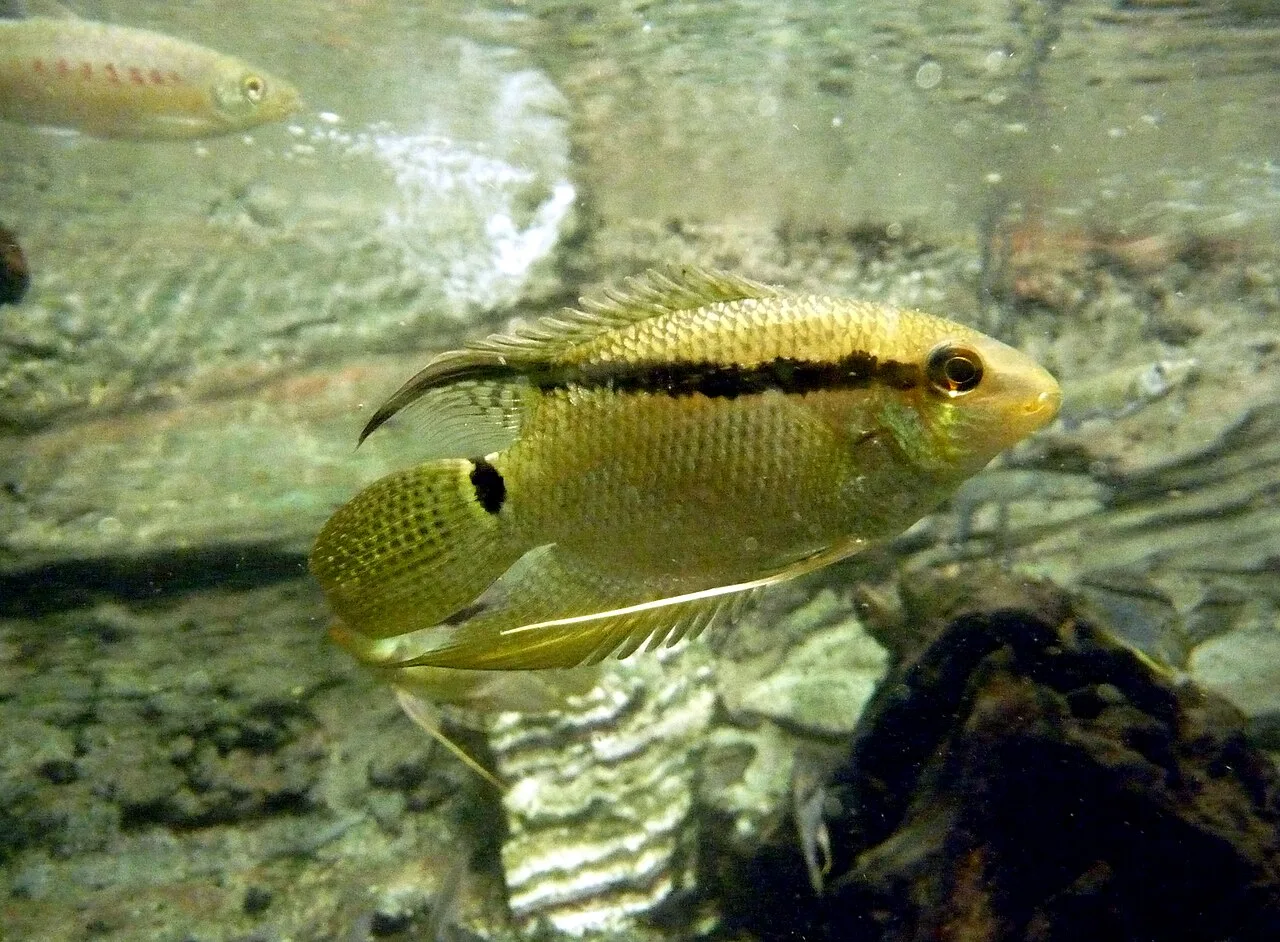
Uaru amphiacanthoides reaches about 25 cm. The body is oval and compressed, olive to brown, with a wedge-shaped dark patch. Juveniles are patterned quite differently, with pale spots, and do not look like the parents. The species stands quietly in midwater and is often compared with the discus, but it is a fish of its own with its own hunger for plants.
Soft leaves count as food. A planted scape and an uaru exclude each other once the fish grow.
Origin & habitat
This describes the origin, not how to furnish the aquarium.
Slow, warm waters of the Amazon basin, among wood. The origin stays coarse. Warmth, soft water and a lot of room are the direction.
Care
Size
27 to 30 °C, pH 6 to 7. A group from five, tanks from about 450 litres and 150 cm, with height, wood and an open run. Tough plants or none. Regular water changes, because the fish eat a lot.
Company
Other large, quiet warm-water fish, such as discus, if the tank carries both. Small tetras are eaten. Aggressive cichlids stress the group.
Diet
A lot of plant food and a substantial granule, plus frozen food. Blanched vegetable strips every day. Anyone who leaves that out loses the remaining plants and sees hollow bellies.
Behavior
A group with a quiet rank order. A single fish becomes shy. For breeding a pair forms and closes a zone. That is limited in time. Afterwards the group stands together again.
Reproduction
Open substrate spawner with brood care. Both parents guard. The young feed at first on the parents’ skin mucus, similar to the discus. That is a breeding tank, not a community tank.
More species in this group

Sources & assertions 1
Wikipedia (deutsch)
Texte in Aquarisma sind eigenständig formuliert. Zahlenbereiche folgen den verlinkten Wikipedia-Artikeln, Lizenz CC BY-SA.
- Haltungsbereich nach https://de.wikipedia.org/wiki/Uaru_amphiacanthoides