
Amano shrimp
Caridina multidentata
15 views
A freshwater shrimp from south-central Japan. The larvae need salt water. Caridina japonica is the outdated name.
3 min read · 347 words
Fresh water, larvae in salt or brackish water
Quick facts
The profile values are backed by one source.
Home & range
Every named country gets a frame and a circle around known waters in or near that area. Hotspots are orientation, not collection sites. A filled area is the range only when the source names a particular water body.
Coarse origin
The circle sits around the country or, a little wider, around known waters there. The points are orientation, not collection sites.
- Japan Wikipedia deutsch
- Japan Coarse region of origin
Overview
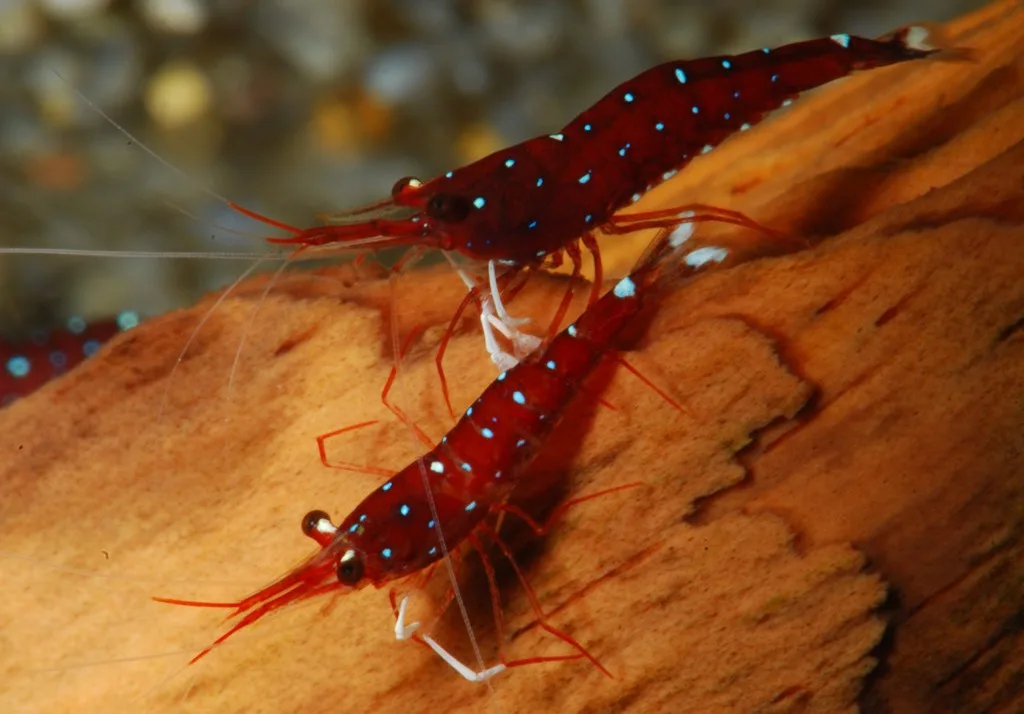
Caridina multidentata, Yamato numaebi in Japanese, is also called Yamatonuma shrimp, Amano shrimp and Japanese freshwater shrimp. It belongs to the Atyidae. Caridina japonica is an older synonym and is still seen in the trade. The body is slightly translucent, with dots in lines along the sides. In water rich in humic substances it can look reddish brown. Maximum 5 cm, males usually smaller. In the aquarium up to 15 years. That is an upper figure from the article, not a fixed age.
Range and habitat
This describes the origin, not how to furnish the aquarium.
The southern part of central Japan, in rivers. Newly hatched larvae are washed to the sea and only migrate back up once they reach at least one centimetre. Japan stays a coarse origin, without a filled outline. Breeding successes described in the aquarium literature for pure fresh water are, according to the article, probably another similar species from eastern Taiwan. That second species is not listed here as Caridina multidentata.
Keeping
Keeping became known through Takashi Amano. Temperature, pH and hardness are not in the article. Gravel up to about 0.5 mm is taken up and grazed all over. It does not clean the glass, because it cannot hold on. A litre figure is missing.
Diet
An omnivore in the habitat. Algae are a main food, which is why it is used against algae. Young animals eat algae, Artemia nauplii or dust food. The article names no dose.
Behaviour and moulting
It belongs to the primitive reproductive type with larvae, not to the specialised type the article illustrates with the crystal red dwarf shrimp. Crystal red is an example in that sentence, not a second species in this profile.
Reproduction and larvae
According to the article, breeding is not possible in pure fresh water. The larvae need salt water. Move egg-carrying females early. After hatching, remove the mother and salt the water so the larvae can survive and the mother is not left in the salt. The larvae moult almost daily, because the shell does not grow with them. Depending on food and temperature they can move to fresh water after about 40 days. A salinity in parts per thousand is not in the text.
More species in this group
Sources & assertions 1
Wikipedia (deutsch)
Texte in Aquarisma sind eigenständig formuliert. Zahlenbereiche folgen den verlinkten Wikipedia-Artikeln, Lizenz CC BY-SA.
- Haltungsbereich nach https://de.wikipedia.org/wiki/Yamatonuma-Garnele