
Bamboo shrimp
Atyopsis moluccensis
24 views
A fan shrimp from the warm lowlands of South and Southeast Asia. Adults stand in strong current and filter.
2 min read · 298 words
Fresh water, larvae in salt or brackish water
Quick facts
The profile values are backed by one source.
Home & range
Every named country gets a frame and a circle around known waters in or near that area. Hotspots are orientation, not collection sites. A filled area is the range only when the source names a particular water body.
Coarse origin
The circle sits around the country or, a little wider, around known waters there. The points are orientation, not collection sites.
- India Wikipedia deutsch
- Sri Lanka Wikipedia deutsch
- Thailand Wikipedia deutsch
- Indonesia Wikipedia deutsch
- India Coarse region of origin
- Sri Lanka Coarse region of origin
- Thailand Coarse region of origin
- Indonesia Coarse region of origin
Overview
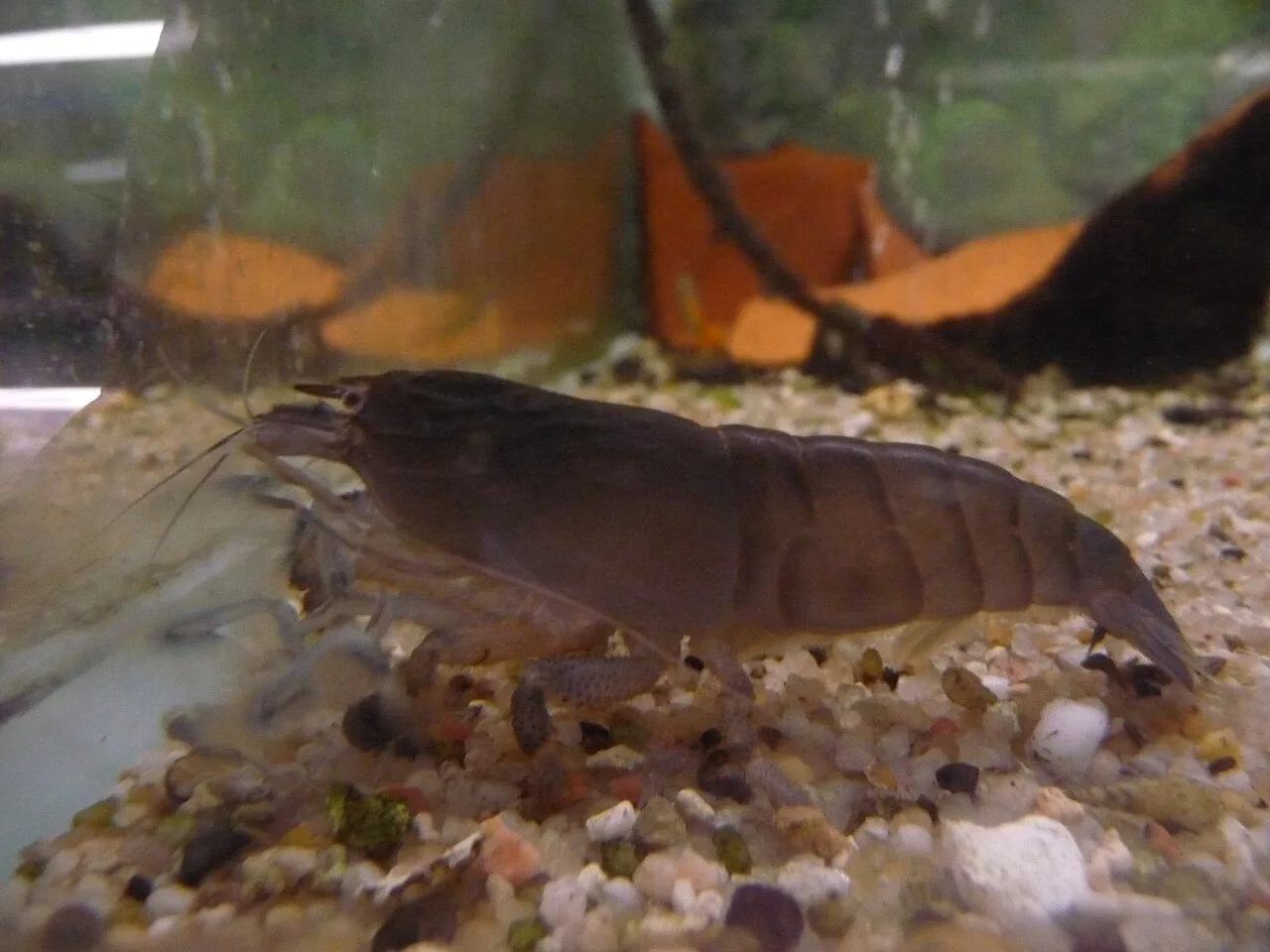
Atyopsis moluccensis belongs to the genus Atyopsis. Up to 8.6 cm, very variable in colour, light to dark brown, with side stripes, broken patterns or a pale dorsal stripe. Regional colour types were formerly treated wrongly as separate species. Placing them in one species came late. In captivity it does not breed, according to the article, which delayed that placement.
Range and habitat
This describes the origin, not how to furnish the aquarium.
South and Southeast Asia, from India and Sri Lanka through Thailand and the Malay Peninsula and Indonesia to New Guinea. The name comes from the Moluccas. Adults live in flowing water and prefer very strong current. Juveniles stand in calmer water. Despite the name mountain-stream shrimp, only warm lowland, not the mountains. India, Sri Lanka, Thailand and Indonesia stay coarse. The Malay Peninsula and New Guinea are not added as further national outlines.
Keeping
In the trade also called fan-hand shrimp. Strongly moving water with many suspended particles, algae and tiny animals. A temperature in degrees is missing. Filters strip the food from the water. Continual small feeds are what the article names, not a gram dose. Captive animals sometimes grub in the substrate or take sessile food. Whether they do that in the wild is unknown.
Diet
The first two pairs of walking legs carry long bristles. The fans stand in the current and are drawn under the body at intervals. The bristles are often cleaned. Folded, the legs also serve for walking and bracing.
Behaviour and moulting
A tank volume and a pH are not in the text. Current is the documented demand of the adults.
Reproduction and larvae
The details are unknown. The larvae probably drift downstream and develop in sea or brackish water before returning to fresh water. Captive breeding has been reported. A protocol with a salinity is missing. It must not be released from the aquarium into natural waters.
More species in this group
Sources & assertions 1
Wikipedia (deutsch)
Texte in Aquarisma sind eigenständig formuliert. Zahlenbereiche folgen den verlinkten Wikipedia-Artikeln, Lizenz CC BY-SA.
- Haltungsbereich nach https://de.wikipedia.org/wiki/Atyopsis_moluccensis