
Skunk cleaner shrimp
Lysmata amboinensis
20 views
A marine shrimp from the Indo-Pacific and the Red Sea. Keep a pair in the aquarium. After a moult they kill rivals.
2 min read · 308 words
Marine
Quick facts
The profile values are backed by one source.
Home & range
Every named country gets a frame and a circle around known waters in or near that area. Hotspots are orientation, not collection sites. A filled area is the range only when the source names a particular water body.
Overview
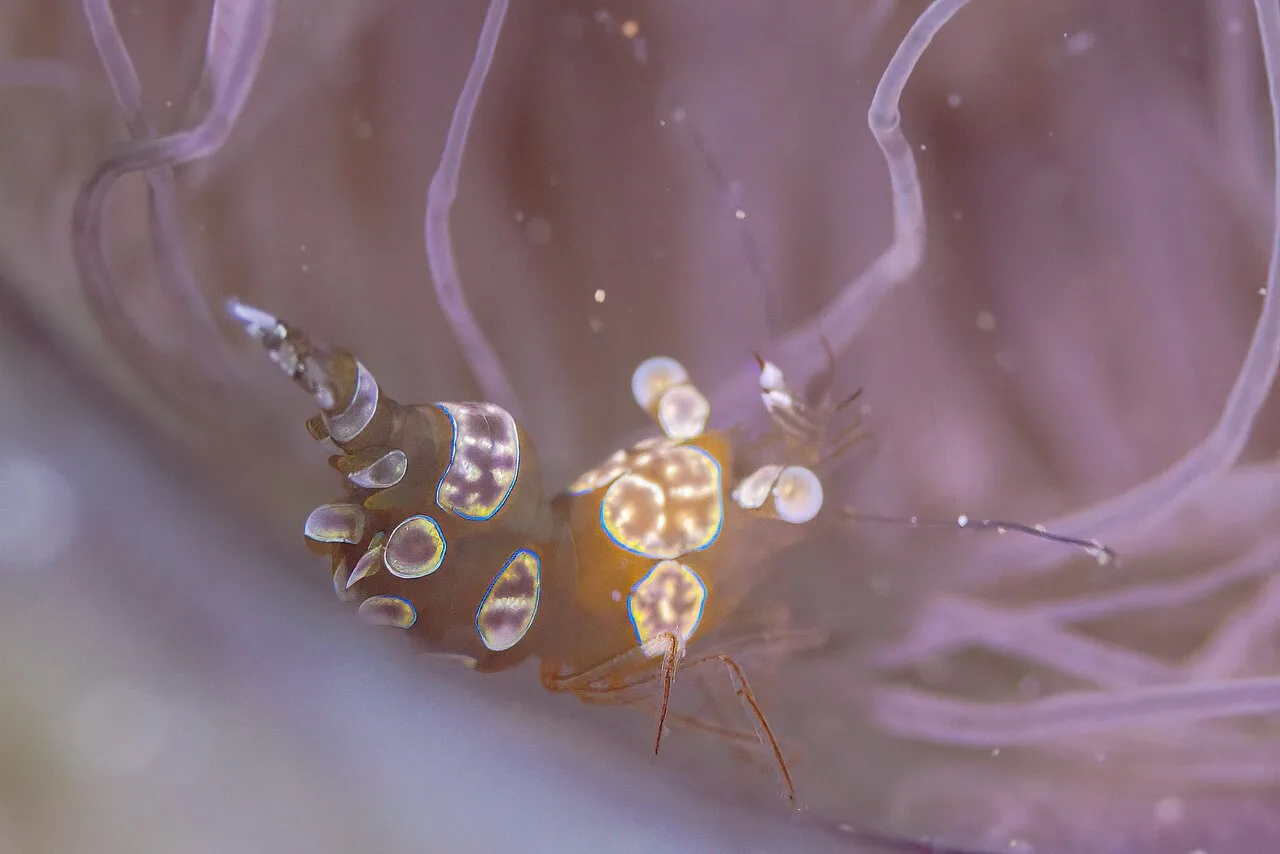
Lysmata amboinensis belongs to the cleaner and marble shrimp. Five to six centimetres. Belly, flanks and legs yellow, the back red with a white longitudinal band. The tail fan is red with white marks. The article uses that to separate it from Lysmata grabhami, the Atlantic sister species. Antennae and the lower segments of the first pair of legs are white. The first two pairs of legs carry small claws. The rostrum is red, white in the middle and serrated above. The white comes from spheres of isoxanthopterin about 300 nm across. Without their spoke structure the stripe would probably be green-blue.
Range and habitat
This describes the origin, not how to furnish the aquarium.
Coral reefs of the Indo-Pacific and the Red Sea, in caves and rock crevices from about ten metres. The article names no individual countries. There is therefore no country row.
Keeping
The shrimp most often imported for marine aquaria, according to the article. Peaceful and without harm to other invertebrates. Acclimate carefully, or an osmotic shock follows. About two years in the aquarium. A temperature or a salinity figure is not in the text. Since a trial in 2011, group keeping is discouraged. Keep a pair. Otherwise peaceful animals remove rivals at night during the moult. At the end of the observation a pair remained.
Diet
They clean fish of parasites and dead skin and eat detritus. They offer the cleaning service with movements of the antennae.
Behaviour and moulting
In the wild in pairs or in groups of up to about 100. The aquarium advice from the 2011 trial is the pair, not the wild group.
Reproduction and larvae
Hermaphrodites. Each animal has male and female sex cells. After a moult it can be fertilised in the female role. The eggs are greenish and are carried under the abdomen. After hatching the larvae are sent into open water by beating of the swimmerets. Captive breeding has succeeded. A larval protocol is not in the text.
More species in this group
Sources & assertions 1
Wikipedia (deutsch)
Texte in Aquarisma sind eigenständig formuliert. Zahlenbereiche folgen den verlinkten Wikipedia-Artikeln, Lizenz CC BY-SA.
- Haltungsbereich nach https://de.wikipedia.org/wiki/Lysmata_amboinensis