
Dwarf hygrophila
Hygrophila polysperma
11 views
A fast stem plant from South Asia. The article names 20 to 28 °C and says extra CO₂ fertilisation is not needed.
3 min read · 458 words
Care profile
The care profile is backed by one source.
Lighting
Medium lightThe profile says moderate light.
CO₂
Low CO₂Added CO₂ is stored as helpful, not mandatory.
Growth rate
FastThe profile describes fast growth.
Nutrient demand
MediumNutrient demand is moderate.
Beginner friendly
Beginner friendlyThe published judgement is suitable for beginners.
- Cuttings
- It must not be released from the aquarium into natural waters.
- ### Fast and invasive Dwarf hygrophila grows in almost any water and is dangerous for exactly that reason once it fills a tank or a natural water without a limit.
Placement in the aquarium
Only the stored position or growth form is highlighted, not every possible layout.
- Background
Home & range
Every named country gets a frame and a circle around known waters in or near that area. Hotspots are orientation, not collection sites. A filled area is the range only when the source names a particular water body.
Coarse origin
The circle sits around the country or, a little wider, around known waters there. The points are orientation, not collection sites.
- India Wikipedia deutsch
- Bhutan Wikipedia deutsch
- Afghanistan Wikipedia deutsch
- Pakistan Wikipedia deutsch
- Bangladesh Wikipedia deutsch
- Nepal Wikipedia deutsch
- Myanmar Wikipedia deutsch
- Vietnam Wikipedia deutsch
- China Wikipedia deutsch
- Taiwan Wikipedia deutsch
- Mexico Named in the article as introduced, not as the native range. Wikipedia deutsch
- United States The article names Texas and Florida. The United States are not filled as a country outline. Wikipedia deutsch
- India Coarse region of origin
- Bhutan Coarse region of origin
- Afghanistan Coarse region of origin
- Pakistan Coarse region of origin
- Bangladesh Coarse region of origin
- Nepal Coarse region of origin
- Myanmar Coarse region of origin
- Vietnam Coarse region of origin
- China Coarse region of origin
- Taiwan Coarse region of origin
- Mexico Coarse region of origin Introduced
- United States Coarse region of origin Introduced
Botanical overview
Hygrophila polysperma was described in 1820 as Justicia polysperma. The name refers to the many-seeded capsules, 20 to 30 seeds. Under water it reaches 15 to 50 cm. The stem is 1 to 2 mm thick and hairless. The leaves are opposite and decussate. Wild forms are rather narrowly elliptical. Narrower leaves also occur in Hygrophila salicifolia and do not separate the species on their own. The chromosome number is 2n = 32.
Natural origin
This describes the origin, not how to furnish the aquarium.
The home is India and Bhutan, plus Afghanistan, Pakistan, Bangladesh, Nepal, Myanmar, Vietnam, China and Taiwan. Introduced in Mexico, Texas and Florida. In Mexico mainly in canals with a very high pH, there half emersed. The IUCN lists it as least concern. Texas and Florida are not filled as the whole United States. It must not be released from the aquarium into natural waters.
Light, CO₂ and position
The article calls it undemanding and suitable for beginners. A wide range of water values, temperature and light is tolerated. In the wild it seems to prefer hard water and also grows at low pH. Extra CO₂ fertilisation is not needed. Between 20 and 28 °C it quickly forms large stands. That matches the existing temperature sheet. The “low CO₂” scale stays, because the article calls extra fertilisation unnecessary and does not set a new step “no CO₂” as a measurement. In weakly lit tanks height growth and side shoots are limited. Upper leaves often turn brown-red. It must not be released from the aquarium into natural waters.
Fast and invasive
Dwarf hygrophila grows in almost any water and is dangerous for exactly that reason once it fills a tank or a natural water without a limit. In the aquarium it is a plant for maturing a tank and for tanks in which someone cuts every week. Beside slow species it lies over them.
It must not be released. Leftovers belong in the household waste, not in the pond and not down the drain.
Growth and trimming
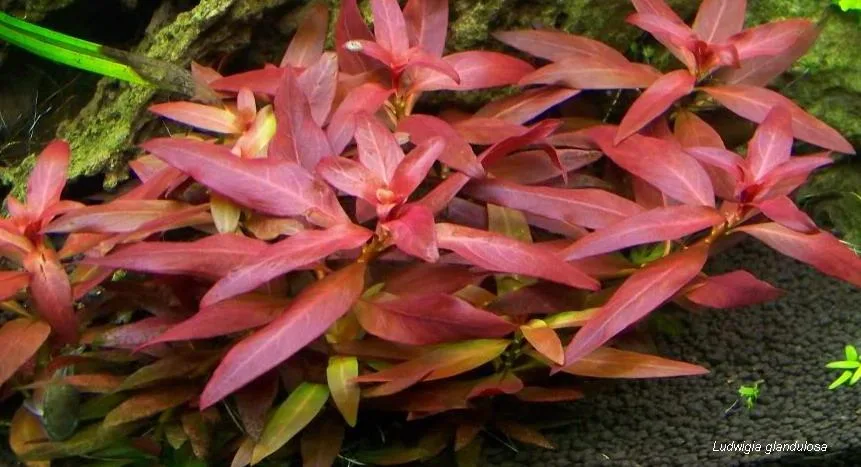
Trim regularly. Poorly rooted bundled shoots float up and can be held with pins. On poor substrate the leaves stay light green. On clay-loam and in a well-fertilised aquarium substrate new leaves turn brown-red, the underside first. The colour changes within a few days after planting.
The trim is the keeping
Topping is not a design choice here. It is the keeping. Replant tips, pull bare stems, limit the mass. The plant takes up nitrate quickly. That is useful in a new tank and a contest as soon as other plants are hungry while the hygrophila is still fat and green.
Further care
In good light it branches strongly and can overgrow other plants. That follows from the dense stand, without a litre figure.
Propagation
Replant cut side shoots. Those are cuttings. The capsules explain the species name. A sowing guide for the aquarium is missing.
More species in this group

Sources & assertions 1
Wikipedia (deutsch)
Texte in Aquarisma sind eigenständig formuliert. Zahlenbereiche folgen den verlinkten Wikipedia-Artikeln, Lizenz CC BY-SA.
- Haltungsbereich nach https://de.wikipedia.org/wiki/Hygrophila_polysperma