
Creeping primrose-willow
Ludwigia repens
14 views
A creeping stem plant from the Americas. The English article is short and states no temperature and no CO₂.
3 min read · 351 words
Care profile
The care profile is backed by one source.
Lighting
High lightThe profile says high light.
CO₂
Medium CO₂Added CO₂ is recommended for the described growth.
Growth rate
FastThe profile describes fast growth.
Nutrient demand
MediumNutrient demand is moderate.
Beginner friendly
ModerateThe published judgement sits between easy and demanding.
- Cuttings
- It must not be released from the aquarium into natural waters.
Placement in the aquarium
Only the stored position or growth form is highlighted, not every possible layout.
- Background
Home & range
Every named country gets a frame and a circle around known waters in or near that area. Hotspots are orientation, not collection sites. A filled area is the range only when the source names a particular water body.
Botanical overview
Ludwigia repens is a perennial herb in the evening-primrose family. The stem creeps, reaches 30 cm and roots at nodes that touch wet substrate. The leaves are opposite and up to 4 or 5 cm long. The flower has four yellow petals, no more than 3 mm, on four pointed sepals. There is no German species page.
Natural origin
This describes the origin, not how to furnish the aquarium.
The home is parts of the Americas. The article names no single country. The species can spread easily and is known as an aquatic weed in some regions. No country list is invented. It must not be released from the aquarium into natural waters.
Light, CO₂ and position
Temperature, light step and CO₂ are not in the article. The older scale of high light, medium CO₂ and 20–28 °C remains the previous sheet. This short text does not describe reddening of the leaves as a result of light. It must not be released from the aquarium into natural waters.
Colour
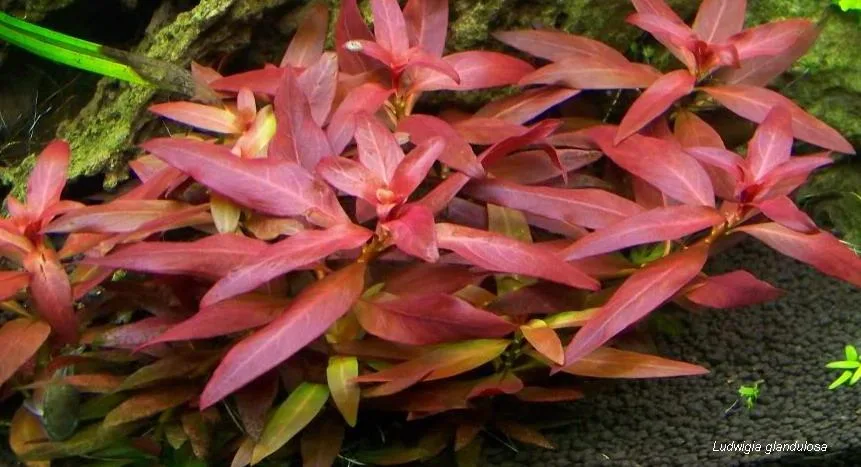
Creeping primrose-willow turns red when the light is strong and iron plus a moderate nitrate supply are right. In shade it stays green and stretched. That is the same plant. A red and a green group in the same tank usually show two light zones, not two species.
CO₂ makes the growth denser and the colour more stable. Without CO₂ and with only medium light it is still a usable, fast stem plant, only not the red wall from the photograph.
Growth and trimming
It is cultivated as an aquarium plant. A pruning guide is missing. Tip cuttings follow from the creeping stem that roots at nodes, without the article using the word cutting.
Holding the group
Top regularly and set the tips forward or into the gaps. The lower leaves fall as soon as they stand permanently in the shade of their own tips. Then the trim is overdue. Soft, transparent leaves are often a nutrient gap, not normal ageing.
Further care
A study of constituents as a depressant and painkiller in animal tests is in the article. That is not a keeping statement and not a note on eating the plant.
Propagation
The stem roots at nodes. A flowering guide for the aquarium is missing.
More species in this group

Sources & assertions 1
Wikipedia (deutsch)
Texte in Aquarisma sind eigenständig formuliert. Zahlenbereiche folgen den verlinkten Wikipedia-Artikeln, Lizenz CC BY-SA.
- Haltungsbereich nach https://en.wikipedia.org/wiki/Ludwigia_repens