
Rotala macrandra
Rotala macrandra
12 views
A red stem plant from India that keeps the large, wavy leaves only under strong light, CO₂ and stable fertilising.
2 min read · 321 words
Care profile
The care profile is backed by one source.
Lighting
High lightThe profile says high light.
CO₂
High CO₂Added CO₂ is part of the described culture.
Growth rate
MediumThe profile describes moderate growth.
Nutrient demand
HighNutrient demand is high.
Beginner friendly
AdvancedThe published judgement is demanding.
- Cuttings
Placement in the aquarium
Only the stored position or growth form is highlighted, not every possible layout.
- Background
Home & range
Every named country gets a frame and a circle around known waters in or near that area. Hotspots are orientation, not collection sites. A filled area is the range only when the source names a particular water body.
Botanical overview
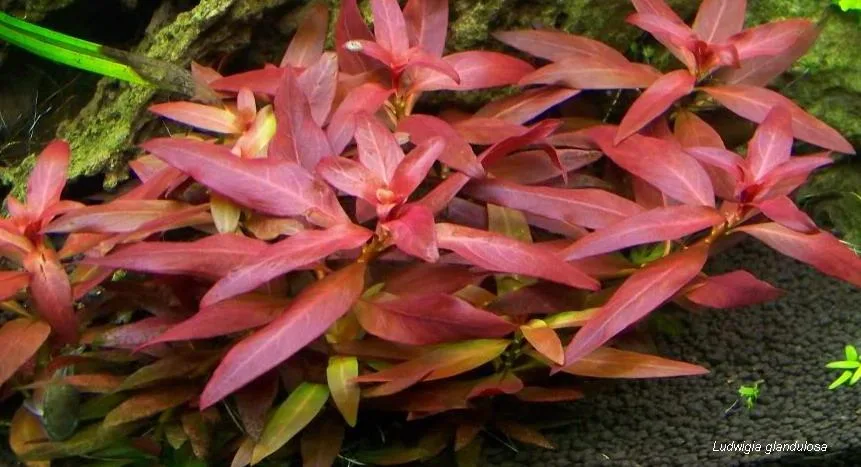
Rotala macrandra carries larger, rounder leaves than Rotala rotundifolia. Under water they become pink to deep red and often wavy at the edge. The stems are brittle. A careless move costs leaves, and the plant then stands ragged for weeks. Emersed it is greener and tougher. The submerged colour is not a different clone. It is light and nutrition.
Narrower forms sit beside the broad one in the trade. They stay demanding. Anyone who wants an uncomplicated red plant is better served by Ludwigia repens or Alternanthera.
Natural origin
This describes the origin, not how to furnish the aquarium.
Swamps and slow, bright waters in India. Warm, soft to medium-hard, nutrient-rich along the banks. India is the coarse origin. The place is bright, not the shade under a dense canopy.
Light, CO₂ and position
Conditions
High light, CO₂, 24 to 28 °C, regular fertilising in the water column and a substrate that is not exhausted. Without CO₂ the tips become small, the lower leaves fall, the stem goes bare. Swinging values, a large water change with completely different water, or a sudden jump in light make whole groups drop their leaves.
Planting
In groups in the middle or background, stems spaced, not as a tight bundle. The lower leaves still need light. Tall floating plants overhead are the most common reason a costly group turns brown and rots.
Growth and trimming
Trim the tips regularly and replant them before the base is bare. The cut tips root. The old stumps send side shoots if they are not already too long and leafless. Do not crush brittle stems with coarse scissors.
The red colour is a result, not a fertiliser product alone. Too much nitrate without light makes the plant greener and softer. Too little nitrate stops growth while the leaves stay red and then full of holes.
Propagation
Tip cuttings. Tips five to eight centimetres long, lower leaves removed, set into the substrate. A mother plant that is bare below does not get prettier by being left standing. It is replaced.
More species in this group

Sources & assertions 1
Wikipedia (deutsch)
Texte in Aquarisma sind eigenständig formuliert. Zahlenbereiche folgen den verlinkten Wikipedia-Artikeln, Lizenz CC BY-SA.
- Haltungsbereich nach https://de.wikipedia.org/wiki/Rotala_macrandra