
Marsh seedbox
Ludwigia palustris
14 views
A stem plant that turns red under strong light and stays green and long in the shade. It is not creeping primrose-willow.
2 min read · 243 words
Care profile
The care profile is backed by one source.
Lighting
High lightThe profile says high light.
CO₂
Medium CO₂Added CO₂ is recommended for the described growth.
Growth rate
FastThe profile describes fast growth.
Nutrient demand
MediumNutrient demand is moderate.
Beginner friendly
ModerateThe published judgement sits between easy and demanding.
- Cuttings
Placement in the aquarium
Only the stored position or growth form is highlighted, not every possible layout.
- Background
Home & range
Every named country gets a frame and a circle around known waters in or near that area. Hotspots are orientation, not collection sites. A filled area is the range only when the source names a particular water body.
Botanical overview
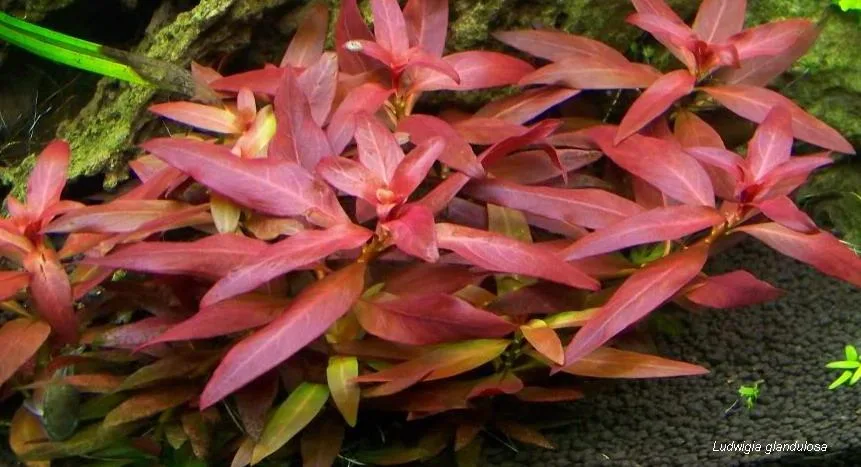
Ludwigia palustris carries opposite, rather narrow leaves. The underside, and in a lot of light the upper side as well, turns red. In shade everything stays green and the internodes grow long. The species is a different plant from Ludwigia repens, whose leaves are rounder. Both are mixed in the trade as red ludwigia.
Emersed it is tougher and can flower. Under water the light decides the colour, not the name on the pot.
Natural origin
This describes the origin, not how to furnish the aquarium.
Swamps, ditches and banks in Europe, North America and beyond. The wide distribution is not a licence to release aquarium plants. For the tank the light-dependent red colour matters.
Light, CO₂ and position
Colour
High light, CO₂ helpful, 18 to 26 °C, a moderate nitrate supply and iron. Background or midground in a group, stems spaced. Without light it becomes a green, quickly lengthening stem plant and is then still usable, only not the red wall from the photograph.
Company
It grows briskly and lies over slow rosettes if it is not cut. In a tank without CO₂ it survives better than Rotala wallichii, but stays looser.
Growth and trimming
Replant tips regularly, before the base is bare. Pull bare stumps. Soft, transparent lower leaves are an overdue trim or a nutrient gap. The red colour fades at very high nitrate and only medium light. Check the light first, then the fertiliser.
Propagation
Tip cuttings with two nodes in the substrate, the lower leaves removed. They root willingly. Surplus stays in the waste and not in the pond.
More species in this group

Sources & assertions 1
Wikipedia (deutsch)
Texte in Aquarisma sind eigenständig formuliert. Zahlenbereiche folgen den verlinkten Wikipedia-Artikeln, Lizenz CC BY-SA.
- Haltungsbereich nach https://de.wikipedia.org/wiki/Ludwigia_palustris