
Bentosi tetra
Hyphessobrycon bentosi
18 views
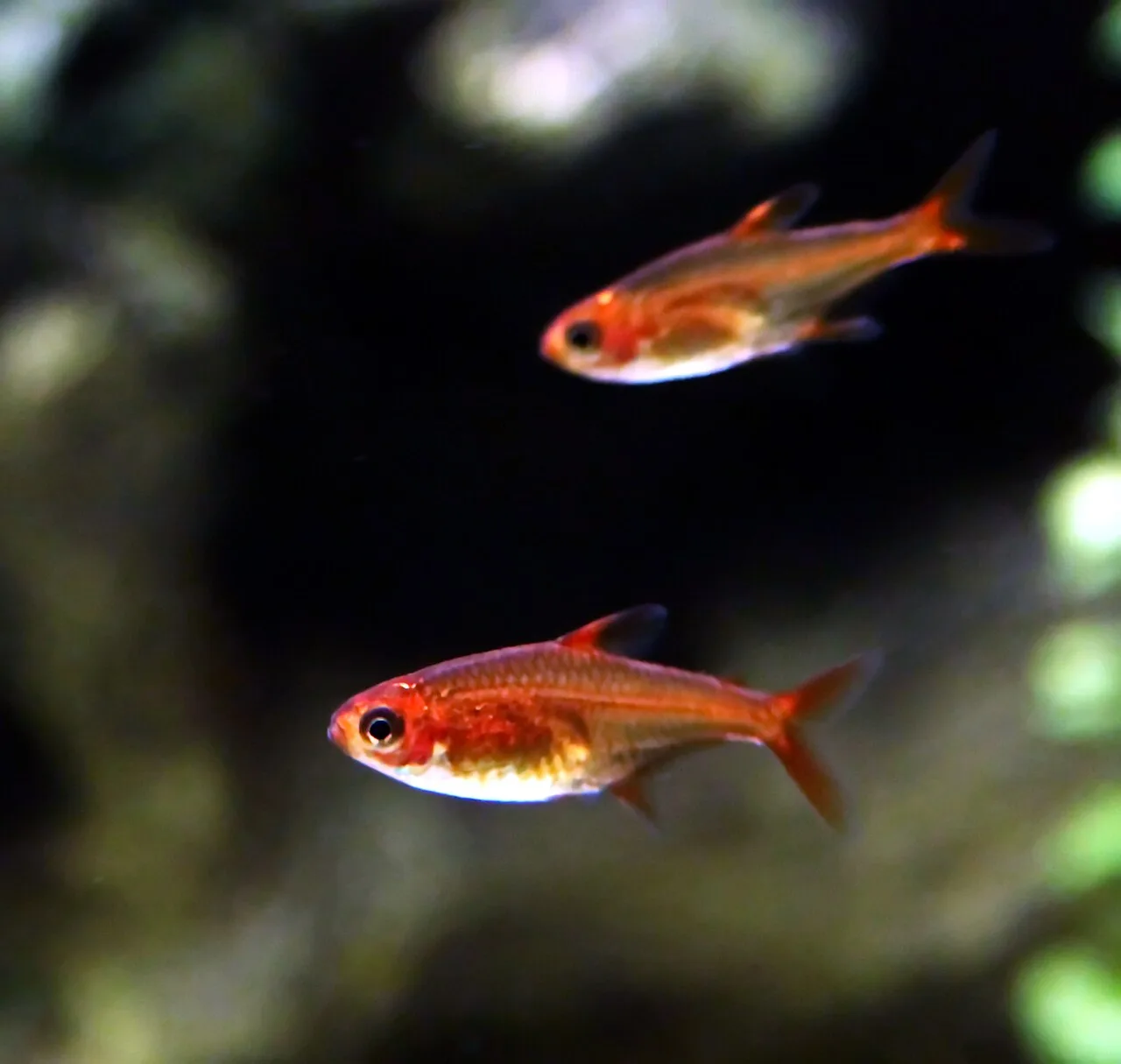
A pink tetra with a black, pale-edged dorsal fin on the males. It shows itself in the group and stays peaceful when the number is right.
2 min read · 333 words
Quick facts
The profile values are backed by one source.
Home & range
Every named country gets a frame and a circle around known waters in or near that area. Hotspots are orientation, not collection sites. A filled area is the range only when the source names a particular water body.
Overview
Hyphessobrycon bentosi reaches about 4 to 5 cm. The body is pink to reddish. The dorsal of the males is conspicuously black with a pale edge and is raised when they display. Females are deeper and have the shorter fin. The species is confused in the trade with other rosy tetras. The flag of the dorsal is a better mark than the name at the till.
In a school the males stand forward and show each other the fin. A single male among other species loses the colour or becomes fidgety toward long veils.
Origin & habitat
This describes the origin, not how to furnish the aquarium.
Slow planted banks in the Amazon region, in Brazil and the neighbouring stretches. Soft to medium-hard water, dim light. The origin stays coarse. A bare, very bright tank does not show the pink colour.
Care
School
23 to 28 °C, pH 6 to 7.5. Groups from eight, tanks from about 80 litres and 70 cm. Several males, plants at the edge, an open middle, a dark bottom. The fish are lively, but not as pushing as an undersized tiger-barb group.
Company
Other peaceful tetras, rasboras, corydoras. Long fins are a risk when the own group is too small. Shrimp usually survive in a well-planted tank as long as the tetras are well fed.
Diet
Fine prepared food with a small share of frozen food. Flakes, granules, brine shrimp, cyclops. Several small portions. The food has to arrive in the school, not only with the males that have the fin raised.
A diet of mosquito larvae alone makes the fish fat without holding the colour.
Behavior
A school with display behaviour by the males. Raising the dorsal is courtship and threat and lasts seconds. In a tank that is too short it becomes a permanent state, and one male stands at the edge with a clamped fin.
The species jumps at times. A cover belongs with it.
Reproduction
Egg scatterer without brood care. Soft water, fine plants and removing the parents are the breeding path. In a community tank the eggs are eaten. The larvae need dust-fine food.
More species in this group

Sources & assertions 1
Wikipedia (deutsch)
Texte in Aquarisma sind eigenständig formuliert. Zahlenbereiche folgen den verlinkten Wikipedia-Artikeln, Lizenz CC BY-SA.
- Haltungsbereich nach https://de.wikipedia.org/wiki/Hyphessobrycon_bentosi