
Serpae tetra
Hyphessobrycon eques
15 views
A reddish tetra from southern South America. Field measurements and the older aquarium recommendation are not the same numbers.
3 min read · 386 words
Quick facts
The profile values are backed by one source.
Home & range
Every named country gets a frame and a circle around known waters in or near that area. Hotspots are orientation, not collection sites. A filled area is the range only when the source names a particular water body.
Coarse origin
The circle sits around the country or, a little wider, around known waters there. The points are orientation, not collection sites.
- Brazil Wikipedia deutsch
- Bolivia Wikipedia deutsch
- Paraguay Wikipedia deutsch
- Argentina Wikipedia deutsch
- French Guiana Named in the article as introduced by people, not as the native range. Wikipedia deutsch
- Brazil Coarse region of origin
- Bolivia Coarse region of origin
- Paraguay Coarse region of origin
- Argentina Coarse region of origin
- French Guiana Coarse region of origin Introduced
Overview
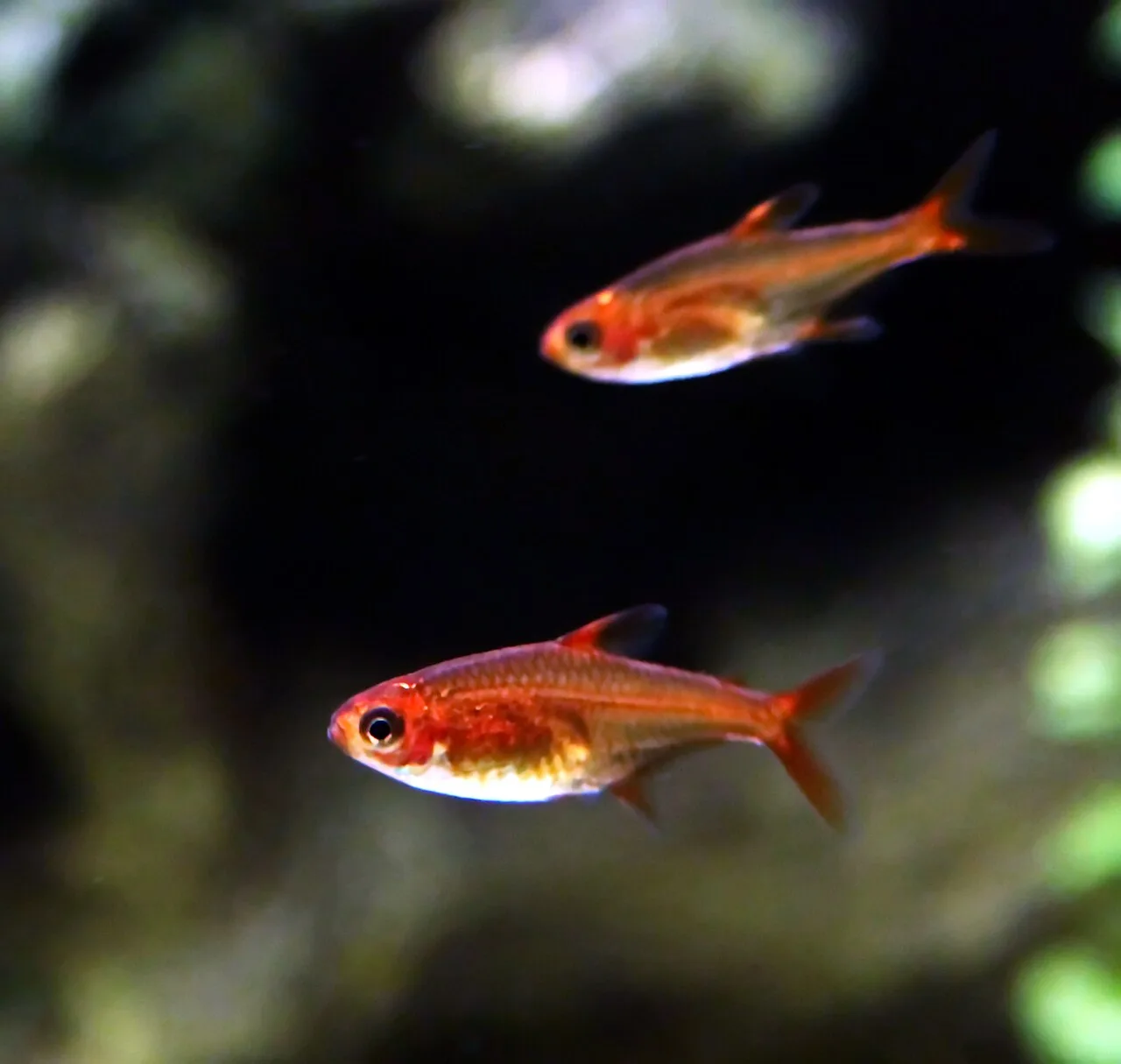
The serpae tetra was described in 1882 by Franz Steindachner as Chirodon eques. The type locality is Óbidos in the Brazilian Amazon. Later descriptions as Tetragonopterus callistus (Corumbá) and Hyphessobrycon serpae (Itacoatiara) are treated as synonyms. The article mentions the September move that placed the rosy-tetra group in the genus Megalamphodus. The catalogue name here remains Hyphessobrycon eques. The body is elongated, moderately deep and strongly compressed. Females are deeper-bodied. Length is four centimetres. Besides the reddish ground colour there is a drop-shaped black shoulder spot that can fade in older fish. The dorsal fin is red at the base and otherwise black with a white upper edge. The anal fin is red with a broad black margin and white leading rays. The other fins are red. The article calls the name “Serpa tetra” incorrect.
Origin & habitat
This describes the origin, not how to furnish the aquarium.
The article names the Amazon basin, the lower Río Paraguay, the Rio Guaporé, the upper Río Paraná and tributaries of the Río Uruguay, in southern Brazil, Bolivia, Paraguay and Argentina. French Guiana is an introduction, not the native range. The fish prefer unshaded, lake-like waters and creeks in swampy floodplains, near plants along the bank but where the surface stays largely open. When threatened they flee into vegetation. Site measurements gave pH 5.5 to 7.6, carbonate hardness from below detection to about 7 °dH, and conductivity of 10 to 240 µS/cm. Tropical readings were mostly 24 to 30 °C. One Argentine site measured 6.3 °C in winter. That is a single field reading, not a keeping recommendation.
Care
The article calls community-tank care usually unproblematic. Compared with other Hyphessobrycon the species is not always peaceful and shows aggression within the group. Weaker fish can be bitten, and eyes can be lost in fights. The text names poor feeding or overcrowding: the fish are social and still need distance. An Austrian regulation is mentioned with a minimum of five fish. The further limits of that rule are missing from the extract and are not filled in here. Most trade fish come, according to the article, from German breeding or Asian imports.
Diet
The husbandry passage names inadequate feeding as one explanation for bite injuries.
Behavior
Serpae tetras are group fish that still keep a minimum distance. Crowding and scarce food are linked with biting. This article does not contain a general warning about long fins of other species.
More species in this group

Sources & assertions 1
Wikipedia (deutsch)
Texte in Aquarisma sind eigenständig formuliert. Zahlenbereiche folgen den verlinkten Wikipedia-Artikeln, Lizenz CC BY-SA.
- Haltungsbereich nach https://de.wikipedia.org/wiki/Blutsalmler