
Red-tailed black shark
Epalzeorhynchos bicolor
10 views
A black and red carp that looks peaceful as a juvenile and needs a clear bottom territory as an adult. It grows larger than the shop tank suggests.
3 min read · 430 words
Quick facts
The profile values are backed by one source.
Home & range
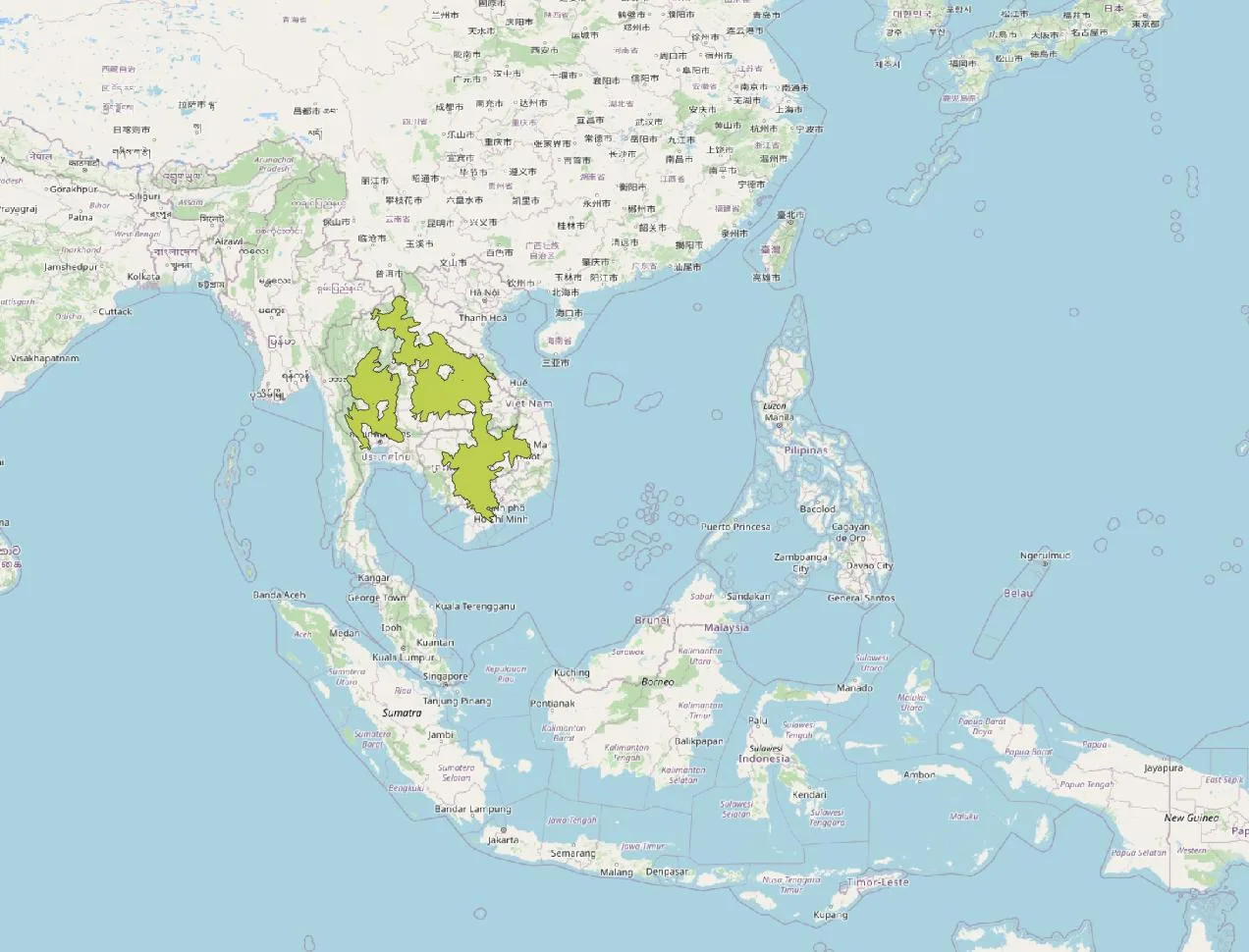
Every named country gets a frame and a circle around known waters in or near that area. Hotspots are orientation, not collection sites. A filled area is the range only when the source names a particular water body.
Overview
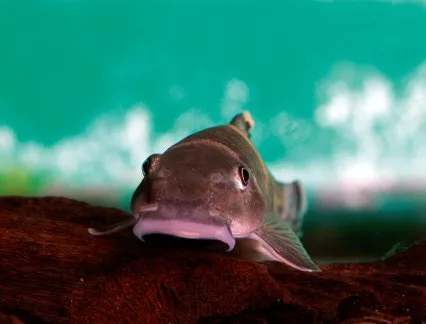
The red-tailed black shark reaches about 12 to 15 cm. The body is velvet black, the tail bright red. The mouth is underneath and carries barbels. Juveniles already show the pattern, which is why the adult size is underestimated. The species is not a shark and not a shark catfish, whatever the trade name says.
Some old fish fade, especially in poor water or constant fighting. The red fin remains the clearest mark against the flying fox, which has a different body and different fins.
Origin & habitat
This describes the origin, not how to furnish the aquarium.
The species comes from flowing waters in Thailand, especially the Mae Klong drainage. Wild stocks are treated as strongly reduced or locally gone. Almost all aquarium fish are captive-bred. That does not remove the need for a large enough tank.
The habitat is current, oxygen and structure, not a bare community tank without a hiding place. Thailand stays a coarse origin.
Care
Space
22 to 26 °C, pH about 6.5 to 7.5. Tanks from about 250 litres and 120 cm long for one adult. Roots, rock and caves, plus an open run. Current and oxygen must not be scarce. One adult is the rule. Two adults on one run fight, often until the loser is exhausted.
Tankmates
Calm fish that do not hold a bottom territory, in the middle and upper water. Other suckermouths, flying foxes and bottom catfish with a similar claim are the worst mix. Shrimp are often eaten. Soft plants suffer less from being eaten than from the constant patrolling.
Diet
Aufwuchs, algae and added food. Tablets, blanched vegetable strips, plant flakes and a share of frozen food. The food has to reach the bottom before the rest of the stock takes it.
The species is not a pure algae eater. A tank with no targeted feeding, in the hope that the fish will clean the glass, does not keep it.
Behavior
As it grows, the schooling juvenile becomes a solitary fish with a territory. Young fish in a shop tank tolerate each other because nobody holds a fixed ground. In a furnished tank that changes. The dominant fish stands in front of the cave and drives off anyone who crosses the same stretch of bottom.
Toward fish that clearly swim above, it often stays calm. Toward anything that feeds on the same wood, it does not.
Reproduction
Egg scatterer. Deliberate breeding in a private community tank is uncommon. The shop fish come from farms. Sexes are uncertain on the living fish. For keeping that does not matter, because only one fish is kept.
A thin fish that is constantly driven off is not a breeding problem. It is a stocking mistake.
More species in this group
Sources & assertions 1
Wikipedia (deutsch)
Texte in Aquarisma sind eigenständig formuliert. Zahlenbereiche folgen den verlinkten Wikipedia-Artikeln, Lizenz CC BY-SA.
- Haltungsbereich nach https://de.wikipedia.org/wiki/Epalzeorhynchos_bicolor