
Paradise fish
Macropodus opercularis
9 views
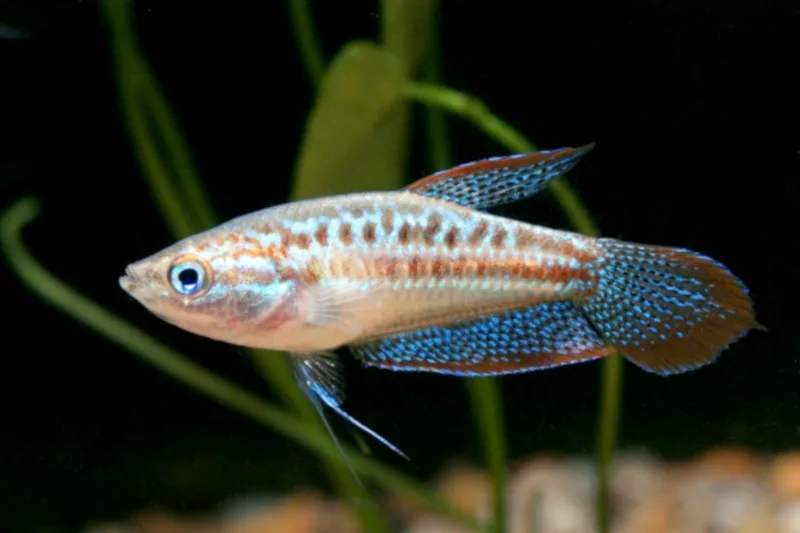
A labyrinth fish, also called the paradise fish. Males are about 8 cm. With filaments a length up to 10.4 cm is given.
2 min read · 324 words
Quick facts
The profile values are backed by one source.
Home & range
Every named country gets a frame and a circle around known waters in or near that area. Hotspots are orientation, not collection sites. A filled area is the range only when the source names a particular water body.
Overview
Males colour up in the breeding season and carry extended fin tips. Females stay smaller and plainer brown. The base colour is grey-yellow to green-yellow and changes when breeding. The article calls them relatively undemanding. Territory shows in a small tank, especially if they are kept permanently warm.
Origin & habitat
This describes the origin, not how to furnish the aquarium.
A planted tank with hiding places matches the Asian habitat named in the article. No coordinate map is published.
Care
The article does not give a closed care range in degrees. It says temperatures down to about 10 °C are tolerated if the drop is slow, and that an unheated tank is possible. Permanently high temperatures increase quarrels. Cover reduces that. A little algae is tolerated.
Cool, and at the surface
The paradise fish tolerates cooler water than most labyrinth fish. 18 to 26 °C is a workable window, not a permanent stay above 28 °C. pH 6 to 8. From about 80 litres for a pair, with floating plants, dense cover and quiet, warm air above the water. Males are brightly coloured and intolerant of each other. One male, or a pair with a retreat for the female, is the keeping.
The species jumps. Keep the tank covered. It must not be released. In Europe there are already naturalised stocks.
Diet
The cited section does not list a diet.
Small animal food and a prepared food that stays at the surface. Brine shrimp, mosquito larvae, flakes. Bottom tablets miss the fish. While courting the male becomes still more decided at the feeding spot. A second feeding place keeps the female in the food.
Behavior
Territorial, especially in permanent heat and with little structure. They may move eggs or fry from another bubble nest into their own.
Reproduction
Males build a bubble nest and guard the brood until hatching. The female holds the outer edge of the territory. At lower temperatures the young grow more slowly and form stronger bodies and larger fins. Very fast rearing in water that is too warm can cause stunting.
More species in this group

Sources & assertions 1
Wikipedia (deutsch)
Texte in Aquarisma sind eigenständig formuliert. Zahlenbereiche folgen den verlinkten Wikipedia-Artikeln, Lizenz CC BY-SA.
- Haltungsbereich nach https://de.wikipedia.org/wiki/Makropode