
Bronze corydoras
Corydoras aeneus
14 views
Sociable bottom fish. Since 2024 the article lists it as Osteogaster aenea. The catalogue keeps the familiar name Corydoras aeneus.
2 min read · 307 words
Quick facts
The profile values are backed by one source.
Home & range
Every named country gets a frame and a circle around known waters in or near that area. Hotspots are orientation, not collection sites. A filled area is the range only when the source names a particular water body.
Coarse origin
The circle sits around the country or, a little wider, around known waters there. The points are orientation, not collection sites.
- Argentina Wikipedia deutsch
- Paraguay Wikipedia deutsch
- Bolivia Wikipedia deutsch
- Brazil Wikipedia deutsch
- Colombia Wikipedia deutsch
- Peru Wikipedia deutsch
- Venezuela Wikipedia deutsch
- Guyana Wikipedia deutsch
- Suriname Wikipedia deutsch
- French Guiana Wikipedia deutsch
- Trinidad Wikipedia deutsch
- Argentina Coarse region of origin
- Paraguay Coarse region of origin
- Bolivia Coarse region of origin
- Brazil Coarse region of origin
- Colombia Coarse region of origin
- Peru Coarse region of origin
- Venezuela Coarse region of origin
- Guyana Coarse region of origin
- Suriname Coarse region of origin
- French Guiana Coarse region of origin
- Trinidad Coarse region of origin
Overview
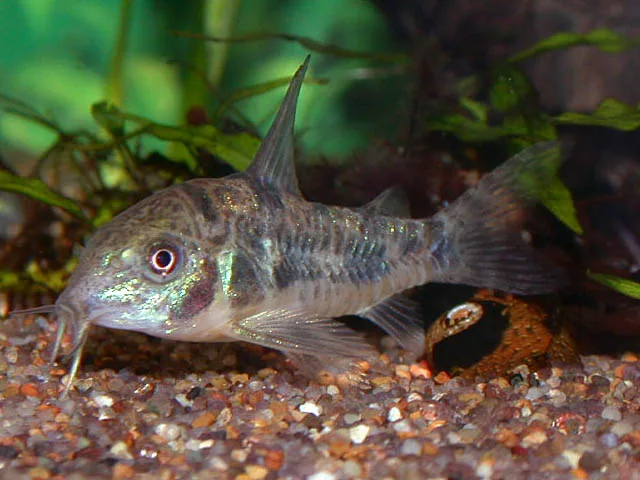
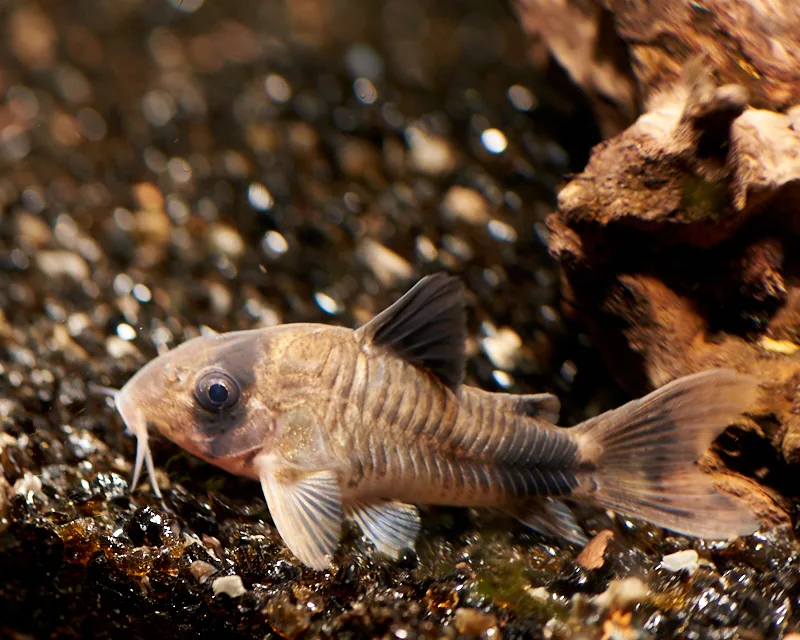
About 7 cm, males usually smaller. The ground colour runs from yellowish brown to a slight red, the upper half is darker, and a narrow yellowish band runs from the gill cover under the dorsal fin. The article treats the species as a group of closely related forms, not one uniform fish. The type locality is Trinidad. In the European trade the deeper-bodied type from the Paraná and Paraguay systems is said to be the usual one, not every fish sold under this name. Albino and veil forms are cultivated. The fish does not replace a filter and must not live on leftovers.
Origin & habitat
This describes the origin, not how to furnish the aquarium.
The article names a wide area east of the Andes: Argentina, Paraguay, Bolivia, Brazil, Colombia, Peru, Venezuela, Guyana, Suriname, French Guiana and Trinidad. These countries are a coarse origin and are not filled. A South America polygon would be larger than the list and is not drawn.
Care
The keeping frame is 22–26 °C, pH 6–7.5, fine sand, groups from six and tanks from about 80 litres. Those tank figures are not in the origin account. In the wild the fish move in schools of 20 to 30. That is the habitat group, not a new tank minimum. Fine sand fits, because they search the bottom.
Diet
Worms, small crustaceans, insect larvae and detritus. Tablets and frozen food have to reach the substrate. Food at the surface misses this species.
Behavior
A peaceful group. Short trips to the surface happen and are not a sign of illness if the fish then search the bottom again.
Reproduction
With the rains, up to 20 eggs are laid per spawning, and 100 to 400 over the season. The larvae hatch after about three days. The article does not say the eggs are stuck to the glass. That older sentence is no longer stated as a sourced claim. Fine rearing food remains the practical follow-up once larvae are there.
More species in this group
Sources & assertions 2
Wikipedia (deutsch)
Texte in Aquarisma sind eigenständig formuliert. Zahlenbereiche folgen den verlinkten Wikipedia-Artikeln, Lizenz CC BY-SA.
- Haltungsbereich nach https://de.wikipedia.org/wiki/Metallpanzerwels
Wikipedia
Texte in Aquarisma sind eigenständig formuliert. Zahlen folgen dem genannten Artikel, Lizenz CC BY-SA. Deutsch und Englisch sind dieselbe Enzyklopädie, keine zweite unabhängige Quelle.
- Der Artikel nennt etwa sieben Zentimeter. Männchen bleiben meist kleiner.
- Im Lebensraum nennt der Artikel kleine Schwärme von 20 bis 30 Tieren.