
Panda corydoras
Corydoras panda
13 views
A small armoured catfish with an eye band and a tail spot. The article names Peru and Ecuador, and for keeping 22 to 26 °C and groups of at least five.
3 min read · 418 words
Quick facts
The profile values are backed by one source.
Further published values
- Beginner friendly
- Beginner friendly
Home & range
Every named country gets a frame and a circle around known waters in or near that area. Hotspots are orientation, not collection sites. A filled area is the range only when the source names a particular water body.
Coarse origin
The circle sits around the country or, a little wider, around known waters there. The points are orientation, not collection sites.
- Peru Wikipedia deutsch
- Ecuador Wikipedia deutsch
- Peru Coarse region of origin
- Ecuador Coarse region of origin
Overview
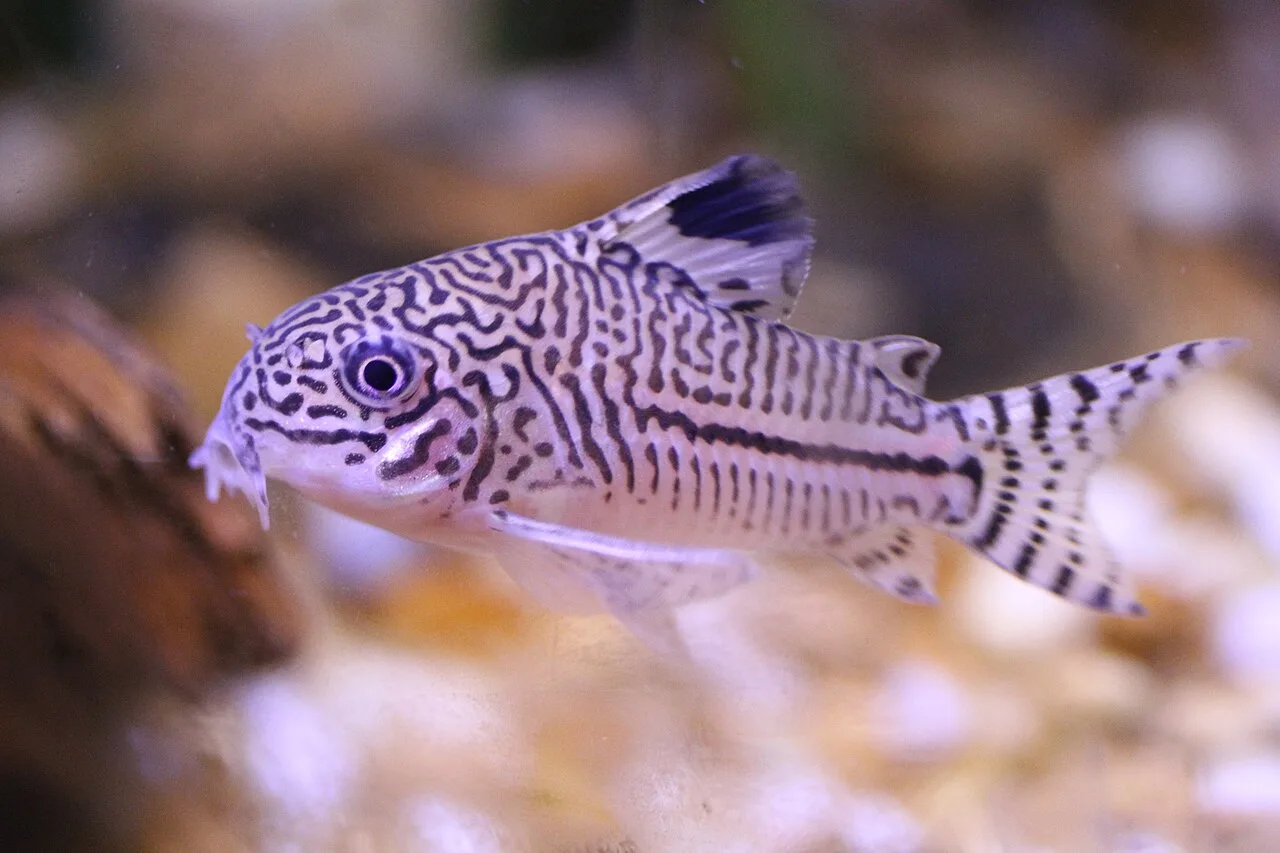
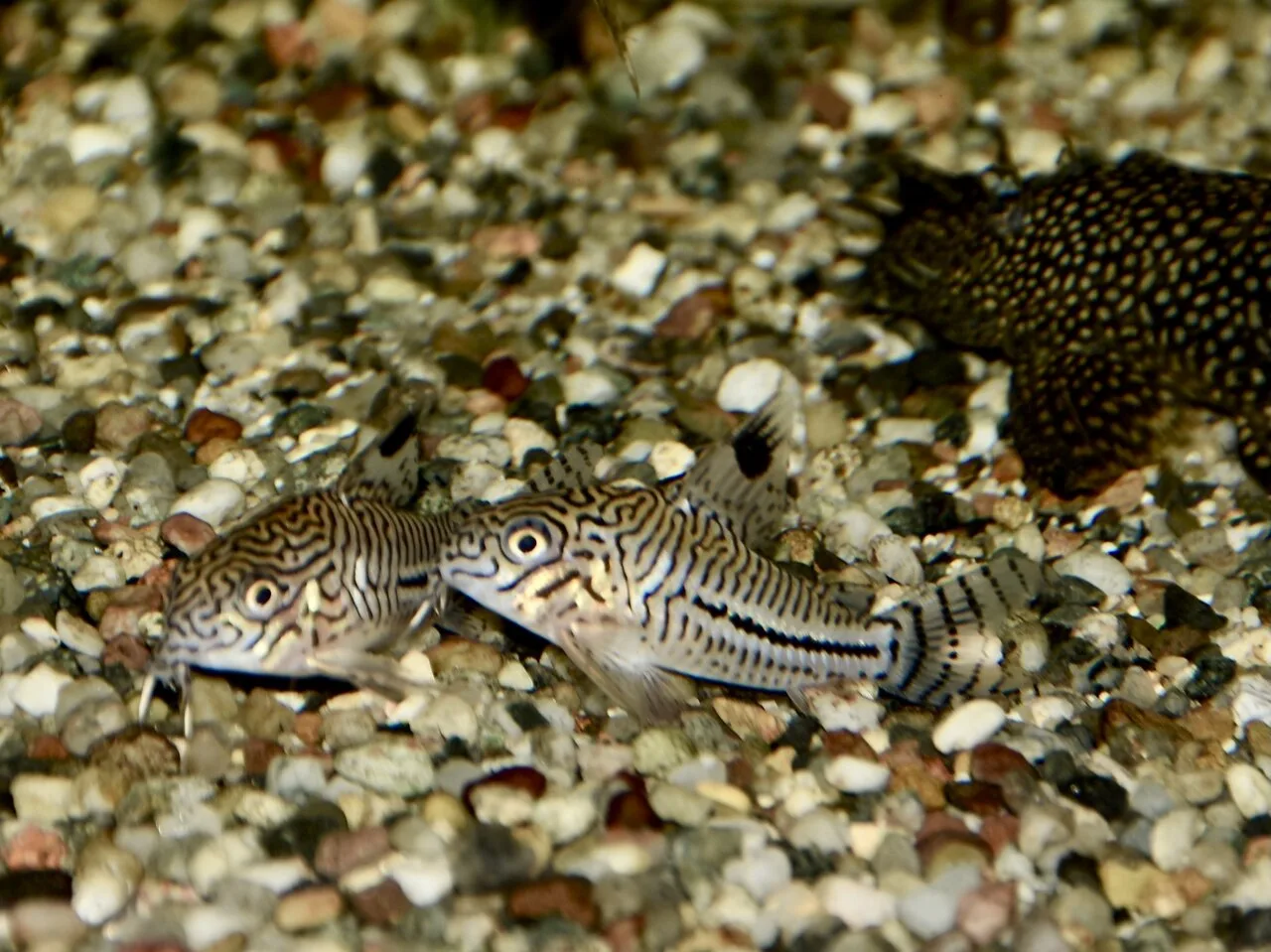
The article lists the species as Hoplisoma panda, with the synonym Corydoras panda. The catalogue name remains Corydoras panda. The ground colour is reddish brown, with a black eye band and a black spot in front of the caudal fin. The species epithet refers to the light-and-dark pattern of the giant panda. Maximum standard length is 3.8 cm. That is not the total length including the caudal fin. The holotype had two pairs of rictal barbels and one pair of mental barbels. The pectoral spine is slightly serrated on the inner edge. Females are fuller and have rounder pelvic fins. Those of the males are pointed.
Origin & habitat
This describes the origin, not how to furnish the aquarium.
The range is the Amazon basin in Peru. The type locality is Aquas Amarillas in the Huánuco region, in the Río Ucayali system, a tributary of the Río Pachitea. In 2010 one specimen was found in the valley of the Río Apurímac. Barriga (2012) additionally names Ecuador, the zones Napo Pastaza and Morona Santiago. Both countries stay a coarse origin and are not filled.
Care
For keeping, the article names 22 to 26 °C, pH 6.0 to 7.8, KH 2 to 10 and GH 2 to 20 °d, and a volume from 56 litres. The bottom should be soft and sandy, with hiding places. The barbels dig through the substrate. As an intestinal breather the fish needs access to the surface. In the wild the animals live in groups of several hundred. For the aquarium the article names at least five. An age of 8 to 10 years is given.
Small, cool, on sand
The panda cory stays at about 4 to 5 cm and wants cooler water than many tropical bottom fish. 22 to 26 °C, not a permanent stay above 27 °C. pH 6 to 7.5, fine sand, a group from six, tanks from about 60 litres. The black spots on a pale ground stay the mark. On coarse gravel the barbels chafe.
The fish are peaceful and search the bottom. Food at the surface does not reach them. A group that constantly dashes to the surface and stays there has too little oxygen.
Diet
An omnivore: algae, detritus, small animals and plant parts. In the aquarium the article names Artemia, mosquito larvae, Cyclops, tablets and flakes.
Sinking tablets and fine frozen food in the evening, when the fish become more active. Several small feeds, so the shy fish eat as well.
Behavior
According to the article community tanks are suitable if a group is kept. No rank order is described.
Reproduction
The article calls the species easy to breed. Females lay about 30 eggs one after another on large leaves, stones or the panes.
More species in this group

Sources & assertions 2
Wikipedia (deutsch)
Texte in Aquarisma sind eigenständig formuliert. Zahlenbereiche folgen den verlinkten Wikipedia-Artikeln, Lizenz CC BY-SA.
- Haltungsbereich nach https://de.wikipedia.org/wiki/Panda-Panzerwels
Wikipedia
Texte in Aquarisma sind eigenständig formuliert. Zahlen folgen dem genannten Artikel, Lizenz CC BY-SA. Deutsch und Englisch sind dieselbe Enzyklopädie, keine zweite unabhängige Quelle.
- Der Artikel nennt eine maximale Standardlänge von 3,8 cm. Der ältere Steckbrief führte 4 cm.