
Dwarf gourami
Trichogaster lalius
9 views
A small labyrinth fish from planted lowlands in South Asia. The bright males are cultivated forms. The species stays calm when the surface is open and the tank is dense enough.
4 min read · 530 words
Quick facts
The profile values are backed by one source.
Home & range
Every named country gets a frame and a circle around known waters in or near that area. Hotspots are orientation, not collection sites. A filled area is the range only when the source names a particular water body.
Overview
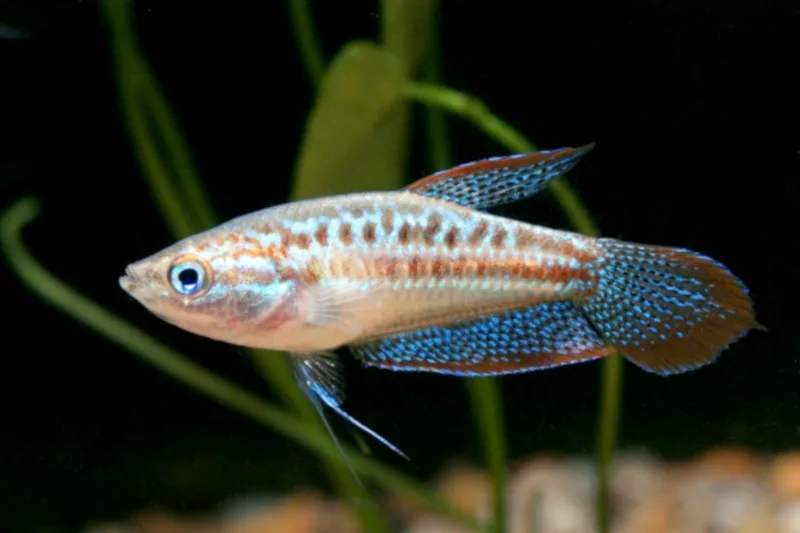
Dwarf gouramis usually stay at 5 to 6 cm. Males in breeding colour are red with turquoise spots and bands. Females are silvery and paler. The pelvic fins are long threads used to feel the surroundings. The labyrinth organ takes air at the surface, so an open, quiet water line matters more than deep water.
Veil forms sit beside the shorter wild form in the trade. Long fins suffer from fin-nippers and from rough nets. The species is often confused with the honey gourami, which stays smaller and turns honey-coloured rather than clear red and blue.
Origin & habitat
This describes the origin, not how to furnish the aquarium.
The species comes from slow and still waters in India, Bangladesh and Pakistan: ditches, rice fields, floodplain and planted banks. The water there is often soft to medium-hard, shaded and full of fine structure. A country outline without a tighter river geometry is not offered as an exact map.
In the wild the fish stand among floating plants and stems, not in open current. The aquarium needs the same cover, or the colours stay pale and the males stay shy.
Care
Temperature and tank
22 to 28 °C is tolerated. A practical window is 24 to 28 °C, pH 6 to 7.5, low to medium hardness. About 60 litres and 60 cm of length are enough for a pair or a small harem if the volume is not empty swimming room. Dense plants, floating plants and a quiet surface are the real layout.
Air and tankmates
The air above the water must not be much colder than the tank. A close cover and a warm air space prevent chilling of the labyrinth. Calm tetras, rasboras and corydoras fit. Tiger barbs, busy danios and other male gouramis in a short tank do not. Two mature males need visual barriers, or the losing fish stays in a corner under the surface.
Diet
Omnivore with a small mouth. Food has to arrive at the surface and in the upper water: fine granules, flakes, brine shrimp, cyclops and mosquito larvae. A plant share, such as blanched spinach or a food with spirulina, supplements the animal part.
Several small feeds beat one large meal that faster tankmates take first. The dwarf gourami rarely searches the bottom. Food that sinks straight into the gravel leaves it hungry beside well-fed corydoras.
Behavior
Peaceful toward other species, clearly male-focused within the species. A male holds a corner under floating plants while courting and drives the female off once the nest is built or she is not ready. Outside spawning they tolerate each other if each has a retreat.
The thread fins are used constantly. Torn threads regrow, but they show that tankmates are nipping or that the net was too coarse.
Reproduction
Bubble-nest builder. The male builds a small nest under a leaf or among floating plants and courts the female. A clutch is often 300 to 800 tiny eggs. The female is then driven off. The larvae hatch after about a day and hang on the nest until they swim free.
Rearing works only in a separate tank, or if the male can actually guard the nest. The young need infusoria or dust-fine food first, then newly hatched brine shrimp. A community tank should not be expected to produce young.
More species in this group

Sources & assertions 1
Wikipedia (deutsch)
Texte in Aquarisma sind eigenständig formuliert. Zahlenbereiche folgen den verlinkten Wikipedia-Artikeln, Lizenz CC BY-SA.
- Haltungsbereich nach https://de.wikipedia.org/wiki/Zwergfadenfisch