
Madagascar laceleaf
Aponogeton madagascariensis
16 views
A bulb plant from Madagascar whose leaves keep only the net of veins. It is demanding, takes rests and is not a beginner sword.
2 min read · 275 words
Care profile
The care profile is backed by one source.
Lighting
Medium lightThe profile says moderate light.
CO₂
Medium CO₂Added CO₂ is recommended for the described growth.
Growth rate
SlowThe profile describes slow growth.
Nutrient demand
MediumNutrient demand is moderate.
Beginner friendly
AdvancedThe published judgement is demanding.
Placement in the aquarium
Only the stored position or growth form is highlighted, not every possible layout.
- Midground
Home & range
Every named country gets a frame and a circle around known waters in or near that area. Hotspots are orientation, not collection sites. A filled area is the range only when the source names a particular water body.
Botanical overview
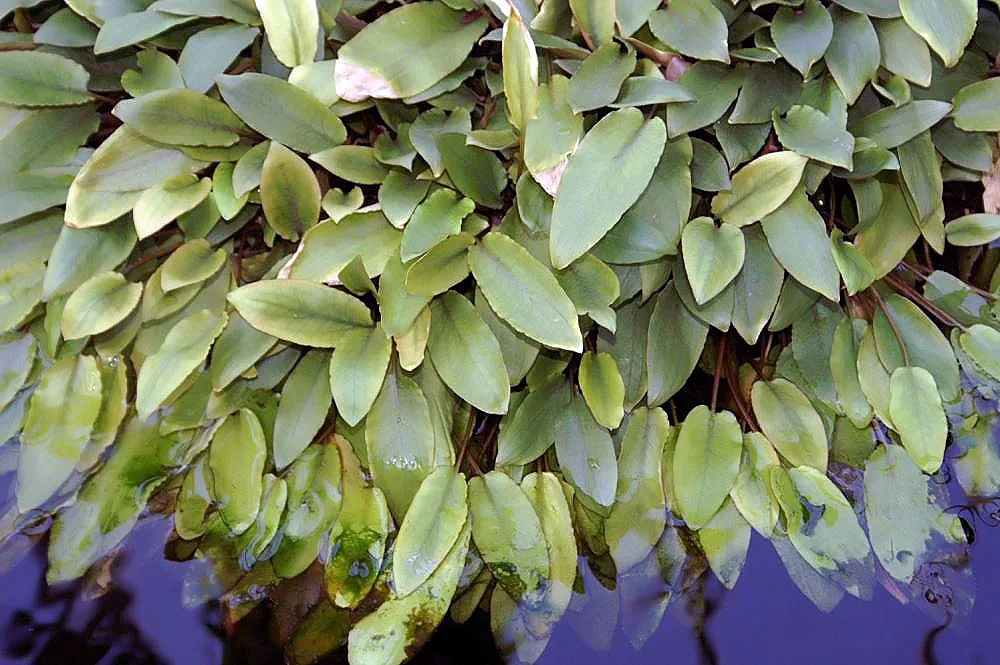
Aponogeton madagascariensis sends from a bulb elongate leaves in which the blade between the veins is missing. The lattice is the species and not feeding damage. Young leaves can still have tissue at first and become perforated later. The bulb carries the plant through rests in which all the leaves die back.
It is not Aponogeton ulvaceus and not A. crispus. Their leaves are continuous and waved. The lace plant wants cooler, very clean, moving water and tolerates dirt and warmth less well than those two.
Natural origin
This describes the origin, not how to furnish the aquarium.
Flowing, cool, clear waters in Madagascar. The island is the origin. Aquarium plants should be captive-bred. The natural place is not a warm, mulmy community tank.
Light, CO₂ and position
Conditions
18 to 24 °C, not a permanent stay in the discus range. pH rather acidic to neutral, the water very clean, moderate current, medium light, CO₂ helpful. Bulb half free, root zone fertilised, but no mulm on the lattice. A single leaf lying full of detritus suffocates.
Rest
If all the leaves die back and the bulb stays firm, take off the remains and wait. Do not dig it up every week. A soft bulb is rot.
Growth and trimming
Take each leaf off singly at the base when it falls apart. Do not rub the lattice. At the water change, rinse the mulm off the veins. The plant uses nutrients through the roots. Veins that turn brown are often age or dirt, not a missing iron alone.
Propagation
Daughter bulbs are rare. Seed from a flower spike is possible and slow. Practical propagation is not the everyday life of the keeping. Anyone who keeps the species keeps a bulb and a few leaves, not a mass.
More species in this group

Sources & assertions 1
Wikipedia (deutsch)
Texte in Aquarisma sind eigenständig formuliert. Zahlenbereiche folgen den verlinkten Wikipedia-Artikeln, Lizenz CC BY-SA.
- Haltungsbereich nach https://de.wikipedia.org/wiki/Aponogeton_madagascariensis