
Creeping burhead
Echinodorus cordifolius
16 views
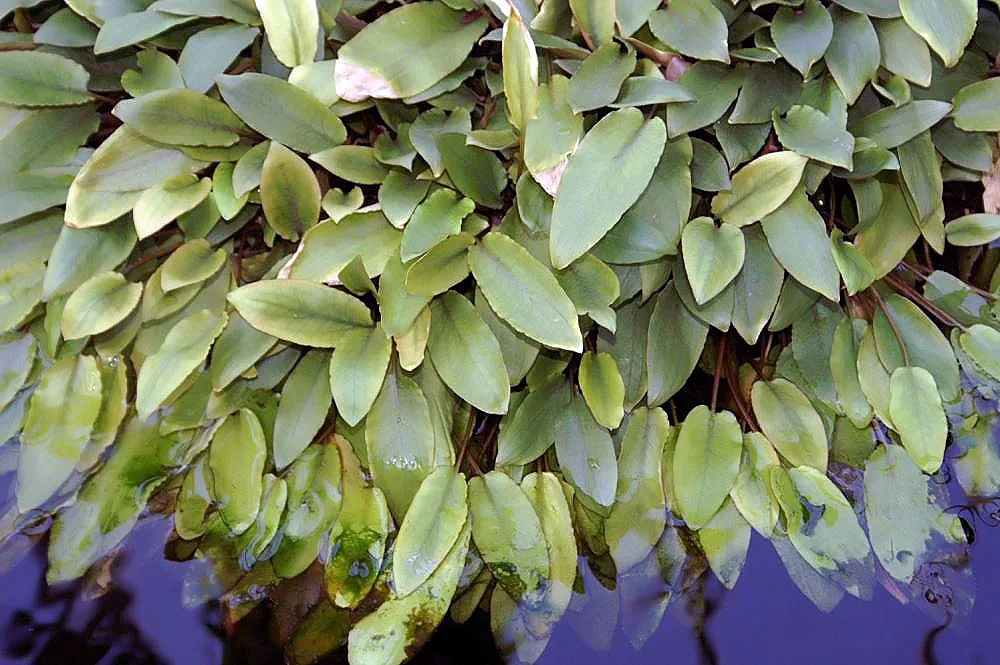
A large sword plant with broad, often heart-shaped leaves. It becomes a specimen and easily grows above the water.
2 min read · 236 words
Care profile
The care profile is backed by one source.
Lighting
Medium lightThe profile says moderate light.
CO₂
Medium CO₂Added CO₂ is recommended for the described growth.
Growth rate
MediumThe profile describes moderate growth.
Nutrient demand
HighNutrient demand is high.
Beginner friendly
ModerateThe published judgement sits between easy and demanding.
Placement in the aquarium
Only the stored position or growth form is highlighted, not every possible layout.
- Background
Home & range
Every named country gets a frame and a circle around known waters in or near that area. Hotspots are orientation, not collection sites. A filled area is the range only when the source names a particular water body.
Botanical overview
Echinodorus cordifolius forms a rosette of broad leaves. Under water they stay elongate. In a low water level or emersed they become clearly heart-shaped and tougher. The plant grows large. A tank of 40 cm height is quickly too low. Then the leaves lie on the surface and shade everything.
It is not the narrow-leaved sword Echinodorus grisebachii. The leaves are broader, the clump heavier. The root ball needs a nutrient-rich substrate.
Natural origin
This describes the origin, not how to furnish the aquarium.
Swamps and banks in the southern United States and in Central America. The origin stays coarse. The species knows emersed and submerged growth and seeks the light with its leaves.
Light, CO₂ and position
Place
Medium to high light, CO₂ helpful, 20 to 28 °C. Specimen or background, growing point free, root zone with fertiliser capsules. Not in the foreground of a small tank. Plant once.
Above water
In open tanks it pushes leaves and flower stalks above the surface. Anyone who wants to keep the submerged form cuts the aerial leaves off and keeps the light high. Sooner or later it still heads upward again.
Growth and trimming
Cut yellow outer leaves at the stalk right at the rosette. Do not injure the centre. A plant fed only through the water column makes small, pale leaves. Old algal leaves are removed, not rubbed until they tear.
Propagation
Adventitious plants on the flower stalk, less often division of the clump. The plantlets are taken off when they have roots and several leaves.
More species in this group
Sources & assertions 1
Wikipedia (deutsch)
Texte in Aquarisma sind eigenständig formuliert. Zahlenbereiche folgen den verlinkten Wikipedia-Artikeln, Lizenz CC BY-SA.
- Haltungsbereich nach https://de.wikipedia.org/wiki/Echinodorus_cordifolius