
Lemon cichlid
Neolamprologus leleupi
16 views
A slender, bright yellow or orange cichlid from Lake Tanganyika. It lives by its cave and stays intolerant of conspecifics in a short tank.
3 min read · 426 words
Quick facts
The profile values are backed by one source.
Home & range
Every named country gets a frame and a circle around known waters in or near that area. Hotspots are orientation, not collection sites. A filled area is the range only when the source names a particular water body.
Overview
Neolamprologus leleupi reaches about 8 to 10 cm. The body is elongate, the colour lemon yellow to orange depending on the population. Males grow larger and have longer fins. The species is not a school and not a Malawi mbuna, even though the colour suggests a yellow mouthbrooder.
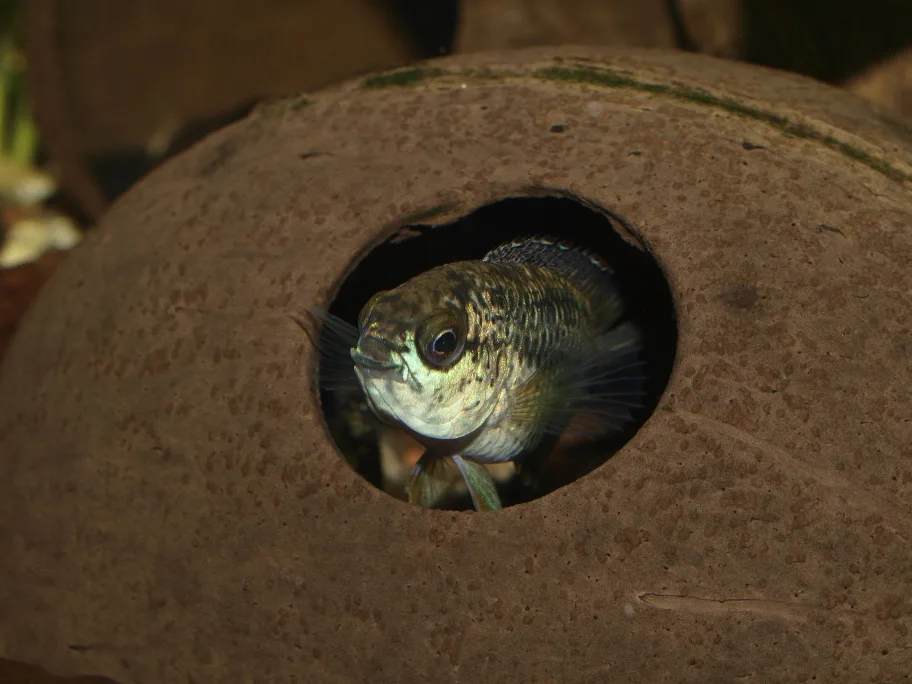
Each fish needs a cave it can treat as its own. One shared tube for two adults is too little. The colour holds only if the fish is not driven off all the time and the water is hard and clear.
Origin & habitat
This describes the origin, not how to furnish the aquarium.
The rock zone of Lake Tanganyika, clear, alkaline, oxygen-rich shores. The populations differ in shade. The lake is the origin, not a random East African spot. Other Neolamprologus, such as the shell dweller, share the lake and not the behaviour.
In the rock a short fight leads into the next crack. In the aquarium that crack has to be built.
Care
Layout
24 to 28 °C, pH 8 to 9, hard. From about 120 litres and 80 cm for a pair, with a rockwork of many caves. Sand or fine gravel. For several fish, clearly more length and more caves than fish. A single fish is possible and often more peaceful than two males.
Company
Other Tanganyika species that use other zones, such as shell dwellers on the sand, if the tank offers both. Malawi mbuna and soft-water fish do not belong. Shrimp rarely survive. The species leaves tough epiphytes more alone than an mbuna does, but it does not eat algae as its main food.
Diet
Small animal food. Brine shrimp, mosquito larvae, frozen food and a granule that sinks into the cave zone. The fish feed in front of the entrance and retreat. Food only at the surface misses them.
Several small feeds also keep the shyer fish in the food, without the dominant male clearing everything.
Behavior
A cave territory. The dominant fish stands in the entrance and drives off whoever wants the same crack. Short threats with spread fins are normal. A fish that is no longer allowed into a cave and hangs at the top of the glass has to come out, or it needs a second layout out of sight.
The species is active by day, but not hectic. It patrols a few hands’ breadths around its own cave.
Reproduction
Cave spawner. The female lays in the cave, both parents guard. The young stay near the entrance for a long time. In a species tank with enough caves a small group grows. In a full community tank the spawn is eaten.
Constantly shining a light into the cave breaks the brood.
More species in this group

Sources & assertions 1
Wikipedia (deutsch)
Texte in Aquarisma sind eigenständig formuliert. Zahlenbereiche folgen den verlinkten Wikipedia-Artikeln, Lizenz CC BY-SA.
- Haltungsbereich nach https://de.wikipedia.org/wiki/Neolamprologus_leleupi