
Cockatoo dwarf cichlid
Apistogramma cacatuoides
16 views
A dwarf cichlid whose males carry a fan-like dorsal fin. The article that was read knows the species so far only near Pucallpa in Peru.
2 min read · 240 words
Quick facts
The profile values are backed by one source.
Home & range
Every named country gets a frame and a circle around known waters in or near that area. Hotspots are orientation, not collection sites. A filled area is the range only when the source names a particular water body.
Coarse origin
The circle sits around the country or, a little wider, around known waters there. The points are orientation, not collection sites.
- Peru The article so far names only the area around Pucallpa on the Río Ucayali. Peru is not filled as a country outline. Brazil is not named in this text. Wikipedia deutsch
- Peru Coarse region of origin
Overview
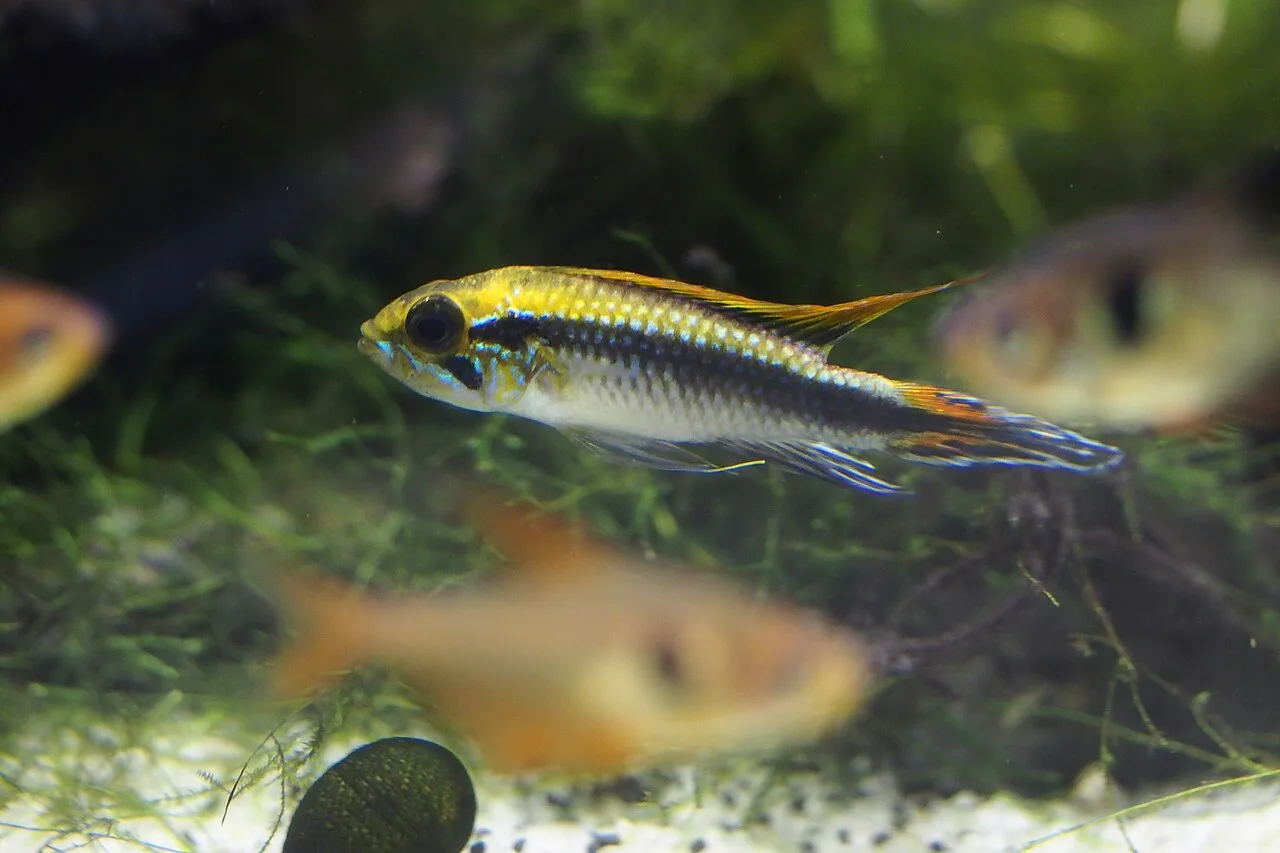
Males of Apistogramma cacatuoides reach eight centimetres. Females stay at five and have shorter fins. The body is only slightly elongated and moderately deep. The mouth is large for the body and has thick lips. Three to four wavy stripes on the lower belly occur in both sexes. The article says aquarium breeding appears to secure the species, while fish bred over many generations show colours clearly different from the wild form.
Origin & habitat
This describes the origin, not how to furnish the aquarium.
So far the species is recorded only near the Peruvian city of Pucallpa on the Río Ucayali. Brazil is not named in this article and is therefore not listed as origin. The habitat is small, shallow streams or lagoon-like pools in rainforest. The fish stay in very shallow zones at 24 to 28 °C. A thick leaf layer is typical, with underwater plants and stones as cover. Water at the sites is described as soft to medium-hard and slightly basic. That is a habitat statement, not a separate aquarium calculation.
Care
The older range of 24 to 28 °C matches the temperature named in the habitat. Males hold territories. The article recommends a pair, or one male with two females. The rather shy fish should be kept only with very quiet tankmates.
Behavior
Males are territorial. No finer social structure is described outside breeding.
Reproduction
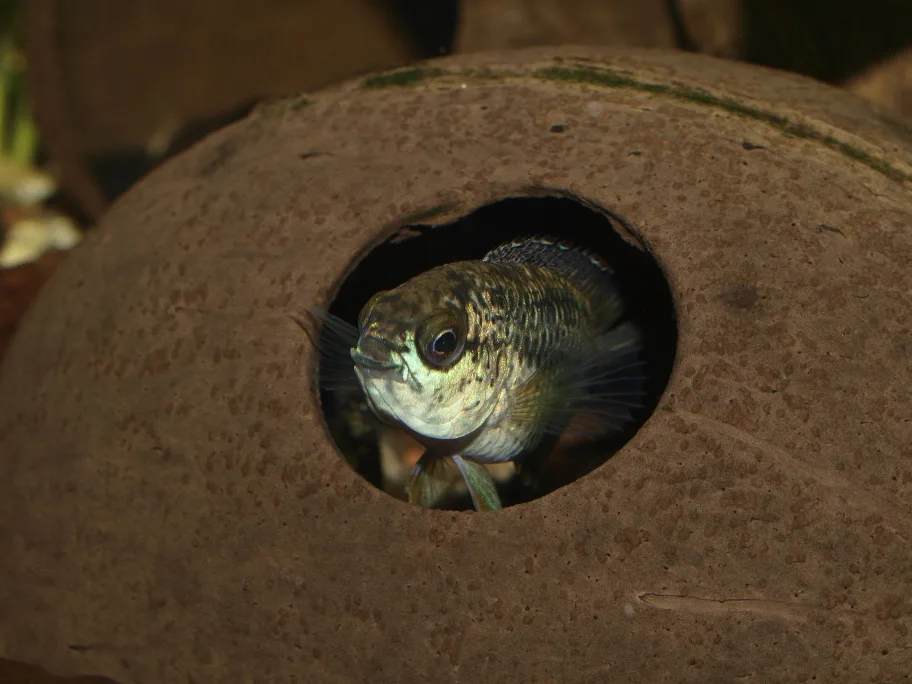
The female lays the eggs on the ceiling of a cave or under the undersides of leaves. She tends the brood alone. The male defends the breeding territory.
More species in this group
Sources & assertions 1
Wikipedia (deutsch)
Texte in Aquarisma sind eigenständig formuliert. Zahlenbereiche folgen den verlinkten Wikipedia-Artikeln, Lizenz CC BY-SA.
- Haltungsbereich nach https://de.wikipedia.org/wiki/Apistogramma_cacatuoides