
Variable platyfish
Xiphophorus variatus
13 views
A livebearing toothcarp from Atlantic Mexico. Many colourful platies in the trade are this species or mixes that include it.
3 min read · 427 words
Quick facts
The profile values are backed by one source.
Home & range
Every named country gets a frame and a circle around known waters in or near that area. Hotspots are orientation, not collection sites. A filled area is the range only when the source names a particular water body.
Overview
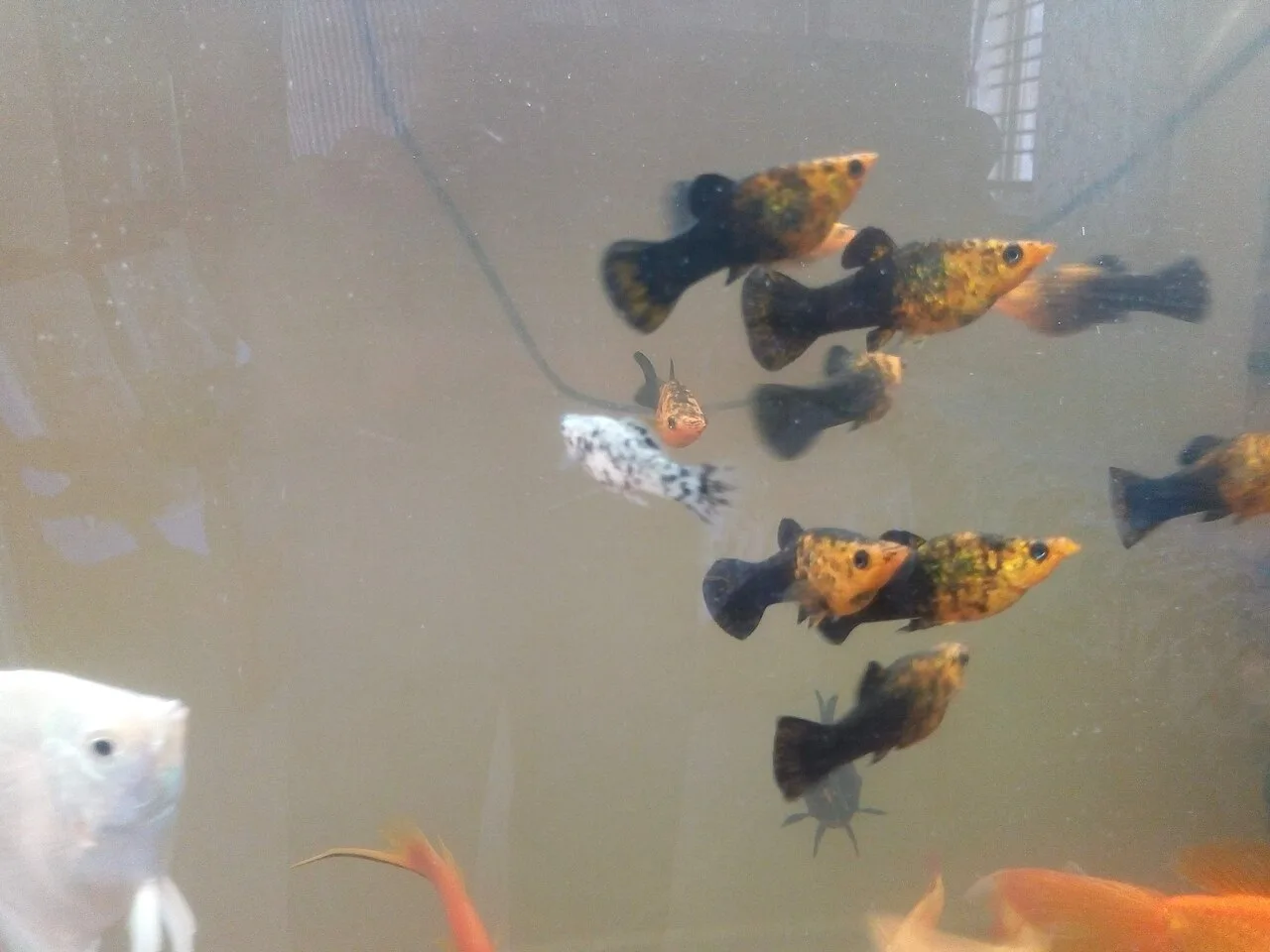
Xiphophorus variatus reaches about 6 to 7 cm. Males have a gonopodium. Females have a fan-shaped anal fin and often grow larger. Wild fish are plain, with spots and a shoulder mark. Orange, yellow, red and tuxedo are cultivated forms. A sword on the tail points to the swordtail or to a hybrid, not to a pure variable platy.
The species is more closely related to the southern platy, Xiphophorus maculatus, than the trade separates them. Crosses are fertile. Anyone who wants a line kept pure does not put it with other Xiphophorus.
Origin & habitat
This describes the origin, not how to furnish the aquarium.
Rivers, ditches and coastal waters on the Atlantic side of Mexico, from Tamaulipas southward. The water there is rather hard and not acidic. Mexico stays a coarse origin. Introduced stocks elsewhere are not an extra native area.
The fish stand in plants and at the surface, not in blackwater.
Care
Water
20 to 26 °C, pH 7 to 8.2, rather hard. From about 80 litres for a group, more females than males. Plants as a visual screen and as extra food. Strong filtration, because the fish eat a lot and produce young. Soft, peaty water is the common mistake: the fish scratch, clamp their fins and stop producing broods.
Company
Other peaceful fish that take hard water. Tetras from very soft water are the wrong mix if the water is set for the platies. Long fins suffer under barbs. Shrimp survive as long as the young have cover and the platies are well fed.
Diet
Omnivore with a clear plant share. Flakes, granules, blanched vegetables and frozen food. The fish graze on algae and leaves. A diet of mosquito larvae alone makes them fat and leaves out the plant food.
Several females have to get to the food. A male that takes everything at the front is a sign of too few feeding spots, not of an especially healthy fish.
Behavior
A peaceful group. Males display with spread fins and short chases. In a group that is too small this becomes permanent stress for a single female. The fish stand in the upper and middle water and are visible through the day.
The stock grows as soon as both sexes are present. That is the normal keeping and needs a plan for the young.
Reproduction
Livebearer. Gestation is several weeks. A brood often includes a few dozen young that swim and feed at once. Dense plants raise the survival rate, because the parents eat part of the brood. Females store sperm and can still drop young after the males are removed.
The fish mature in a few months. Without intervention the tank becomes tight.
More species in this group

Sources & assertions 1
Wikipedia (deutsch)
Texte in Aquarisma sind eigenständig formuliert. Zahlenbereiche folgen den verlinkten Wikipedia-Artikeln, Lizenz CC BY-SA.
- Haltungsbereich nach https://de.wikipedia.org/wiki/Xiphophorus_variatus