
Rummy-nose tetra
Petitella bleheri
11 views
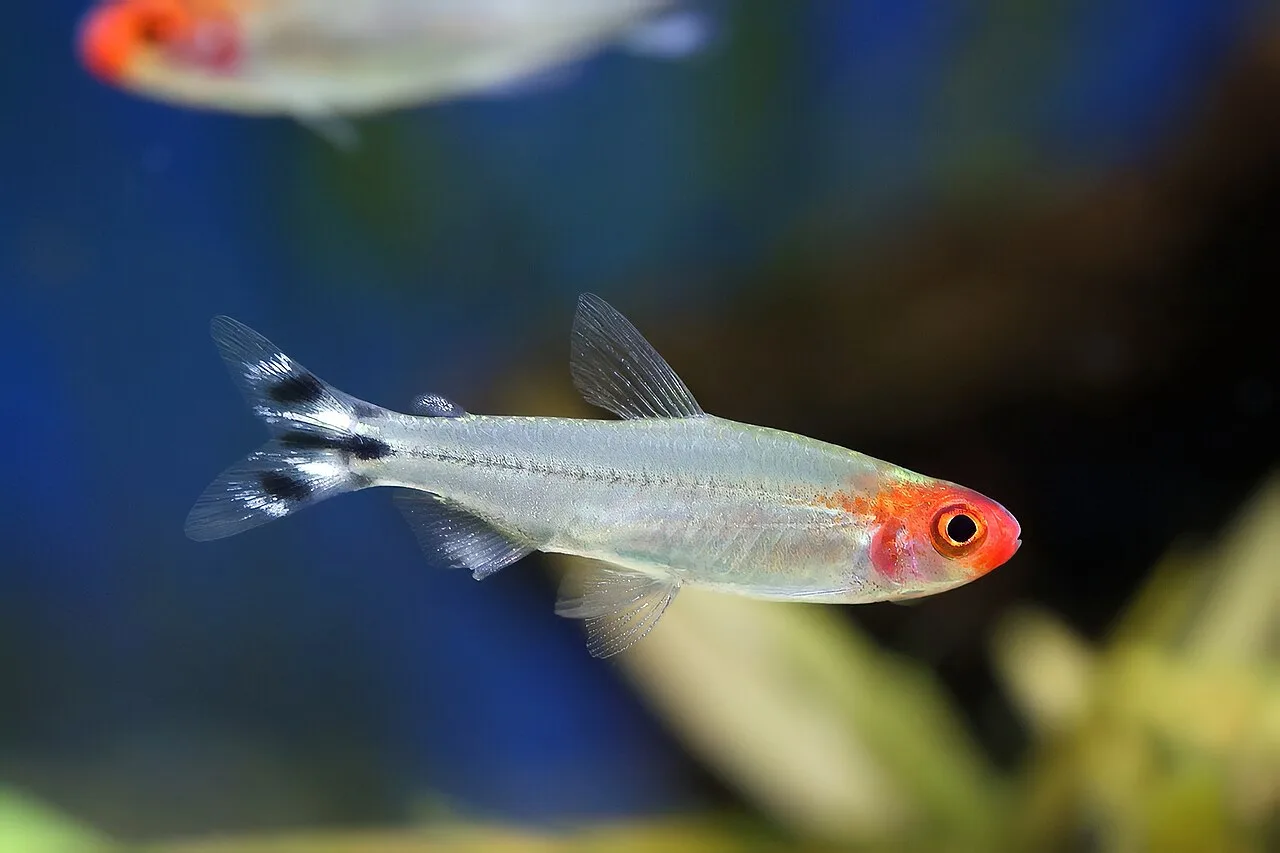
A slender tetra with a red head and a banded tail. Authors disagree on whether the home waters are blackwater only.
4 min read · 590 words
Quick facts
The profile values are backed by one source.
Home & range
Every named country gets a frame and a circle around known waters in or near that area. Hotspots are orientation, not collection sites. A filled area is the range only when the source names a particular water body.
Overview
Petitella bleheri, synonym Hemigrammus bleheri, belongs to the Acestrorhamphidae. The German name was coined in 1967 by the wholesaler Otto Schultze of Coburg. The fish is slender, the head and iris are red, and the tail is banded black and white. The red extends beyond the gill cover. The article suggests the pattern makes changes of direction visible in turbid water. Length is given as at least 4.5 cm, five centimetres by Schmidt and 5.5 cm by Schliewen. Females are fuller. Those three figures are not smoothed into one adult size. The species is confused with Petitella rhodostomus, which has a narrow dark band over the caudal peduncle and whose red usually stays on the head, and with Petitella georgiae, whose stripe is broader, which has a black line at the anal-fin base and whose red usually covers only the upper third of the head.
Origin & habitat
This describes the origin, not how to furnish the aquarium.
The original home is northwestern Brazil and southern Colombia. The Rio Negro is given as the type area, including the middle Rio Negro and the Río Vaupés coming from Colombia. Parts of the upper Colombian Orinoco, the Río Meta and, according to Staeck, the lower Río Inírida are added. Riehl called the species a blackwater fish in 2004. Schliewen in 2011 named clearwater and blackwater streams. Schmidt wrote in 2001 that the species occupies all water types, preferring small side streams and oxbows, so whitewater as well. The article sets these contradictions side by side and therefore does not publish one pH span as the species value. General sentences about Amazonian blackwater of very low hardness and about clearwater at pH 4.4 to 6.6 describe water types, not measurement series for this species. True water plants are rare in blackwater. Many tetras stay where clearwater and blackwater mix.
Care
What is documented is sensitivity to hardness and to pollution caused by people. Hugo Benninger had good results with strongly flowing, unpolluted water of about 20 µS/cm for spawn and larvae. That is a breeder’s experience, not a field measurement. Fading red is not explained in the article as a reliable sign of poor water.
School and colour
The rummy-nose shows the red head only in a real group and in clean, rather soft water. If the red fades, that is a hint of nitrite, too much stress, or a group that is too small, not a cosmetic problem. From about 100 litres, a school from ten, 24 to 28 °C, slightly acidic to neutral. Plenty of swimming room, dim light, a dark bottom, so that the band in the tail stays visible.
The fish are more sensitive to neglect than a neon tetra. An overdue water change shows on them before the tougher tankmates react.
Diet
During spawning the species also acts as an egg predator.
Behavior
The article calls the fish decidedly lively and peaceful, and a schooling fish that prefers structured, rather dark surroundings with some plant cover, without plant growth taking over. The behaviour is explicitly not equated with that of true schooling fish such as herrings.
A tight school in midwater. Too few fish stand singly and lose the colour. Calm tankmates. Hectic barbs and large cichlids do not fit. The species does not jump as strongly as a hatchetfish. A cover is still sensible.
Reproduction
Spawning is in pairs, freely among fine-leaved plants. The spawning mother can defend the brood and drive other fish away. The young hatch after 30 to 36 hours and swim free after the fourth day. The article stresses that in the home waters the eggs are laid in flowing water and need a steady supply of fresh water.
More species in this group


Sources & assertions 1
Wikipedia (deutsch)
Texte in Aquarisma sind eigenständig formuliert. Zahlenbereiche folgen den verlinkten Wikipedia-Artikeln, Lizenz CC BY-SA.
- Haltungsbereich nach https://de.wikipedia.org/wiki/Rotkopfsalmler