
Ram cichlid
Mikrogeophagus ramirezi
11 views
Small cichlid from the Orinoco and the Llanos. Warm, soft, and kept as a pair.
2 min read · 275 words
Quick facts
The profile values are backed by one source.
Home & range
Every named country gets a frame and a circle around known waters in or near that area. Hotspots are orientation, not collection sites. A filled area is the range only when the source names a particular water body.
Coarse origin
The circle sits around the country or, a little wider, around known waters there. The points are orientation, not collection sites.
- Venezuela Wikipedia deutsch
- Colombia Wikipedia deutsch
- Venezuela Coarse region of origin
- Colombia Coarse region of origin
Overview
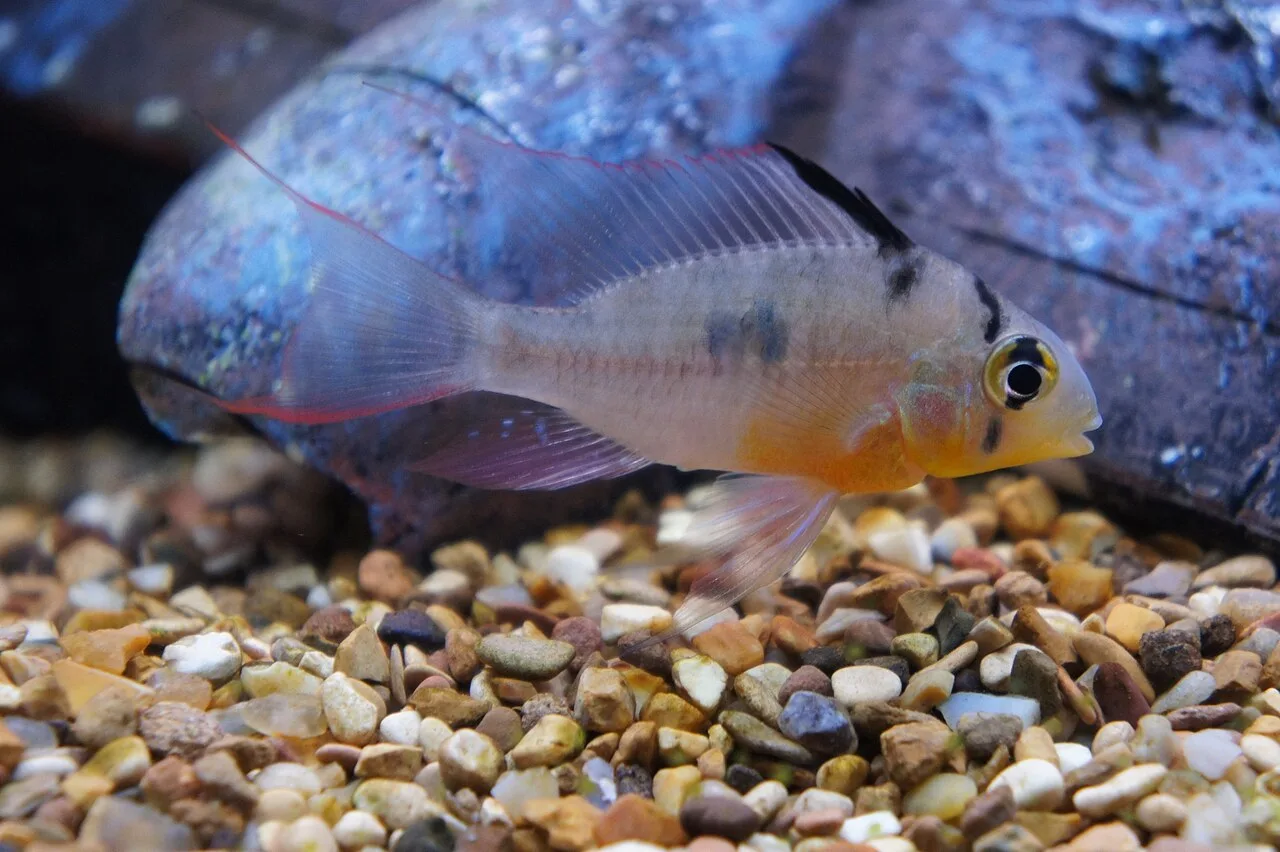
Rarely to 5 cm. Males have a longer second dorsal ray. Females are smaller and have a reddish to violet belly. A short ovipositor shows just before spawning. Fish from large Southeast Asian farms, and so-called jumbo rams, have lost parts of their breeding behaviour. The African butterfly cichlid is a different species.
Origin & habitat
This describes the origin, not how to furnish the aquarium.
Lower and middle Orinoco and the other waters of the Llanos in Venezuela and Colombia. Both countries stay a coarse origin and are not filled. Earlier records from the Bolivian Mamoré belong to the sister species Mikrogeophagus altispinosus and are not added here. The habitat is clear, slow, densely planted streams with a mud bottom, and vegetated shores of warm turbid lakes.
Care
Measured habitats: one reading of pH 5.1, 3 µS/cm and 28.5 °C, and a span of pH 4.6 to 7.3, under 10 to 40 µS/cm and 27.5 to 31 °C. Keeping stays at 27–30 °C and pH 5.5–7, inside those readings, without turning one sample into the new span. The source does not name tanks from about 80 litres. Fine substrate and cover follow from mud and plants.
Diet
Frozen brine shrimp and mosquito larvae, and live daphnia, cyclops and brine shrimp. The article makes varied food a condition for growth and breeding. Granules alone are not what it states.
Behavior
Always a pair, not a loose group. Territorial when spawning, otherwise reserved. A pair that does not tolerate each other is not a pair that can be kept.
Reproduction
Open spawner on stones or in pits, 150 to 200 eggs. Both parents guarding the brood is the older wording. It says breeding is difficult and depends on food and on soft, slightly acidic water. A community tank should not be expected to produce young.
More species in this group
Sources & assertions 2
Wikipedia (deutsch)
Texte in Aquarisma sind eigenständig formuliert. Zahlenbereiche folgen den verlinkten Wikipedia-Artikeln, Lizenz CC BY-SA.
- Haltungsbereich nach https://de.wikipedia.org/wiki/Schmetterlingsbuntbarsch
Wikipedia
Texte in Aquarisma sind eigenständig formuliert. Zahlen folgen dem genannten Artikel, Lizenz CC BY-SA. Deutsch und Englisch sind dieselbe Enzyklopädie, keine zweite unabhängige Quelle.
- Zitierte Messungen im Lebensraum: 28,5 °C sowie 27,5 bis 31 °C.
- Der Artikel schreibt, die Tiere werden selten bis zu fünf Zentimeter lang.