
Shell dweller
Neolamprologus multifasciatus
15 views
A tiny Tanganyika cichlid that builds a colony in empty snail shells. Without shells there is no keeping that deserves the name.
3 min read · 466 words
Quick facts
The profile values are backed by one source.
Home & range
Every named country gets a frame and a circle around known waters in or near that area. Hotspots are orientation, not collection sites. A filled area is the range only when the source names a particular water body.
Overview
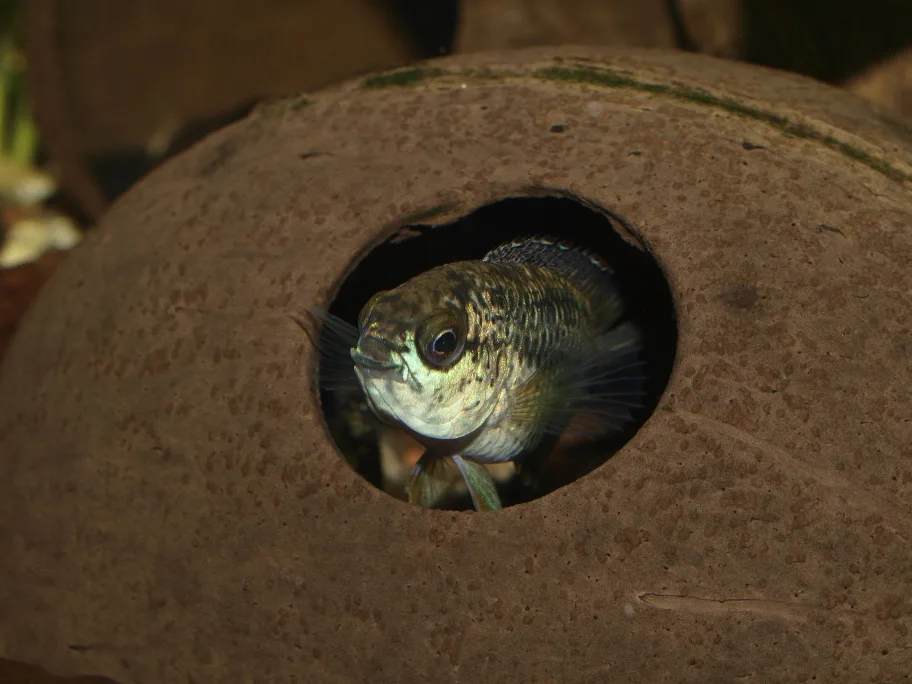
Neolamprologus multifasciatus stays at about 3 to 4 cm, males a little larger and more elongate than females. Pale bars on a sand-coloured ground break up the outline over the bottom. The species is not a general cichlid that spawns anywhere. It is a shell dweller.
Each fish claims at least one shell, dominant males often several. The colony grows sideways and downward, not upward. A tall, empty tank is the wrong shape even when the litres look large.
Origin & habitat
This describes the origin, not how to furnish the aquarium.
The species lives in Lake Tanganyika on open sand where empty shells of the snail Neothauma lie. The water is hard and alkaline, clear and rich in oxygen. The fish dig the shells in until only a usable opening remains, and they build a small sand crater around each shell.
The origin is the lake, not a random East African water. Other shell dwellers such as N. similis or N. brevis are separate species with other shell sizes and other social behaviour.
Care
Layout
24 to 28 °C, pH 8 to 9, hard water. Tanks from about 60 litres for a starting group, better long than tall. The substrate is fine sand, several centimetres deep, because the fish dig. Add a field of empty snail shells, clearly more shells than fish. Escargot shells are the usual substitute when Neothauma shells are missing. The opening has to fit the fish.
Stocking
Start with a small group, not a single pair on one shell. The colony then decides how many fish stay. Tankmates only in the upper water, and only if they leave the sand and the shells alone. Corydoras that overturn every shell end the keeping.
Diet
Small animal food. Brine shrimp, cyclops, fine frozen food and a granule that reaches the bottom. The fish feed in front of the shell and retreat with a bite. Food that only drifts at the surface reaches the colony poorly.
A fixed feeding spot beside the shells stops every male from closing the whole area as a feeding territory.
Behavior
A colony of mini-territories. Males patrol between their shells. Females stay closer to their own shell. Fights stay short and ritualised as long as spare shells exist. Without shells the ritual becomes real injury.
The fish work the sand all day. A freshly smoothed sand bed is a field of craters the next morning. That is the species, not a sign that the substrate was chosen wrongly.
Reproduction
A cave spawner inside the shell. The female lays on the inner wall, the male fertilises the clutch. The brood stays in the shell until the young swim out and remain in the crater at first. In a species tank the colony grows. Too many young for too few shells have to be moved on, not packed tighter.
The eggs are invisible inside the shell. Lifting shells to look destroys the brood.
More species in this group
Sources & assertions 1
Wikipedia (deutsch)
Texte in Aquarisma sind eigenständig formuliert. Zahlenbereiche folgen den verlinkten Wikipedia-Artikeln, Lizenz CC BY-SA.
- Haltungsbereich nach https://de.wikipedia.org/wiki/Neolamprologus_multifasciatus