
Sailfin molly
Poecilia latipinna
10 views
A large livebearing toothcarp with a high sail on the males. It needs hard, alkaline water, length, and a group in which the males do not all descend on a single female.
3 min read · 447 words
Quick facts
The profile values are backed by one source.
Home & range
Every named country gets a frame and a circle around known waters in or near that area. Hotspots are orientation, not collection sites. A filled area is the range only when the source names a particular water body.
Overview
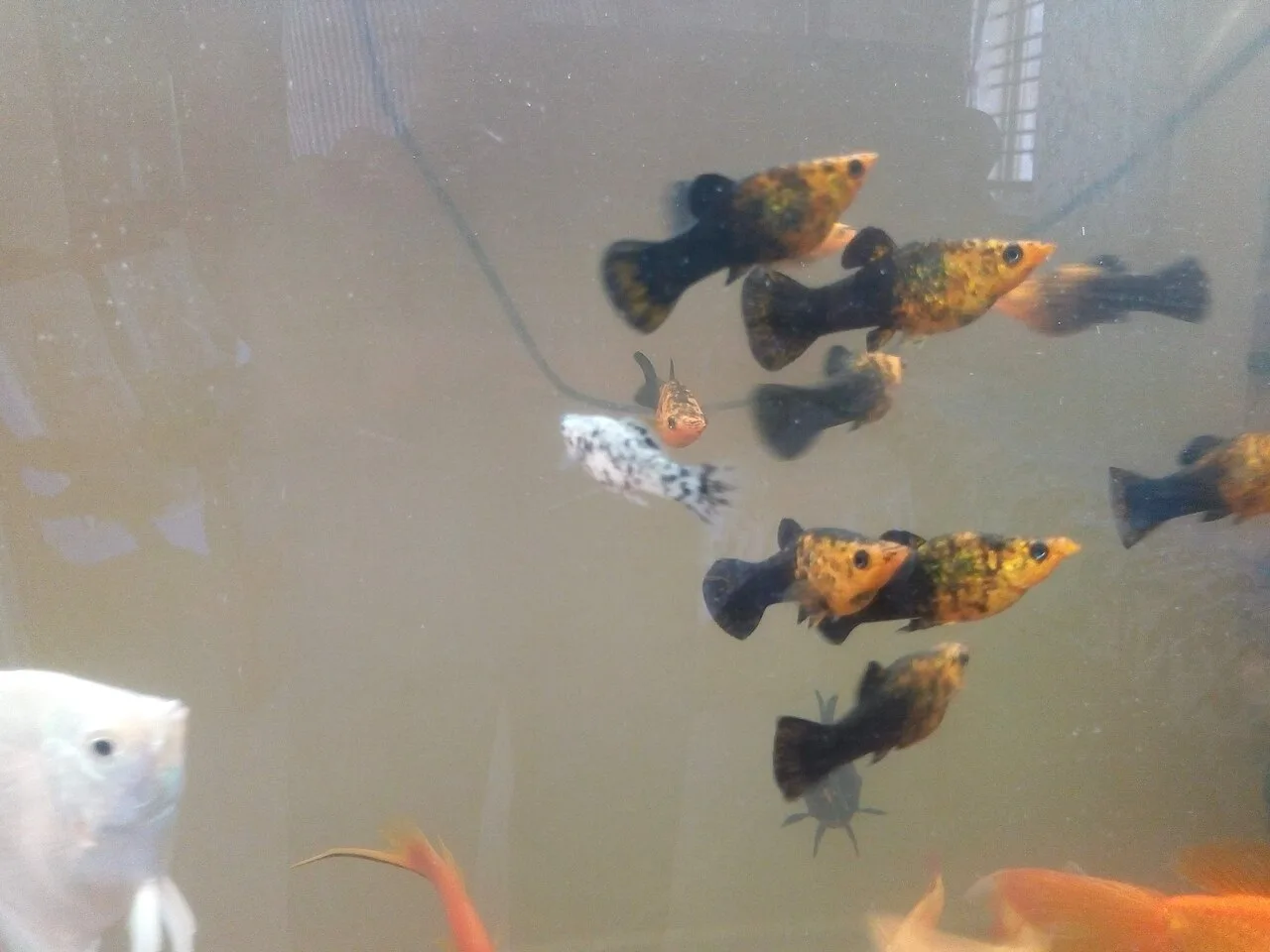
Males carry a gonopodium and, when they are healthy and not suppressed, a sail-like dorsal fin. Females often grow larger and stay without the sail. The species can reach 10 to 12 cm. Black, mottled and leucistic fish are cultivated forms. Wild fish are plainer olive with spots and a smaller sail.
The sailfin molly is not a molly for 40 litres. The black mollies usually sold are often mixes of several Poecilia species. A high sail and the body size point to P. latipinna. A certain separation of the cultivated strains often fails on a single fish.
Origin & habitat
This describes the origin, not how to furnish the aquarium.
Shallow coastal and brackish waters, ditches and river mouths from the south-eastern United States to Mexico. The species tolerates brackish water and also lives in fresh water as long as it is hard and not acidic. Soft, peaty water is the most common keeping mistake.
The wide natural span explains the toughness in hard water and, at the same time, why fish in soft water scratch, clamp their fins and stop feeding.
Care
Water
22 to 28 °C, pH 7.5 to 8.5, hard. A low salt content can help, but it does not replace hardness and cleanliness. Tanks from about 120 litres and 80 cm long for a group. Several females per male. Plants as a visual screen and as extra food. Strong filtration, because the fish eat a lot and load the water quickly.
Company
Other fish that tolerate hard water and are not too small. Platies and swordtails can fit, but they cross with mollies. Anyone who wants to keep the species pure does not put it with other Poecilia. Soft-water tetras and shrimp are the wrong company.
Diet
Mostly plants and aufwuchs, plus small animals. Food with a high plant share, blanched vegetable strips, spirulina and a share of frozen food. The fish graze on the glass and the leaves through the day. One flake in the morning is not enough.
A diet that is too rich in protein produces heavy fish and more algae, because the plant food is missing and the nutrient load rises.
Behavior
Lively, focused on the males, otherwise peaceful. Males show each other the sail. In a group that is too small, one male becomes permanent stress for the females. The females need plants behind which the chase breaks off.
The species stands in the upper and middle water and at the glass. It is not a bottom fish.
Reproduction
Livebearer. The gestation is several weeks. A brood can be large. The parents eat young. Dense plants raise the survival rate. Without intervention the stock grows, and the tank becomes tight before anyone notices.
Females store sperm. A single female can still produce broods after the males have long been removed.
More species in this group

Sources & assertions 1
Wikipedia (deutsch)
Texte in Aquarisma sind eigenständig formuliert. Zahlenbereiche folgen den verlinkten Wikipedia-Artikeln, Lizenz CC BY-SA.
- Haltungsbereich nach https://de.wikipedia.org/wiki/Segelk%C3%A4rpfling