
Monte Carlo
Micranthemum tweediei
18 views
A creeping ground cover from South America, sold as Monte Carlo. A lawn appears only from many small tufts, strong light and time.
3 min read · 354 words
Care profile
The care profile is backed by one source.
Lighting
High lightThe profile says high light.
CO₂
High CO₂Added CO₂ is part of the described culture.
Growth rate
MediumThe profile describes moderate growth.
Nutrient demand
HighNutrient demand is high.
Beginner friendly
ModerateThe published judgement sits between easy and demanding.
- Runners
Placement in the aquarium
Only the stored position or growth form is highlighted, not every possible layout.
- Foreground
- Ground cover
Home & range
Every named country gets a frame and a circle around known waters in or near that area. Hotspots are orientation, not collection sites. A filled area is the range only when the source names a particular water body.
Botanical overview
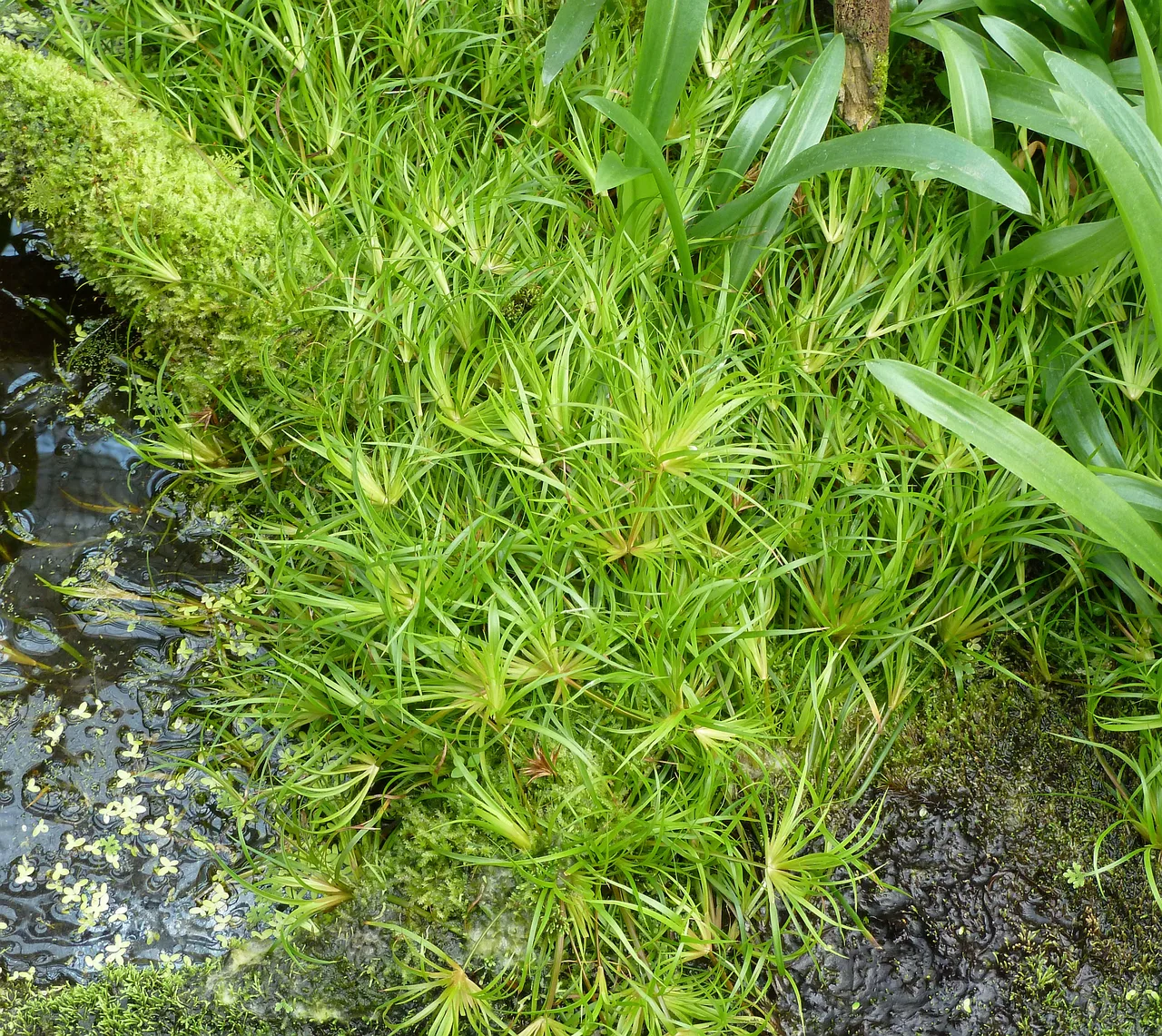
Micranthemum tweediei stays low when light reaches the bottom. The leaves are small and rounded, the shoots creep and root at the nodes. In shade the shoots stand up and the plant becomes a loose bush instead of a lawn. It is not Hemianthus callitrichoides, even though both are sold as ground cover. Monte Carlo has slightly larger leaves and is more tolerant, without growing in the dark.
The trade name Monte Carlo is not a second species. Anyone who expects an instant carpet is buying a future area, not a single pot.
Natural origin
This describes the origin, not how to furnish the aquarium.
The genus Micranthemum is American. M. tweediei grows on damp, bright banks and in shallow water, emersed and submerged. A tighter water polygon is not stored here. For the tank the bright, nutrient-rich shallows matter, not a shaded forest stream.
Light, CO₂ and position
Light and CO₂
High light and CO₂ are the condition for the flat habit. Without CO₂ the plant grows more slowly and more loosely. It does not automatically die. 22 to 26 °C is a workable window. The substrate has to be rich, because the roots at the nodes feed, not only the leaves in the water.
Planting
Split the pot. Take out the rock wool, divide the mat into small tufts, and set each tuft at an angle with tweezers, with a gap. A whole pot as one lump rots in the middle. Foreground, in front of tall plants, not under a dense floating cover.
Growth and trimming
In the first weeks the tufts grow sideways, not upward. Any shoot that heads up is trimmed or replanted. After one or two months the area closes if light and CO₂ are right. Algae on the young lawn mean too little plant mass or too much light without enough nutrients, not that the species is unsuitable.
Fertilise through the substrate and sparingly into the water. A lawn that turns yellow usually needs more nitrogen or iron, not still more light.
Propagation
Division of the shoots. Runners with roots are separated and replanted. Seed plays no role in the aquarium. A dense lawn is thinned, or the lower layer suffocates and lifts off the substrate in whole sheets.
More species in this group
Sources & assertions 1
Wikipedia (deutsch)
Texte in Aquarisma sind eigenständig formuliert. Zahlenbereiche folgen den verlinkten Wikipedia-Artikeln, Lizenz CC BY-SA.
- Haltungsbereich nach https://de.wikipedia.org/wiki/Micranthemum