
Dwarf hairgrass
Eleocharis acicularis
15 views
A fine sedge of large parts of the northern hemisphere. The article mentions aquarium use in one sentence and gives no keeping figures.
3 min read · 418 words
Care profile
The care profile is backed by one source.
Lighting
High lightThe profile says high light.
CO₂
Medium CO₂Added CO₂ is recommended for the described growth.
Growth rate
MediumThe profile describes moderate growth.
Nutrient demand
MediumNutrient demand is moderate.
Beginner friendly
ModerateThe published judgement sits between easy and demanding.
- Rhizome
- Runners
Placement in the aquarium
Only the stored position or growth form is highlighted, not every possible layout.
- Foreground
- Ground cover
Home & range
Every named country gets a frame and a circle around known waters in or near that area. Hotspots are orientation, not collection sites. A filled area is the range only when the source names a particular water body.
Botanical overview
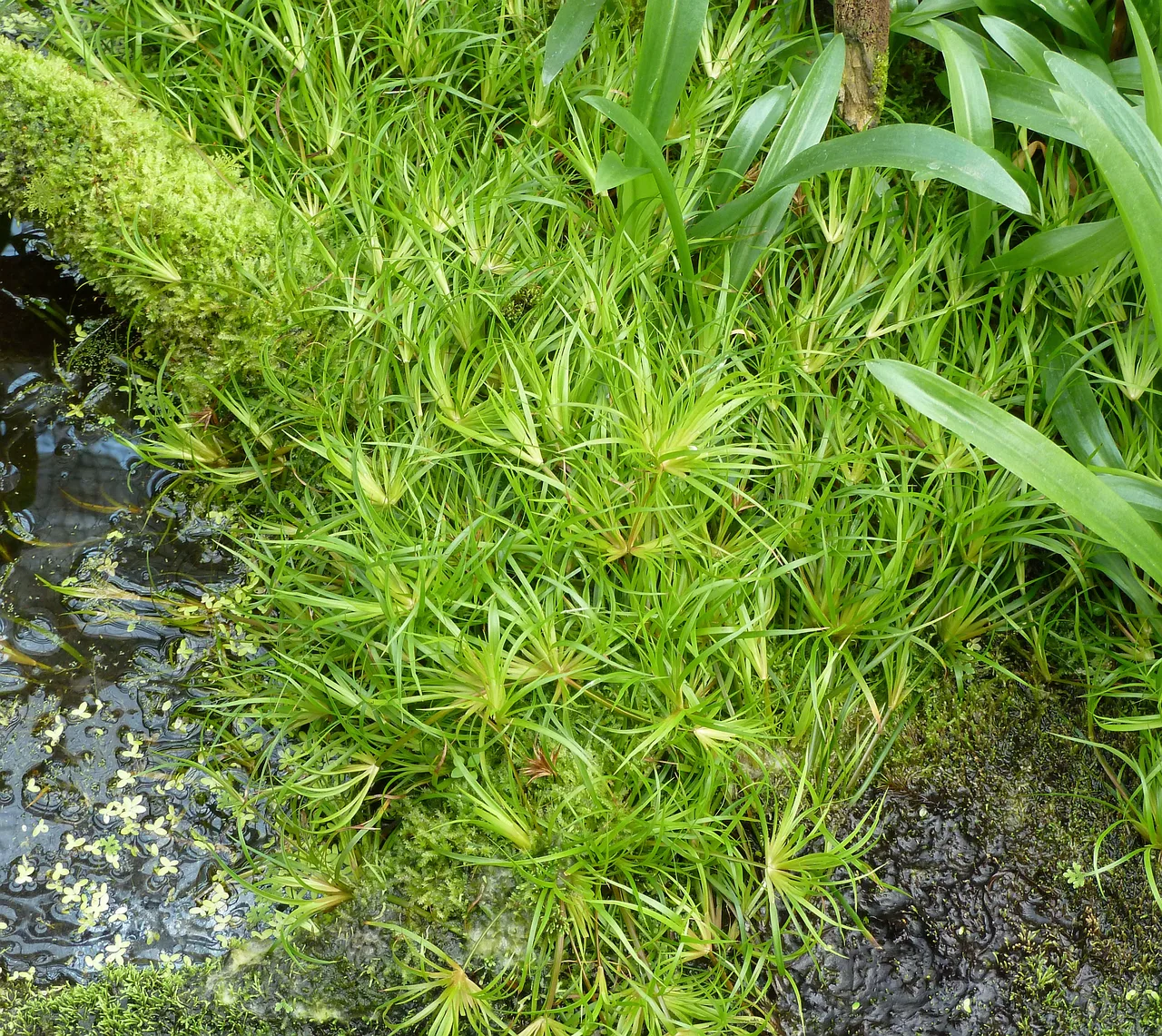
Eleocharis acicularis was described by Linnaeus in 1753 as Scirpus acicularis and placed in Eleocharis by Roemer and Schultes. At its sites it forms small stands that spread across the ground from spring into early summer. Runners are therefore the vegetative spread. A lawn in the aquarium with a time span is not in the text.
Natural origin
This describes the origin, not how to furnish the aquarium.
Widespread in Eurasia and the New World. Rare in Central Europe and missing in places. In Australia probably introduced. Individual countries are not added from the continents. It stands on at least temporarily flooded, moderately nutrient-rich, often lime-rich but usually lime-poor sand, gravel, clay, mud or rubble, on shallow lake shores, ponds, oxbows, ditches and wet meadows. In Central Europe from the colline to the montane belt, up to 1000 m. At Lago nero near the Bernina at 2200 m only sterile shoots. At Lake Constance down to 1.5 m. Landolt indicators for Switzerland: light figure 4 of 5, so bright, nutrient figure 2, so nutrient-poor, reaction neutral to basic. Those are ecological indicators, not aquarium PAR values. Assessed as threatened in Germany in 1996.
Light, CO₂ and position
Temperature, CO₂ and a light step for the aquarium are not in the text. The older scale of high light, medium CO₂ and 18–26 °C remains the previous sheet. Light figure 4 supports bright light in the field and is not converted into PAR.
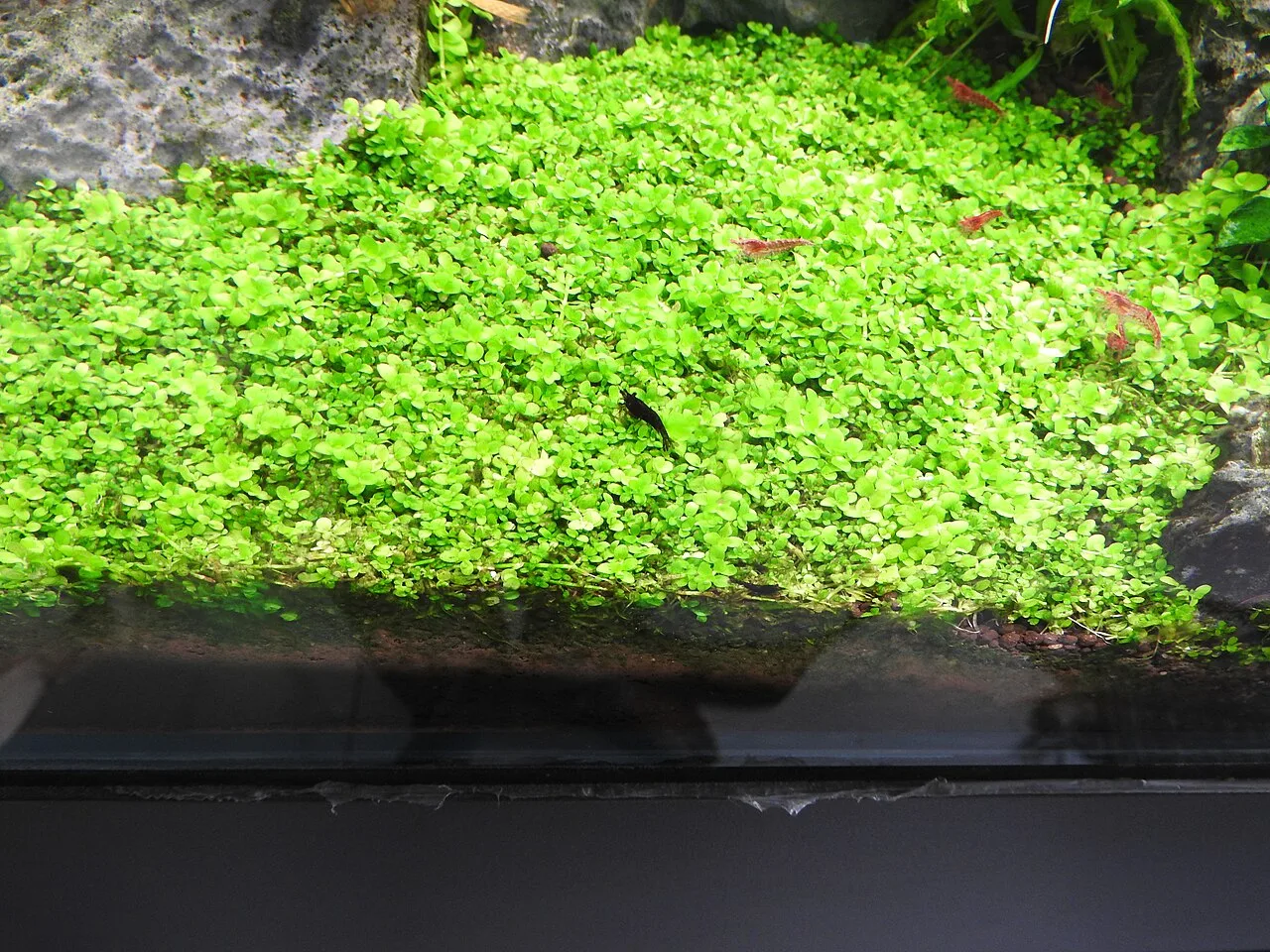
A lawn from portions
Hairgrass is set in many small tufts, with a gap, in high light and if possible with CO₂. A dense block from the pot lifts and rots. The blades stay short as long as light reaches the bottom. Under floating plants they grow long and lie over.
Patience is part of the care. A lawn that is gappy after two weeks is normal. The runners close the gaps if they are not rearranged every week.
Growth and trimming
Shearing tall culms is not in the botanical article. The spread across the ground in early summer is the field observation.
Mowing and mulm
Blades that are too long can be cut once the area can carry it. Before that the cut weakens the few shoots. Mulm between the needles is siphoned, or the lawn turns brown from below. Yellow patches are replaced together with the piece of rhizome, not poured over with still more fertiliser.
Further care
It prefers places that lie mostly dry from autumn to spring. That explains why permanently deep water is not the only natural state.
Propagation
Runners. An aquarium guide to dividing them is missing. The article only says that it is used as an aquarium plant.
More species in this group
Sources & assertions 1
Wikipedia (deutsch)
Texte in Aquarisma sind eigenständig formuliert. Zahlenbereiche folgen den verlinkten Wikipedia-Artikeln, Lizenz CC BY-SA.
- Haltungsbereich nach https://de.wikipedia.org/wiki/Eleocharis_acicularis