
Helanthium tenellum
Helanthium tenellum
13 views
A small runner ground cover, formerly placed with the Amazon swords. A lawn comes from many single plants and from light.
2 min read · 294 words
Care profile
The care profile is backed by one source.
Lighting
High lightThe profile says high light.
CO₂
Medium CO₂Added CO₂ is recommended for the described growth.
Growth rate
MediumThe profile describes moderate growth.
Nutrient demand
MediumNutrient demand is moderate.
Beginner friendly
ModerateThe published judgement sits between easy and demanding.
- Runners
Placement in the aquarium
Only the stored position or growth form is highlighted, not every possible layout.
- Foreground
- Ground cover
Home & range
Every named country gets a frame and a circle around known waters in or near that area. Hotspots are orientation, not collection sites. A filled area is the range only when the source names a particular water body.
Botanical overview
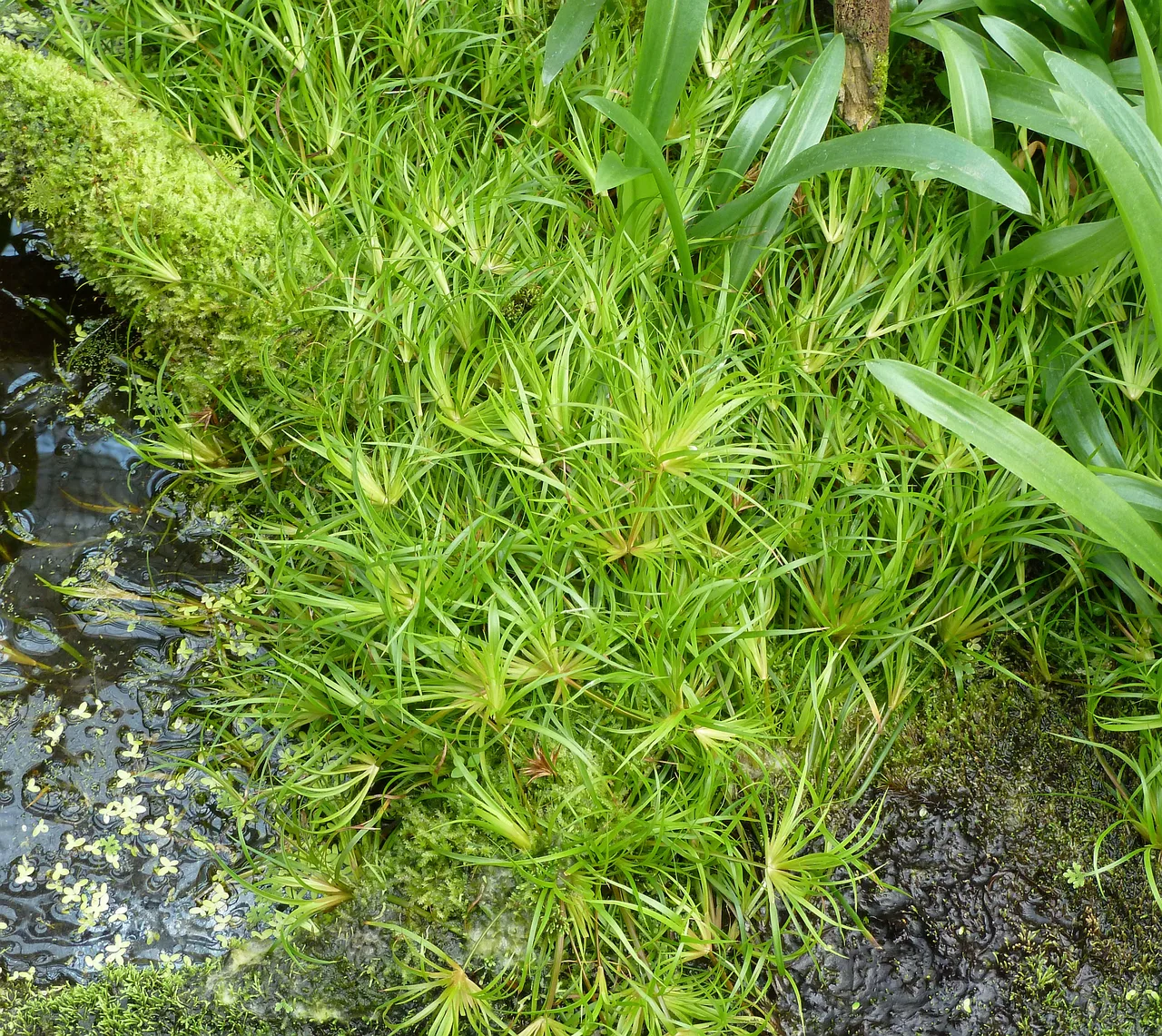
Helanthium tenellum forms small rosettes with narrow leaves and links them by runners. Under strong light the height stays at a few centimetres. In shade the leaves grow long and the plant stands as a loose bush. The species is not Echinodorus grisebachii and not Lilaeopsis. The leaves are broader than hairgrass and clearly a small rosette.
In the pot there is often a dense mat in rock wool. The mat is divided. As a lump it lifts and rots in the middle.
Natural origin
This describes the origin, not how to furnish the aquarium.
Shallow, bright banks in the Americas, at times flooded. The plant knows emersed and submerged growth. In the aquarium it stays submerged if light and substrate are right. The Americas stay the coarse origin.
Light, CO₂ and position
Lawn
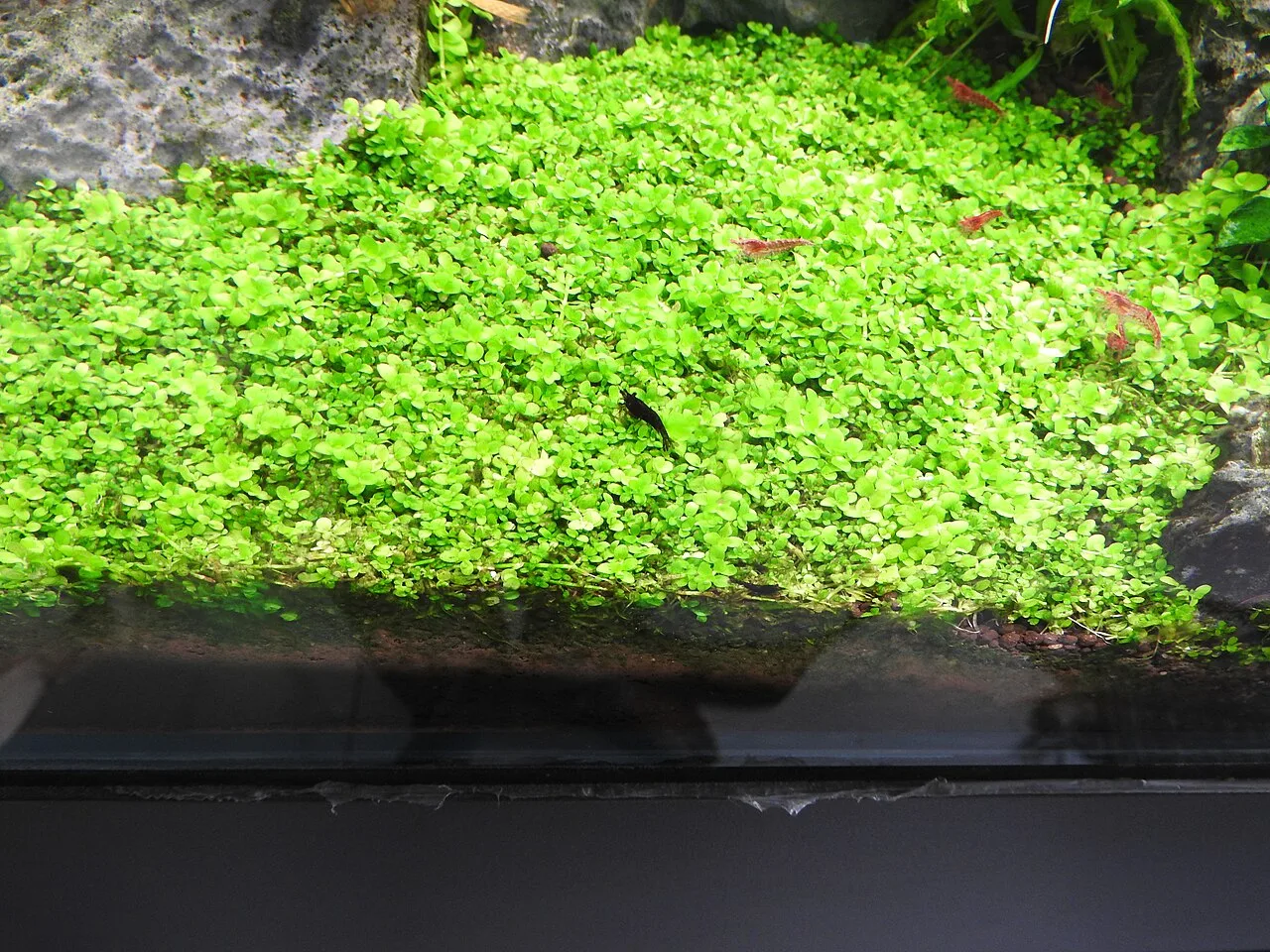
High light, CO₂ recommended, 20 to 28 °C, a nutrient-rich substrate. Small rosettes with a gap in the foreground, free of tall shade plants. The area closes over weeks to months. Without CO₂ it often survives, but stays taller and gappier.
Patience
A gappy stand after two weeks is the normal state. The runners fill in if they are not replanted every week. Under frogbit or a dense floating cover the lawn becomes a tall grass.
Growth and trimming
Leaves that are too tall can be cut once the area can carry it. Before that the cut weakens the few rosettes. Yellow patches are replaced together with the small rosette. Siphon mulm from between the plants at the water change, or the lawn turns brown from below.\n\nFertiliser in the substrate is the base. A dose given only into the water reaches the small root less well than food in the substrate.
Propagation
Separate runners with a rosette and roots of their own and set them into the gaps. That is the propagation and the way the area becomes dense.
More species in this group
Sources & assertions 1
Wikipedia (deutsch)
Texte in Aquarisma sind eigenständig formuliert. Zahlenbereiche folgen den verlinkten Wikipedia-Artikeln, Lizenz CC BY-SA.
- Haltungsbereich nach https://de.wikipedia.org/wiki/Helanthium_tenellum