
Cherry barb
Rohanella titteya
13 views
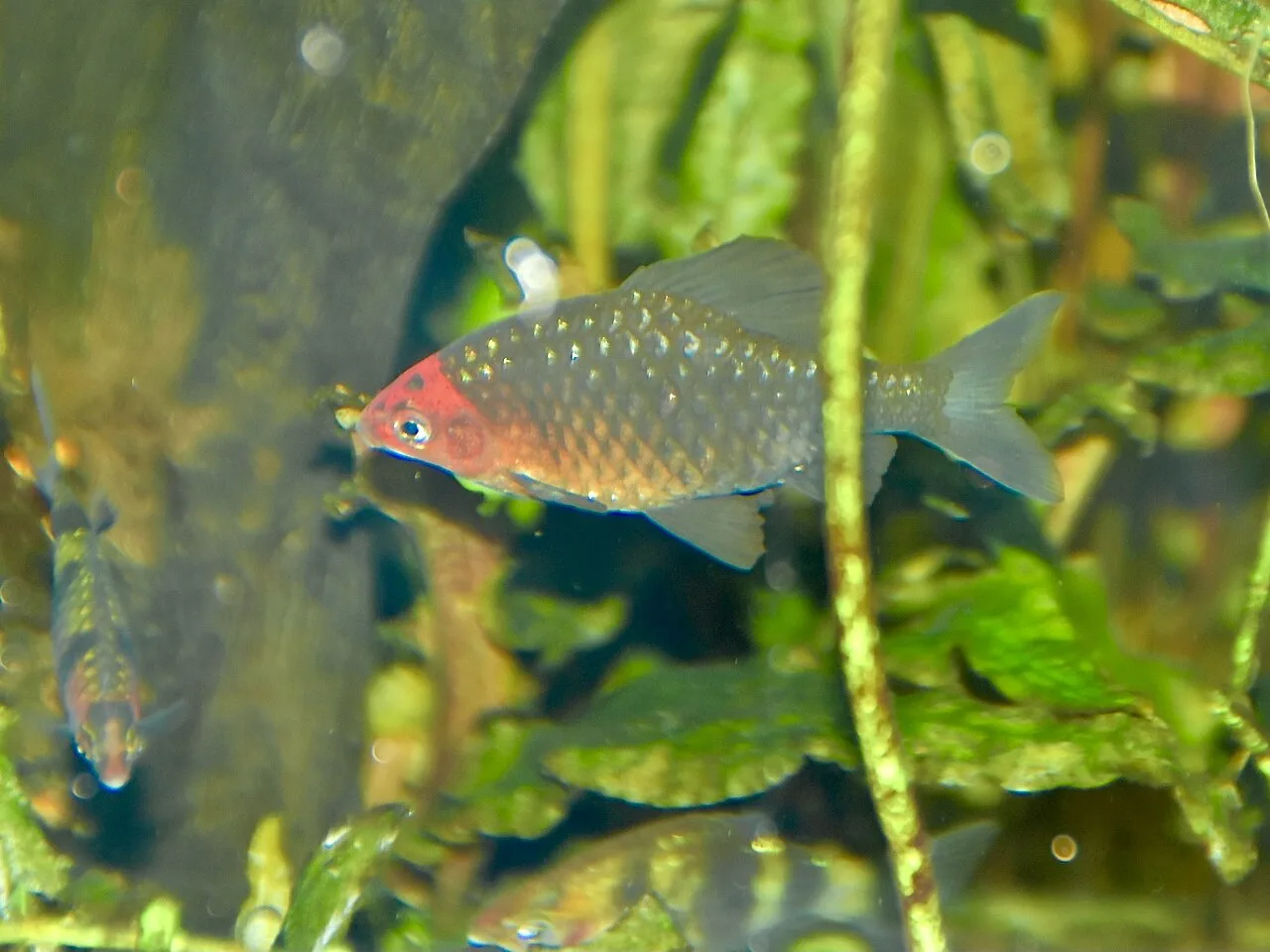
Endemic to Sri Lanka, 4 to 5 cm. Puntius titteya is the synonym. Red and yellow colours are variations.
1 min read · 155 words
Quick facts
The profile values are backed by one source.
Home & range
Every named country gets a frame and a circle around known waters in or near that area. Hotspots are orientation, not collection sites. A filled area is the range only when the source names a particular water body.
Coarse origin
The circle sits around the country or, a little wider, around known waters there. The points are orientation, not collection sites.
- Sri Lanka Wikipedia deutsch
- Sri Lanka Coarse region of origin
Overview
The only species of the genus Rohanella, erected in 2023. Males more strongly coloured and larger-finned when courting, females mostly yellow, both with a dark band and one pair of barbels. The sister species Plesiopuntius bimaculatus stays outside.
Origin & habitat
This describes the origin, not how to furnish the aquarium.
Southern Sri Lanka, slow rainforest streams, including the Nilwala and the Kelani. Sri Lanka only, coarse. Threatened by habitat loss.
Care
Relatively undemanding. pH 6.5 to 7.0, medium-hard to hard without a stored degree span, 20 to 27 °C, also unheated, from 54 litres, plants and cover, dark sand or fine gravel, floating plants. Groups from six. Not with long-finned fish, because the barbs eat fins.
Diet
Adults are omnivores: live, dry and frozen food. Breeding is encouraged with live food.
Reproduction
Free spawner, up to 280 eggs in Java moss, usually early in the morning. Breeding names soft water and about 25 °C. That is breeding, not the keeping span. Larvae need paramecia or Artemia. About five years in captivity, without a stored span.
More species in this group
Sources & assertions 1
Wikipedia (deutsch)
Texte in Aquarisma sind eigenständig formuliert. Zahlenbereiche folgen den verlinkten Wikipedia-Artikeln, Lizenz CC BY-SA.
- Haltungsbereich nach https://de.wikipedia.org/wiki/Bitterlingsbarbe