
Black ruby barb
Pethia nigrofasciata
10 views
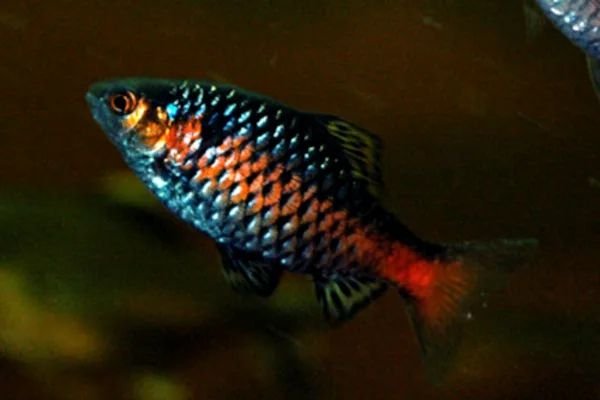
A barb from Sri Lanka whose males turn purple-black when courting. It stays peaceful in a school and turns pale without a group.
2 min read · 294 words
Quick facts
The profile values are backed by one source.
Home & range
Every named country gets a frame and a circle around known waters in or near that area. Hotspots are orientation, not collection sites. A filled area is the range only when the source names a particular water body.
Overview
The black ruby barb reaches about 6 cm. Outside courtship the fish are silvery with dark bars. When courting the males colour the fore-body deep purple to black and the fins redden. Females stay lighter and deeper. This colour change is mood and rank, not another sex and not a disease.
In the shop the fish often look pale, because the tank is bright, bare and the group too small. In a planted aquarium with several males the colour comes.
Origin & habitat
This describes the origin, not how to furnish the aquarium.
Forest streams and slow waters in Sri Lanka, shaded, with leaf litter and gravel. The island stays the coarse origin. Soft to medium-hard water matches that better than very hard tap water, even though captive-bred fish tolerate a good deal.
Care
School
22 to 26 °C, pH 6 to 7.5. A group from eight, with several males, tanks from about 100 litres and 80 cm. Plants at the edge, an open middle, a dark bottom, some current. Permanently very warm water they tolerate less well than many tetras.
Company
Other calm barbs, larger rasboras, corydoras. Long fins are a risk when the own group is too small. In the right number they hardly nip. Tiny Boraras are too small.
Diet
Omnivore with a plant share. Flakes, granules, blanched vegetables, frozen food. Several small feeds. Mosquito larvae alone make them fat and do not replace the green food they also take.
Behavior
A school with courtship by the males. The purple is display, not permanent aggression, as long as there is room to get away. A single male stays silvery or becomes fidgety. The fish are active by day and need the run.
Reproduction
Egg scatterer without brood care. Softer water, fine plants and removing the parents are the breeding path. In a community tank the eggs are eaten. The young are small.
More species in this group
Sources & assertions 1
Wikipedia (deutsch)
Texte in Aquarisma sind eigenständig formuliert. Zahlenbereiche folgen den verlinkten Wikipedia-Artikeln, Lizenz CC BY-SA.
- Haltungsbereich nach https://de.wikipedia.org/wiki/Purpurkopfbarbe