
Rosy barb
Pethia conchonius
9 views
A barb of ponds and streams at 18 to 22 °C. The article gives a tolerance of pH 6 to 8 and hardness 5 to 19 °dH.
2 min read · 214 words
Quick facts
The profile values are backed by one source.
Home & range
Every named country gets a frame and a circle around known waters in or near that area. Hotspots are orientation, not collection sites. A filled area is the range only when the source names a particular water body.
Coarse origin
The circle sits around the country or, a little wider, around known waters there. The points are orientation, not collection sites.
- Afghanistan Wikipedia deutsch
- Pakistan Wikipedia deutsch
- India Wikipedia deutsch
- Nepal Wikipedia deutsch
- Bangladesh Wikipedia deutsch
- Afghanistan Coarse region of origin
- Pakistan Coarse region of origin
- India Coarse region of origin
- Nepal Coarse region of origin
- Bangladesh Coarse region of origin
Overview
The rosy barb lives in ponds, pools and flowing water. It prefers soft, slightly acidic water and tolerates pH 6 to 8 and hardness of 5 to 19 °dH. The cited section does not give a body length.
Origin & habitat
This describes the origin, not how to furnish the aquarium.
Afghanistan, Pakistan, India, Nepal and Bangladesh, in waters of 18 to 22 °C. No coordinate map is published. The temperature is that of the home waters.
Care
18 to 22 °C, pH 6 to 8, hardness 5 to 19 °dH. Those are the habitat conditions and the tolerance named in the article. No tank volume is given.
Cool, and in a school
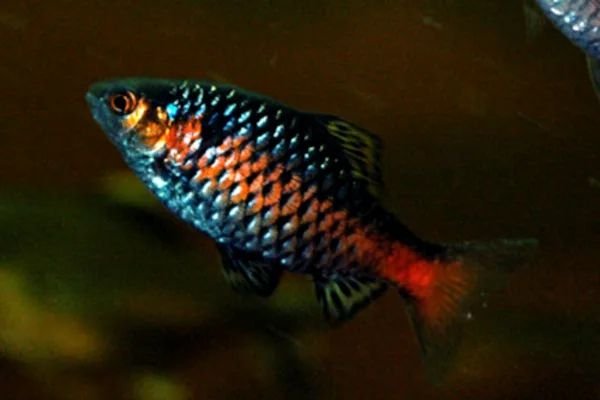
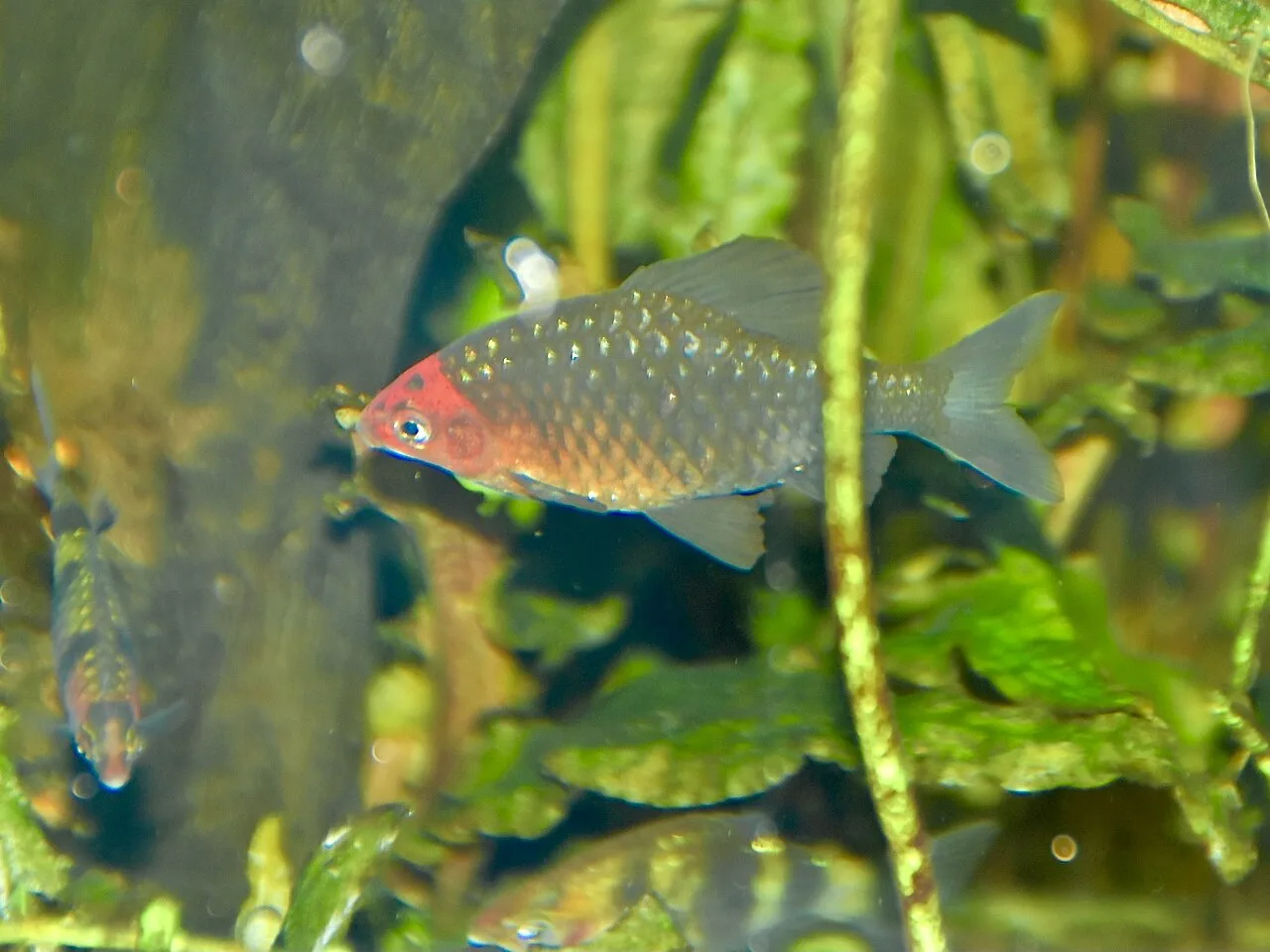
The rosy barb tolerates cooler water than many tropical barbs. 18 to 24 °C is a good window. Above that it becomes short of breath and pale. pH 6.5 to 7.5. A school from eight, tanks from about 80 litres. The males turn deep red when courting. A single male among other species stays silvery.
It is lively, but less of a fin-nipper than an undersized tiger-barb group, as long as its own group is right.
Diet
The cited section does not list a diet.
Omnivore with a plant share. Flakes, granules, blanched vegetables and frozen food. The fish feed in every layer and grow fat quickly if they are given only mosquito larvae.
Behavior
The cited section does not give a minimum group size.
Reproduction
The cited section does not describe breeding.
More species in this group
Sources & assertions 1
Wikipedia (deutsch)
Texte in Aquarisma sind eigenständig formuliert. Zahlenbereiche folgen den verlinkten Wikipedia-Artikeln, Lizenz CC BY-SA.
- Haltungsbereich nach https://de.wikipedia.org/wiki/Prachtbarbe