
Melon barb
Haludaria fasciata
11 views
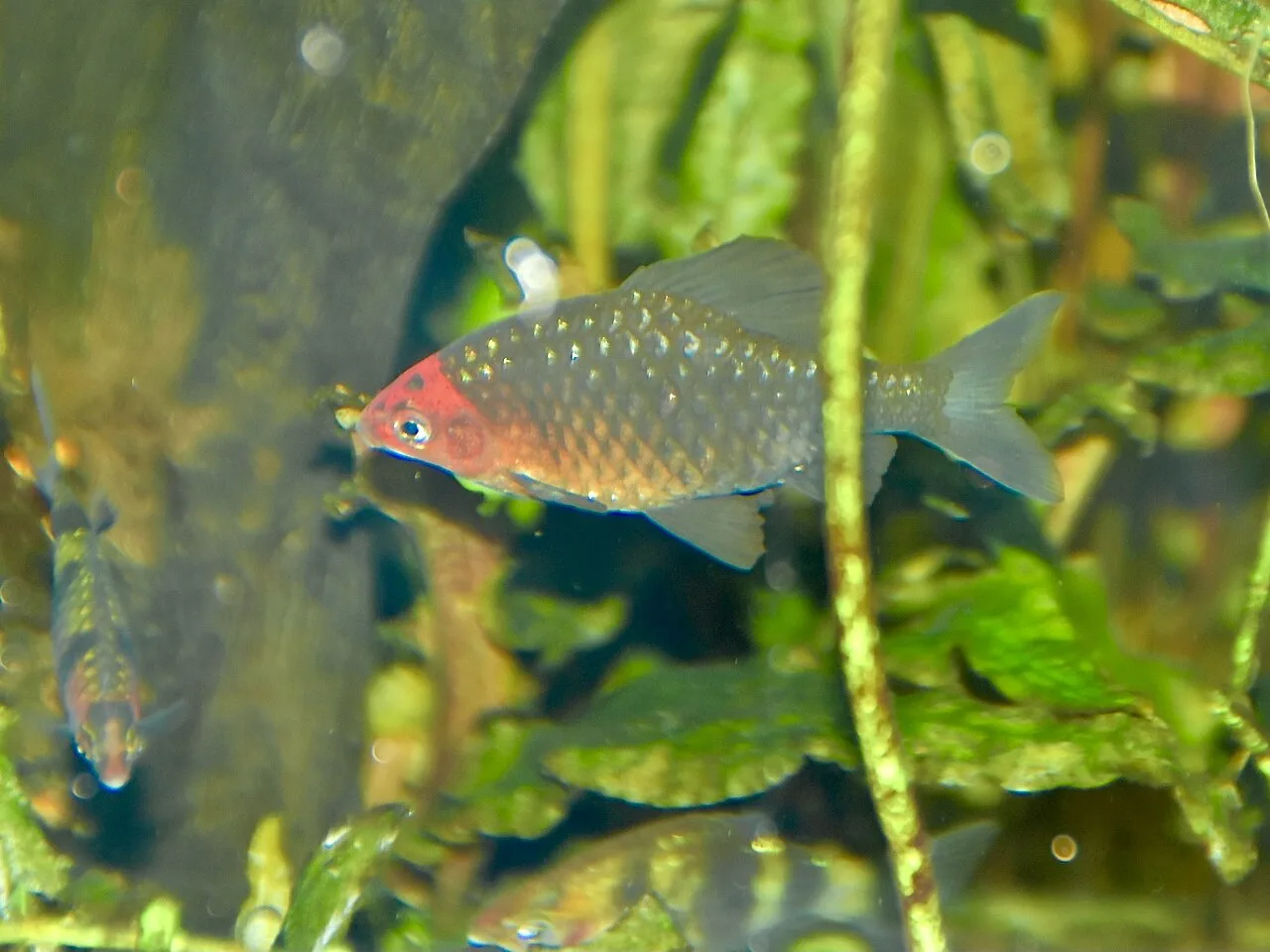
A barb with dark bars that become stronger in the school and during courtship. It stays more manageable than many other barbs.
2 min read · 179 words
Quick facts
The profile values are backed by one source.
Home & range
Every named country gets a frame and a circle around known waters in or near that area. Hotspots are orientation, not collection sites. A filled area is the range only when the source names a particular water body.
Overview
Haludaria fasciata reaches about 6 cm. The body is silvery to reddish, with several dark bars. When courting the males turn redder, the females stay deeper. Earlier trade names say Puntius fasciatus. It is the same species.
It is not the tiger barb. The bars are less sharp, the temperament quieter, the adult size smaller. A school remains the keeping.
Origin & habitat
This describes the origin, not how to furnish the aquarium.
Streams and slow waters in southern India. The origin stays coarse. Plants and an open run belong together.
Care
School
22 to 26 °C, pH 6 to 7.5. A group from eight, tanks from about 80 litres and 70 cm. Plants at the edge, some current, a cover.
Company
Peaceful tetras, rasboras, corydoras. The long fins of a fighting fish are the wrong neighbourhood, even though this barb is quieter than a tiger barb.
Diet
Prepared food. Flakes, granules, frozen food, a plant share. Several small feeds.
Behavior
A school with small courtship chases. Too few fish nip or stand pale. The colour comes in the school, not on a single fish.
Reproduction
Egg scatterer without brood care. The eggs are laid in plants and eaten if the parents stay.
More species in this group

Sources & assertions 1
Wikipedia (deutsch)
Texte in Aquarisma sind eigenständig formuliert. Zahlenbereiche folgen den verlinkten Wikipedia-Artikeln, Lizenz CC BY-SA.
- Haltungsbereich nach https://de.wikipedia.org/wiki/Haludaria_fasciata