
Lambchop rasbora
Trigonostigma espei
17 views
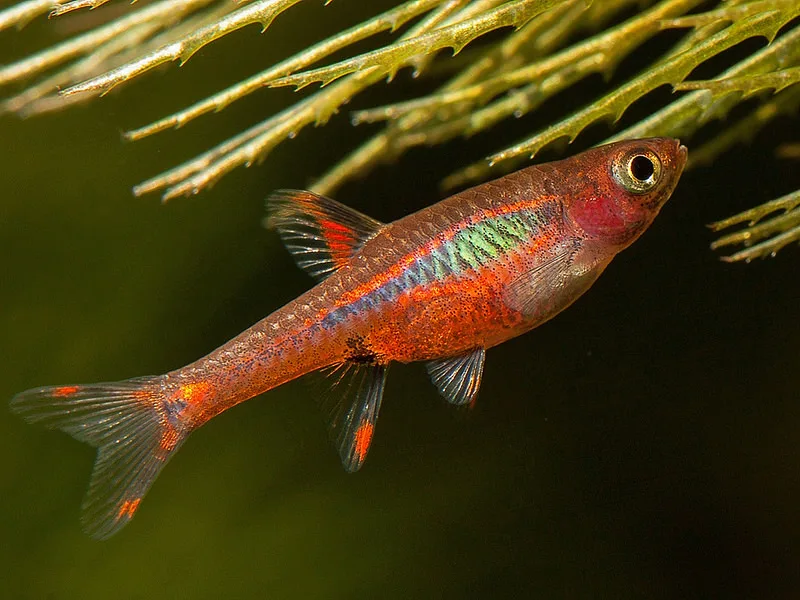
A slender schooling fish from Southeast Asia with a narrow wedge spot. It stays smaller, and wants warmer and softer water, than many rasboras sold under the same shop name.
3 min read · 399 words
Quick facts
The profile values are backed by one source.
Home & range
Every named country gets a frame and a circle around known waters in or near that area. Hotspots are orientation, not collection sites. A filled area is the range only when the source names a particular water body.
Overview
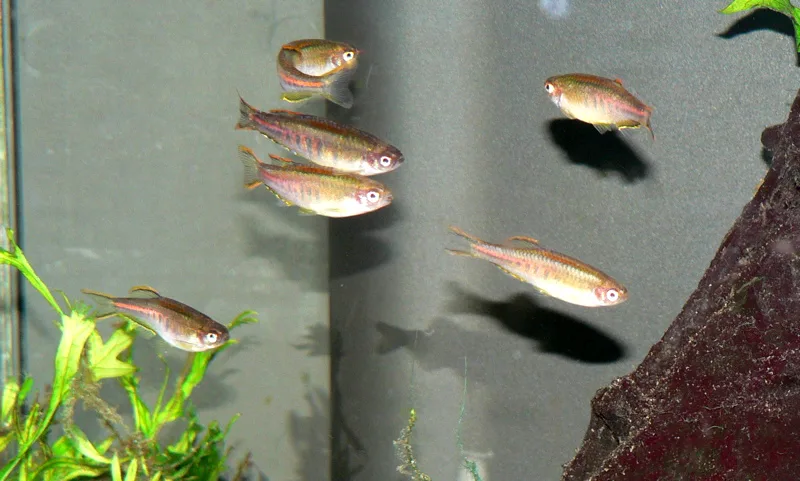
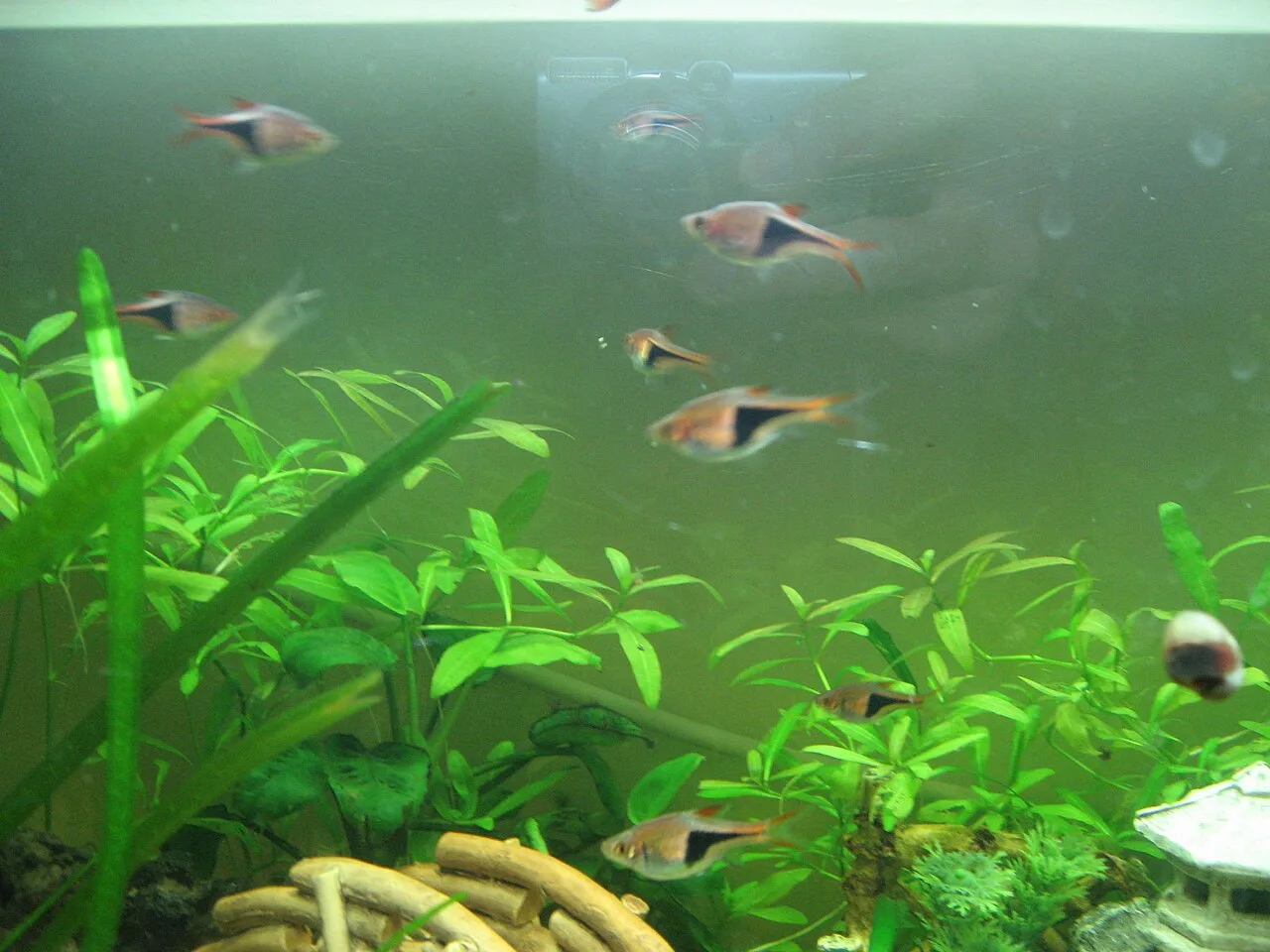
Trigonostigma espei reaches about 3 to 3.5 cm. The body is warm orange to copper, and the wedge is narrower than in the classic harlequin, T. heteromorpha. In a school the species looks like a small glow over a dark bottom. A single fish puts that effect out.
Females are deeper, males slimmer and often stronger in colour. The difference is easier in the school than on one fish in a net. Confusion with T. heteromorpha and T. hengeli is common in the trade. Body depth and the shape of the spot separate them, not the label at the till.
Origin & habitat
This describes the origin, not how to furnish the aquarium.
The species lives in soft, often acidic, humic waters in Thailand and Cambodia, in flooded forest and quiet side channels. That is not hard tap water, even though some captive-bred fish are more tolerant than wild ones.
A country note without a water polygon stays coarse. For the tank the water type matters: dim light, leaf litter and wood, not a bright gravel desert.
Care
Water
23 to 28 °C, pH 5.5 to 7, rather soft. Tanks from about 60 litres, a school from eight, better more. Floating plants dim the light. A fine, dark bottom and wood give the copper a background against which the fish can be seen at all.
Company
Other small, calm fish: celestial pearl danios, small tetras, pygmy corydoras, shrimp in a mature tank. Large barbs and cichlids eat or stress them. The species jumps. Cover the tank.
Diet
Fine prepared foods. The mouth is small. Flakes that are too large are spat out or ignored. Cyclops, brine-shrimp nauplii, dust-fine dry food and crushed frozen food fit.
The fish feed in midwater. A feeding of bottom tablets alone misses them.
Behavior
A close, quiet school. The fish do not form a ball, but they keep each other in sight. When startled they move together under the floating plants. Too few fish lose the band and stand singly at the glass.
Within the species they are peaceful. Male courtship is a display, not a fight across the whole tank.
Reproduction
The fish spawn on the underside of broad leaves, much like the harlequin. The male courts the female and turns her against the leaf. The parents do not guard the eggs and eat them if they can still reach them.
Breeding works in soft water with a separate setup and a suitable leaf, not beside a hungry school. The larvae are very small.
More species in this group

Sources & assertions 1
Wikipedia (deutsch)
Texte in Aquarisma sind eigenständig formuliert. Zahlenbereiche folgen den verlinkten Wikipedia-Artikeln, Lizenz CC BY-SA.
- Haltungsbereich nach https://de.wikipedia.org/wiki/Trigonostigma_espei