
Giant danio
Devario aequipinnatus
19 views
A large danio with steel-blue stripes. Maximum length is 12 to 13 cm.
2 min read · 217 words
Quick facts
The profile values are backed by one source.
Home & range
Every named country gets a frame and a circle around known waters in or near that area. Hotspots are orientation, not collection sites. A filled area is the range only when the source names a particular water body.
Overview
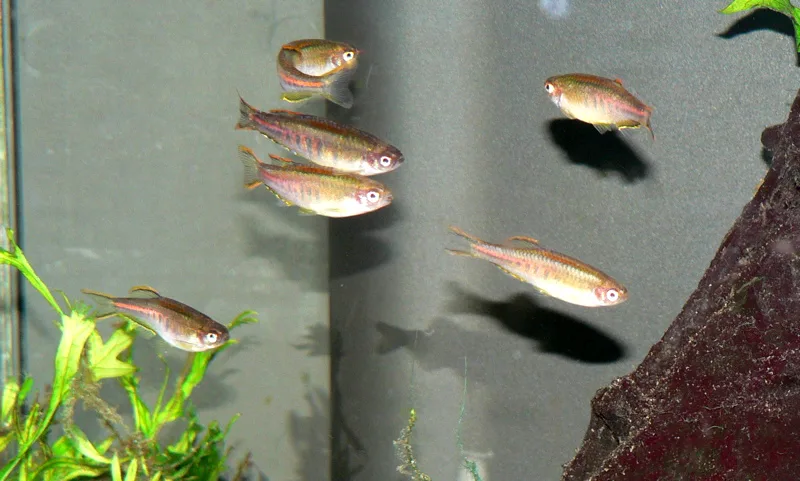
The body is long, compressed, and relatively deep at the front. Three or four steel-blue stripes, separated by narrow gold stripes, run onto the caudal peduncle. The back is steel blue to green-grey, the head silver, the iris gold. Females are duller and deeper. The mouth is slightly superior, with one pair of barbels on the upper jaw.
Origin & habitat
This describes the origin, not how to furnish the aquarium.
The cited section does not give an origin with coordinates.
Care
Maximum length is 12 to 13 cm. The tank has to match that length. No volume is given.
Large, and ready to jump
The giant danio reaches about 10 cm and is clearly livelier and larger than a zebrafish. 18 to 25 °C, pH 6.5 to 8, a school from eight, tanks from about 200 litres and 100 cm, with a firm cover. The fish jump accurately out of open gaps.
Small tetras and shrimp are harassed or eaten. Calm, medium-sized fish and a long swimming run fit. A short tank turns the species into permanent stress.
Diet
The cited section does not list a diet.
A substantial prepared food. The portions have to be large enough for the mouth and numerous enough that the fish at the back still find something.
Behavior
The cited section does not give a minimum group size.
Reproduction
Females are duller and deeper. A spawning protocol is not in the cited section.
More species in this group
Sources & assertions 1
Wikipedia (deutsch)
Texte in Aquarisma sind eigenständig formuliert. Zahlenbereiche folgen den verlinkten Wikipedia-Artikeln, Lizenz CC BY-SA.
- Haltungsbereich nach https://de.wikipedia.org/wiki/Malabarb%C3%A4rbling