
White cloud mountain minnow
Tanichthys albonubes
17 views
A small cyprinid from mountain streams in southern China and northern Vietnam. The article that was read describes cool water and groups of at least ten to twelve fish.
3 min read · 503 words
Quick facts
The profile values are backed by one source.
Home & range
Every named country gets a frame and a circle around known waters in or near that area. Hotspots are orientation, not collection sites. A filled area is the range only when the source names a particular water body.
Coarse origin
The circle sits around the country or, a little wider, around known waters there. The points are orientation, not collection sites.
- China The article names mountain streams north of Guangzhou and the island of Hainan. China is not filled as a country outline. Wikipedia deutsch
- Vietnam The article names a coastal river entering Ha Long Bay in Quảng Ninh Province. Vietnam is not filled as a country outline. Wikipedia deutsch
- China Coarse region of origin
- Vietnam Coarse region of origin
Overview
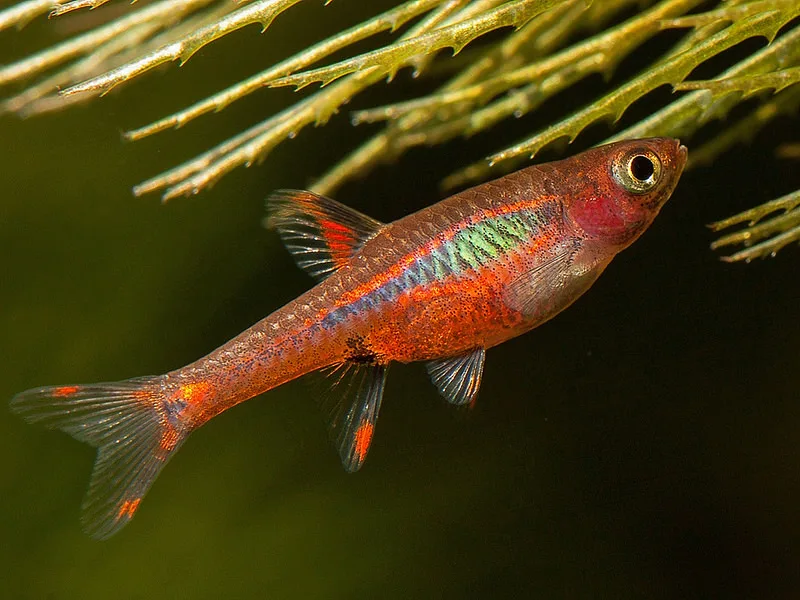
Tanichthys albonubes was described in 1932 by Lin Shuyan and named after Tan Kam Fei, who found the fish. The species name means “white cloud” and refers to Baiyunshan near Guangzhou. The body is brown-green to grey-green, with a paler belly and a noticeable longitudinal band. The fins are greenish or yellowish, with variable red and pale tips. A black spot sits at the base of the caudal fin, which itself can be red. Males are more strongly coloured. Females with eggs look fuller. Length is given as 2.5 to 3.5 cm. The lower jaw projects like a chisel, there are no barbels, and there is no lateral line. A longitudinal scale row is given as 30 to 32 scales. A 2020 genetic study separates eight groups inside fish previously treated under this name and proposes seven species that are hardly distinguishable by eye.
Origin & habitat
This describes the origin, not how to furnish the aquarium.
The main range lies near the Tropic of Cancer, north of Guangzhou: streams on Baiyunshan, the Huaxian area in Guangdong, and a coastal river entering Ha Long Bay in Quảng Ninh, Vietnam. Further reports concern Hainan. After 1980 the species was treated as lost in the wild. In September 2003 a small population was found again north of Guangzhou. Stocks near Hong Kong and Shenzhen may, according to the article, be extinct. The fish live in clear, slow, densely planted streams. Forest loss, erosion of irrigation banks and the diversion of streams for rice fields are named as threats. Reproduction in the wild is described as unproductive.
Care
The article prefers cool temperatures up to 20 °C and mentions tolerance below 5 °C. It gives pH 6 to 8 and hardness below 30. Prolonged keeping above 23 °C is linked with disease. The older sheet range of 16 to 22 °C is not the same statement as the preference up to 20 °C and remains the previous recommendation. Groups below 10 to 12 fish and tanks shorter than 60 cm are discouraged. The article does not state 60 litres. It asks for planted zones and open swimming space. Too many males in a small tank leads to rank fights. Only small, peaceful tankmates are described as suitable. A long-finned veil form exists. With suitable water and varied food the article mentions an age of up to nine years.
Diet
In streams the minnow eats plankton, meiobenthos and aquatic insect larvae. In aquaria it takes plant and animal foods, flakes, granules and frozen food that fits the small mouth. Cyclops and small daphnia are named specifically.
Behavior
The article describes no aggression toward other species, except toward young fish that may be treated as food. Males can fight over rank when the group is small or the tank is tight.
Reproduction
They are egg scatterers without brood care. A short rise in temperature can trigger spawning. Young hatch after 36 to 72 hours. Infusoria or dust food come first, then newly hatched Artemia after 12 to 14 days. Adults sometimes hunt their own brood even when they are well fed. Healthy groups can spend the summer in garden ponds. The article also mentions overwintering in a favourable site, without turning that into a general pond recommendation.
More species in this group

Sources & assertions 2
Wikipedia (deutsch)
Texte in Aquarisma sind eigenständig formuliert. Zahlenbereiche folgen den verlinkten Wikipedia-Artikeln, Lizenz CC BY-SA.
- Haltungsbereich nach https://de.wikipedia.org/wiki/Kardinalfisch
Wikipedia
Texte in Aquarisma sind eigenständig formuliert. Zahlen folgen dem genannten Artikel, Lizenz CC BY-SA. Deutsch und Englisch sind dieselbe Enzyklopädie, keine zweite unabhängige Quelle.
- Der Artikel bevorzugt Temperaturen bis 20 °C, nennt Verträglichkeit bis unter 5 °C und Erkrankungen bei längerer Haltung über 23 °C. Die veröffentlichte Spanne 16–22 °C bleibt stehen.
- Der Artikel nennt eine Länge von 2,5 bis 3,5 cm. Der ältere Steckbrief führte 4 cm.
- Der Artikel rät von Gruppen unter 10 bis 12 Tieren ab. Der ältere Steckbrief führte 8.