
Harlequin rasbora
Trigonostigma heteromorpha
11 views
A deep-bodied cyprinid from the Malay Peninsula and southeastern Thailand. Total length is two to two and a half centimetres.
3 min read · 493 words
Quick facts
The profile values are backed by one source.
Home & range
Every named country gets a frame and a circle around known waters in or near that area. Hotspots are orientation, not collection sites. A filled area is the range only when the source names a particular water body.
Coarse origin
The circle sits around the country or, a little wider, around known waters there. The points are orientation, not collection sites.
- Malaysia Wikipedia deutsch
- Thailand Wikipedia deutsch
- Malaysia Coarse region of origin
- Thailand Coarse region of origin
Overview
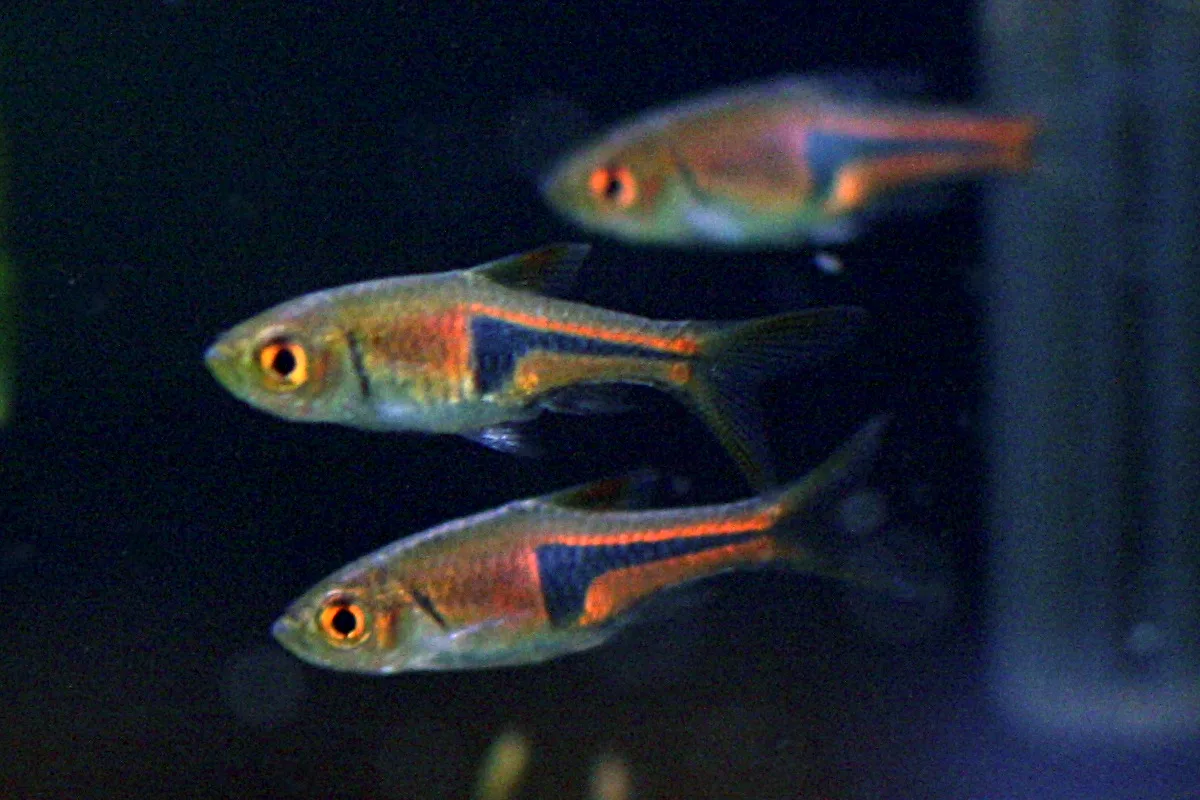
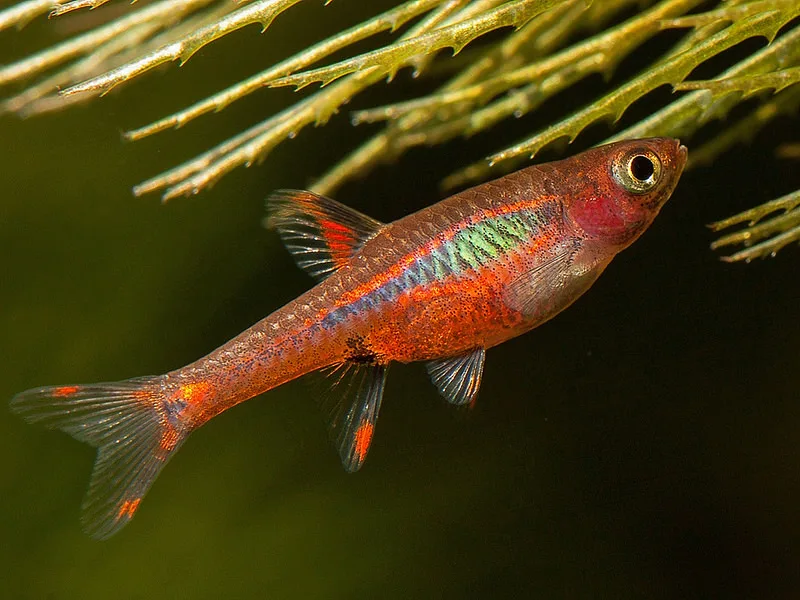
Trigonostigma heteromorpha is deep-bodied, broadest between the first rays of the dorsal and pelvic fins. The scales are relatively large. The ground colour runs from pale pink to copper red and is stronger on the head, back and caudal peduncle. Toward the belly it becomes silvery to white. The wedge starts below the dorsal origin. In females it ends at the caudal base. In males it continues as a dark point through the caudal fin. The male anal fin carries a dark streak that is hardly visible or absent in females. The mouth is upturned and the lateral line is incomplete. Kottelat and Witte erected the genus in 1999 because of the different spawning behaviour. Tang and colleagues in 2010 synonymised it, on mitochondrial DNA, with Rasbora in the broad sense. Kullander and colleagues argued on morphology for keeping the genus. FishBase and the Catalog of Fishes still list the species as Trigonostigma. The catalogue name here remains Trigonostigma heteromorpha.
Origin & habitat
This describes the origin, not how to furnish the aquarium.
Duncker described the species in 1904 from fish in a pond of the Singapore botanic garden. The range extends across the Malay Peninsula and southeastern Thailand. Ladiges named shaded, weedy streams. Total hardness there was below 3 °dGH. That is a measurement from the home streams and is not stored as an aquarium span of 0 to 3.
Care
The article states no aquarium temperature. Soft water is described as decisive for the development of the eggs. The first breeding anywhere succeeded only more than twenty years after the first import, because soft water was available. Fish sold today come from large farms in Thailand, Malaysia, Poland and the Czech Republic. There is a melanistic, a xanthoristic and a veil-finned form. The article dates the first live import to Europe at 1906, by Julius Reichelt in Berlin.
School and leaf
The harlequin stays small, about 4 to 4.5 cm, and only works in a school of eight or ten. 23 to 28 °C, rather soft, slightly acidic to neutral water, tanks from about 60 litres. Floating plants, a dark bottom, little bustle. The wedge-shaped mark is the character, not a disease spot.
The fish spawn on the underside of broad leaves. In a community tank that is a behaviour, not a breeding project. The parents eat the spawn as soon as they can reach it.
Diet
Insect larvae, copepods, other zooplankton and food taken from the surface.
Fine food that stays in midwater. Flakes that are too coarse are spat out. Cyclops and crushed frozen food fit better than a large granule made for barbs.
Behavior
According to the article harlequin rasboras are not schooling fish. They live in simply structured social groups. For spawning, males separate from the group.
Reproduction
Males court with spread fins, intense colour and jerky to dancing movements. Pairs form briefly. Females stick the eggs to the undersides of leaves, and only then does the male fertilise them. There is no further brood care, and the spawning site is not guarded. The other species of the genus share this spawning behaviour.
More species in this group
Sources & assertions 2
Wikipedia
Texte in Aquarisma sind eigenständig formuliert. Zahlen folgen dem genannten Artikel, Lizenz CC BY-SA. Deutsch und Englisch sind dieselbe Enzyklopädie, keine zweite unabhängige Quelle.
- Der Artikel nennt eine Gesamtlänge von zwei bis zweieinhalb Zentimetern.
Wikipedia (deutsch)
Texte in Aquarisma sind eigenständig formuliert. Zahlenbereiche folgen den verlinkten Wikipedia-Artikeln, Lizenz CC BY-SA.
- Haltungsbereich nach https://de.wikipedia.org/wiki/Keilfleckb%C3%A4rbling