
Long-finned tetra
Brycinus longipinnis
1 view
A West African tetra whose males carry a long filament on the dorsal fin. It grows larger than many expect.
- Temperature
- 22 – 26 °C
- pH
- 6 – 7.5 pH
- General hardness
- 4 – 15 °dH
- Maximum size
- 13 cm
- Minimum group size
- 6
- Minimum tank size
- 250 L
2 min read · 196 words
Quick facts
Place in the aquarium
Highlighted are the water layer and the spots where the species usually stays in the tank.
- Upper water Usually stays in the top third of the tank.
- Middle water Usually stays in the middle of the tank, between bottom and surface.
- Open swimming space Needs an open area without plants or decor to swim at length. Tank length matters more than height.
Shrimp in the tank
Dwarf shrimp at risk
- Not shrimp safe
- Dwarf shrimp at risk
- Shrimplets at risk
- Shrimp safe
- Adult dwarf shrimp
- At risk
- Shrimplets
- Get eaten
- Safe from shrimp size
- about 4 cm
The long-finned tetra is not suitable for dwarf shrimp. At about 13 cm it eats insects, larvae and small crustaceans. Neocaridina and Caridina are eaten, and juveniles straight away. Larger shrimp from about 4 cm are usually safe if they have hiding places.
Anyone who wants to combine the two chooses sturdy, large shrimp and plenty of wood and stone on the bottom. Dwarf shrimp belong in a tank of their own.
Home & range
Hatched countries are where the species occurs. It lives in particular waters there, not across the whole country. The points name known waters for orientation, not collection sites.
- Country of origin
- Water for orientation
Native
Overview
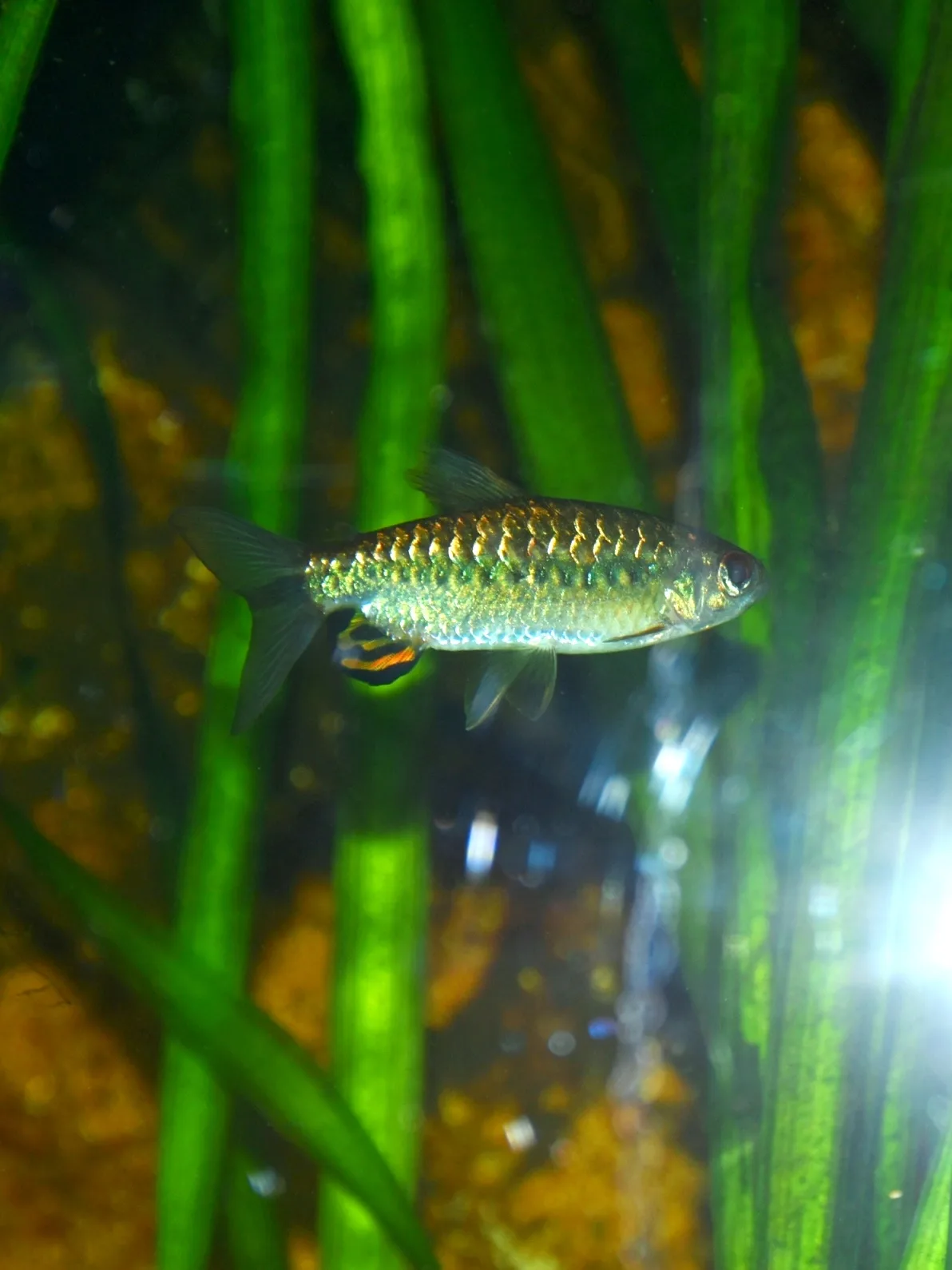
Brycinus longipinnis reaches about 13 cm. The body is silvery. A dark band runs to the tail base, and the tail fin is yellow to orange with a dark centre. Males carry an extended filament on the dorsal fin. Females are deeper-bodied and shorter-finned. Newer classifications list the species as Bryconalestes longipinnis. It is the same species.
It is not a small community tetra. Its size and speed call for a long tank.
Origin & habitat
This describes the origin, not how to furnish the aquarium.
Coastal rivers and streams in West Africa. The countries stay a coarse origin. Clear, flowing water and length match that.
Care
Length
22 to 26 °C, pH 6 to 7.5. A group from six, tanks from about 250 litres and 120 cm. Moderate current, plants at the edge, a tight cover.
Company
Calm fish of the same size. Small tetras, dwarf shrimp and slow, long-finned fish do not fit.
Diet
Omnivore with a taste for insects. Mosquito larvae, brine shrimp, granules, flakes. Vegetables and plant food are taken too.
Behavior
A peaceful school with small scuffles among males. The species jumps when frightened. Too few fish stay shy.
Reproduction
Egg scatterer. The eggs are large and fall into plants. A separate spawning tank without the parents is the way to young.
Gallery
More species in this group



Similar water needs
Species with a similar temperature, a similar pH and a comparable adult size. Whether their behaviour fits as well is what the compatibility check is for.
