Black neon tetra
Hyphessobrycon herbertaxelrodi
31 views
A slender tetra from Mato Grosso with a pale-blue and a black longitudinal band. It is not closely related to the neons of the genus Paracheirodon.
- Temperature
- 23 – 27 °C
- pH
- 5.5 – 7.5 pH
- General hardness
- 2 – 12 °dH
- Maximum size
- 4 cm
- Minimum group size
- 8
- Minimum tank size
- 54 L
3 min read · 444 words
Fresh water
Quick facts
Place in the aquarium
Highlighted are the water layer and the spots where the species usually stays in the tank.
- Middle water Usually stays in the middle of the tank, between bottom and surface.
- Dense plants Looks for dense planting as cover, retreat or grazing ground.
Shrimp in the tank
Shrimplets at risk
- Not shrimp safe
- Dwarf shrimp at risk
- Shrimplets at risk
- Shrimp safe
- Adult dwarf shrimp
- Safe
- Shrimplets
- Get eaten
- Safe from shrimp size
- about 1.5 cm
Adult dwarf shrimp are safe with the black neon tetra. Females reach about 4 cm, males stay smaller, and the mouth is small. The diet includes worms, small crustaceans and plant matter. Shrimp from about 1.5 cm no longer count as prey, but newly hatched young do. In a community tank only a few juvenile shrimp survive.
With dense moss, fine-leaved plants and leaf litter on the bottom, enough young grow up to keep a colony of Neocaridina or Caridina going.
Home & range
Hatched countries are where the species occurs. It lives in particular waters there, not across the whole country. The points name known waters for orientation, not collection sites.
- Country of origin
- Water for orientation
Native
- Brazil
- Range: the upper Río Paraguay basin and other waters of Mato Grosso.
Overview
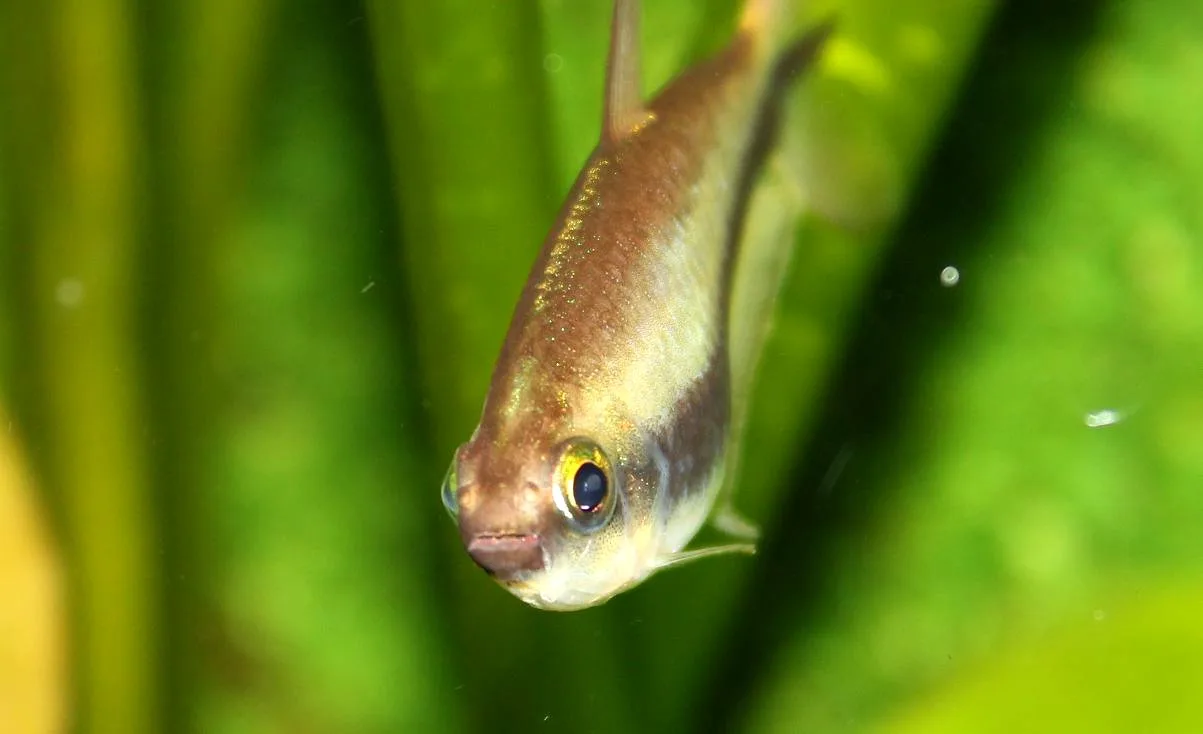
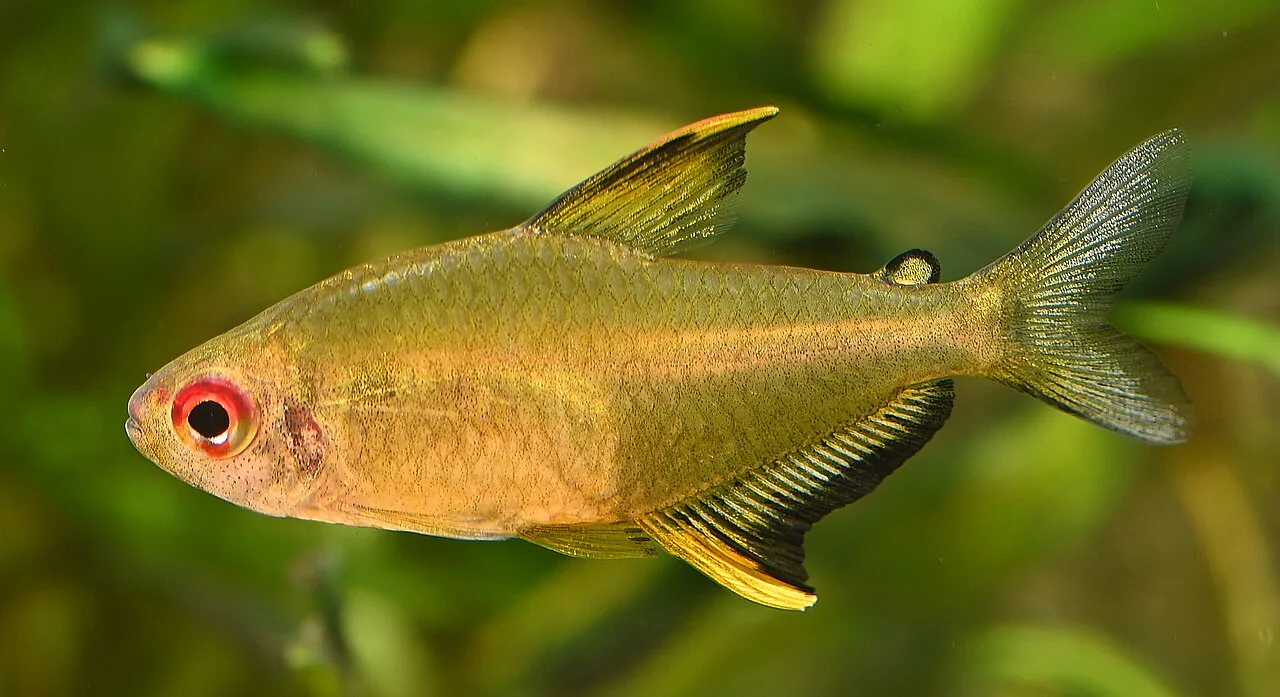
Hyphessobrycon herbertaxelrodi was described in 1961 by Jacques Géry and named after Herbert R. Axelrod. Females reach 4 cm. Males stay smaller and slimmer, with a less curved belly line. The back is grey-brown, dark scale edges form a fine net, and the belly is silvery. Two bands run from the gill cover to the caudal base: above, an iridescent pale blue or grass green to yellow-green, and below a deep black band that is blurred downward. The black band continues onto the middle caudal rays. The dorsal fin is short and high, the anal fin long. The upper iris is red, the lower iris greenish. The fins are transparent with a yellowish sheen. The genus Hyphessobrycon is not monophyletic. The black neon sits in the group of elongated fish with a dark stripe named after H. agulha. That group is itself intertwined with the heterorhabdus group.
The species is also called Schwarzer Flaggensalmler. The dorsal fin has 2 simple and 9 branched rays, the anal fin 4 simple and 21 branched. The middle longitudinal row has 32 to 34 scales, 7 to 8 of which accompany the incomplete lateral line. Members of the agulha group include H. agulha, H. loretoensis, H. margitae, H. peruvianus and H. zoe.
Origin & habitat
This describes the origin, not how to furnish the aquarium.
The species lives in the upper Río Paraguay basin and other waters of Mato Grosso. That is Brazil as a coarse origin, not an outline of the whole country and not automatically the country Paraguay.
Care
In aquaria the fish stay in the middle and upper layers. The first import for keeping was in 1960. Today mostly captive-bred fish are sold.
Group
The black neon is a slender tetra that shows the pale blue band above the black stripe only in a group. Females reach about 4 cm. Males stay smaller and slimmer. 23 to 27 °C, pH 6 to 7.5, tanks from about 80 litres, a school from eight. Dim light and a dark bottom make the pattern readable. In a bare, glaring tank it looks grey.
It is peaceful and stands in midwater. Fast barbs take the food from it. Corydoras below do not bother it.
Diet
The food consists of worms, small crustaceans and plant material.
Fine prepared foods, flakes, granules and small frozen food. Several small portions. The mouth is small. Food that is too coarse is ignored, and the fish thin out even though the tank is being fed.
Behavior
Black neons are group fish. They tend to form a school especially when threatened from outside.
Reproduction
Like other Hyphessobrycon they are egg scatterers. After vigorous driving they spawn just below the surface. Larvae hatch after 24 to 30 hours, depending on temperature. Aquarium breedings often produce a surplus of males. Males become sexually mature only after more than a year.
Gallery
More species in this group





Similar water needs
Species with a similar temperature, a similar pH and a comparable adult size. Whether their behaviour fits as well is what the compatibility check is for.