Blackwing hatchetfish
Carnegiella marthae
17 views
A hatchetfish of 3 to 3.5 cm. Not the marbled hatchetfish Carnegiella strigata.
- Temperature
- 24 – 28 °C
- pH
- 5 – 6.5 pH
- General hardness
- 1 – 8 °dH
- Maximum size
- 3.5 cm
- Minimum group size
- 5
- Minimum tank size
- 80 L
2 min read · 311 words
Fresh water
Quick facts
Place in the aquarium
Highlighted are the water layer and the spots where the species usually stays in the tank.
- Water surface Stays just below the surface. The top needs a calm current and a cover.
Shrimp in the tank
Shrimplets at risk
- Not shrimp safe
- Dwarf shrimp at risk
- Shrimplets at risk
- Shrimp safe
- Adult dwarf shrimp
- Safe
- Shrimplets
- Get eaten
- Safe from shrimp size
- about 1 cm
The black-winged hatchetfish is harmless to adult shrimp. It reaches only 3 to 3.5 cm and feeds mainly on insects that fall onto the water surface, plus small insect larvae just below it. It hardly searches the bottom for food. Shrimp from about 1 cm are safe. Juvenile shrimp are only at risk when they swim up to the surface.
The species goes well with dwarf shrimp, because the two use different zones. Moss and fine plants on the bottom keep the young out of reach as well.
Home & range
Hatched countries are where the species occurs. It lives in particular waters there, not across the whole country. The points name known waters for orientation, not collection sites.
- Country of origin
- Water for orientation
Native
Overview
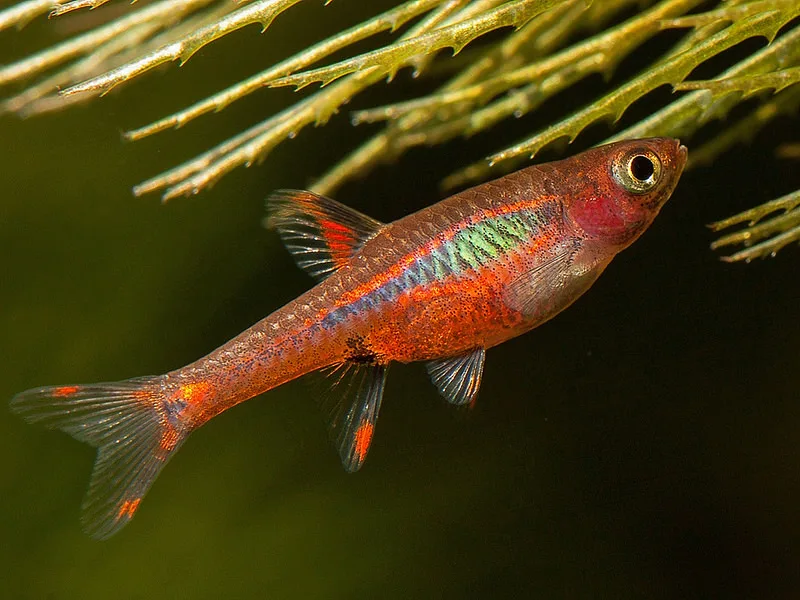
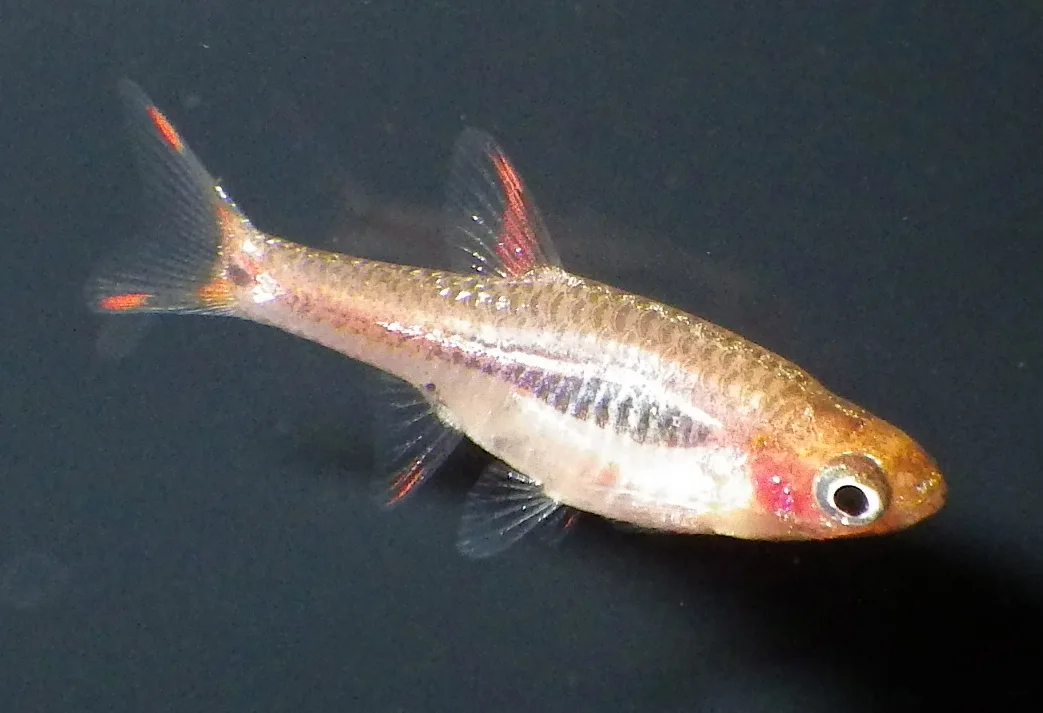
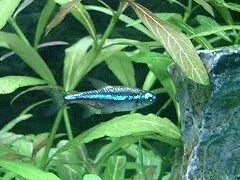
Strongly curved belly, straight back, superior mouth. Silver flanks with fine dark diagonal lines, pectoral fins slightly dark grey. Carnegiella schereri lacks that dark chest.
Systematics
George Sprague Myers described the species in 1927. It belongs to the freshwater hatchetfishes (Gasteropelecidae). The name comes from the slight dark grey tint of the pectoral fins. Carnegiella schereri is a close relative. According to a molecular study by Abe and colleagues from 2013, C. marthae sits within the species swarm around the marbled hatchetfish C. strigata. It is more closely related to the strigata population at Barcelos in north-western Brazil than to the population in the state of Acre.
Confusion
The marbled hatchetfish lives in the same area. Laypeople often take it for C. marthae. Conversely, the species usually reaches the trade as bycatch of the marbled hatchetfish and is then often sold under that name. C. schereri lacks the dark tint of the pectoral fins, and its fine lines are weaker.
Origin & habitat
This describes the origin, not how to furnish the aquarium.
Brazil and Venezuela in the northern Orinoco and Rio Negro, plus Peru and Bolivia. The four countries stay coarse. The waters are very soft and acidic to very acidic, mostly 23 to 27 °C. That is the habitat, not a care optimum.
The species lives in smaller flowing waters of the Amazon basin. It prefers the open water surface near dense stands of plants.
Care
From 60 cm tank length, not converted to litres, groups from five, an open surface, dense marginal plants or overhanging roots, a light current, a covered tank. Described as the most sensitive hatchetfish. Planned breeding has not succeeded, so the trade is wild-caught.
Water values and diet should follow natural conditions. In larger groups the fish show their sociable behaviour.
Diet
Insects that fall on the surface and small insect larvae. After settling in, also fine dry food.
Reproduction
Peaceful, gregarious, at the surface. It jumps when the tank is handled hastily.
More species in this group






Similar water needs
Species with a similar temperature, a similar pH and a comparable adult size. Whether their behaviour fits as well is what the compatibility check is for.