Wine-red betta
Betta coccina
21 views
A small blackwater betta. The males are wine-red. Soft, acidic water and a quiet tank are the keeping, not a veil fight in a glass.
- Temperature
- 24 – 28 °C
- pH
- 4.5 – 6.5 pH
- General hardness
- 1 – 8 °dH
- Maximum size
- 4 cm
- Minimum tank size
- 30 L
5 min read · 683 words
Fresh water
Quick facts
Place in the aquarium
Highlighted are the water layer and the spots where the species usually stays in the tank.
- Water surface Stays just below the surface. The top needs a calm current and a cover.
- Dense plants Looks for dense planting as cover, retreat or grazing ground.
Shrimp in the tank
Dwarf shrimp at risk
- Not shrimp safe
- Dwarf shrimp at risk
- Shrimplets at risk
- Shrimp safe
- Adult dwarf shrimp
- At risk
- Shrimplets
- Get eaten
- Safe from shrimp size
- about 3 cm
The wine-red betta is a risk for dwarf shrimp. It grows 5 to 6.8 cm long and in the wild eats small crustaceans, insect larvae and insects that fall into the water. Crustaceans are thus explicitly part of its prey. Juvenile shrimp are eaten, and small adult dwarf shrimp too, depending on the individual. Larger shrimp from about 3 cm are usually safe.
The species needs very soft, acidic blackwater, in which Neocaridina do poorly. If at all, larger soft-water shrimp with plenty of hiding places in leaf litter fit.
Home & range
Hatched countries are where the species occurs. It lives in particular waters there, not across the whole country. The points name known waters for orientation, not collection sites.
- Country of origin
- Water for orientation
Native
Overview
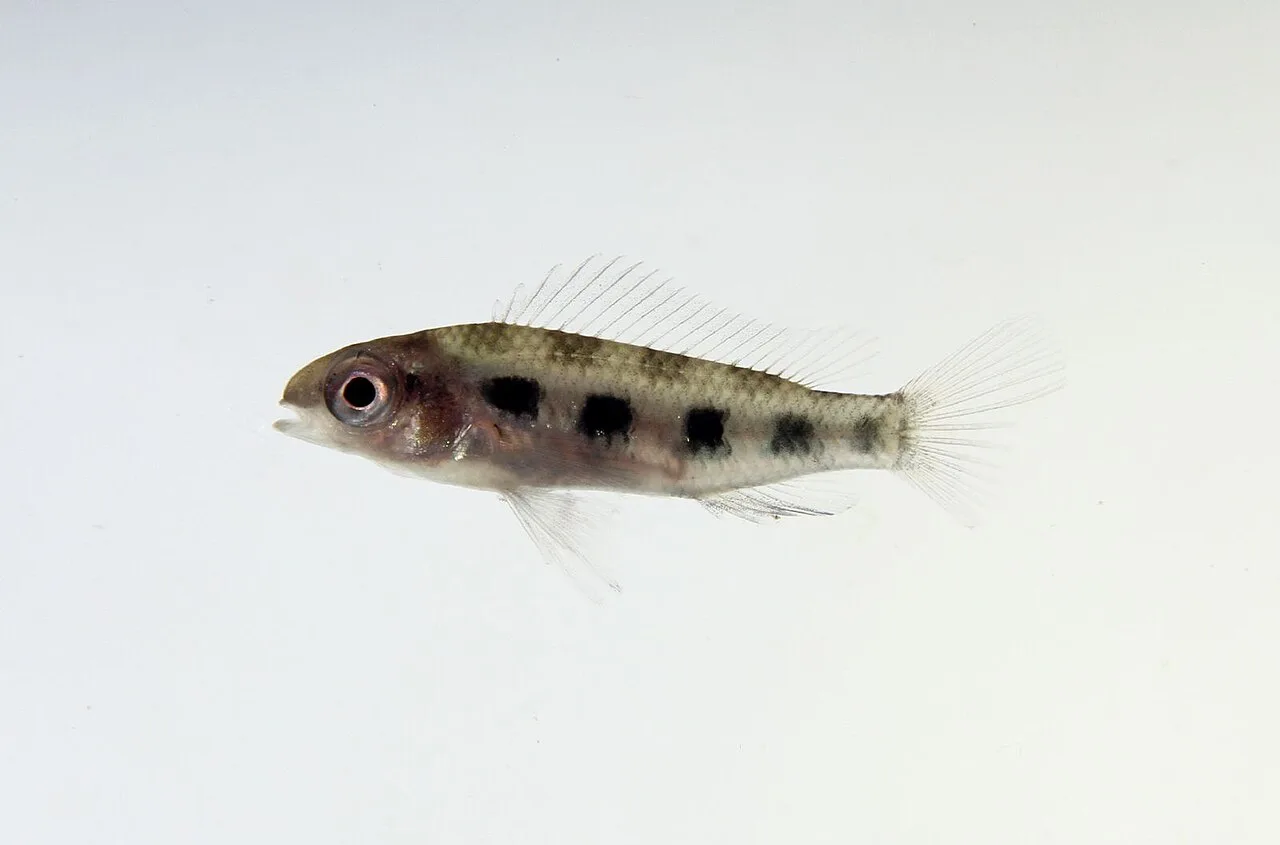
Betta coccina stays at about 4 cm. The males are deep wine-red with a dark spot in the middle. The females are paler and with a clearer spot. The fins are short, not veiled. The species is shy, stands among leaves and litter and takes air at the surface.
It is not Betta splendens. Crosses should not be passed on as this species. Hard, bright water lets the colour fade and the fish struggle.
Description and relatives
Jörg Vierke described the species in 1979 in the magazine Das Aquarium from aquarium fish. The locality in Jambi Province on Sumatra was learned only later by asking the importer. Later imports came mostly from the Malay Peninsula, especially around Muar. Betta livida, described from there, cannot be separated from B. coccina by classical or molecular methods. Together with B. brownorum, B. burdigala, B. hendra, B. miniopinna, B. persephone, B. rutilans, B. tussyae and B. uberis the species forms a complex of very similar species.
Figures for total length range from 4 to 6.8 cm, in both sexes. The body is slender and cylindrical. Depending on mood the ground colour is dull to strong wine red. Dorsal and caudal fins are edged white, and small metallic green spots appear in the dorsal, caudal and anal fins. The gill covers carry two red spots, which can glow golden in females. Under certain conditions and during courtship three dark longitudinal stripes become visible. The clearest sex difference is the slightly larger fins of males. Fish from the Selangor forest always have bright white pelvic fin tips.
Origin & habitat
This describes the origin, not how to furnish the aquarium.
Peat swamps and blackwater on the Malay Peninsula and Sumatra. Acidic, soft, warm, dark. The origin stays coarse.
The species lives in lowland flood zones and swamps, mainly in small standing and remnant waters, and in flowing waters only in densely vegetated calm areas. The water comes from swamp and peat forests on very mineral-poor soils: blackwater without measurable hardness and a pH well below 5. Animal food is scarce there. On the west coast of the Malay Peninsula the range extends from Selangor to the south of Ayer Hitam.
Care
Water
24 to 28 °C, pH 4.5 to 6.5, very soft. From about 30 litres for a pair, with leaf litter, fine plants, floating plants, almost no current and warm air above the water. One male alone is the simplest keeping. Two males need separate zones.
Company
Best the species alone, or with equally small, acid-loving fish. Barbs and lively tetras, no. Shrimp can work, but are sometimes eaten.
The species is a fish for ichthyologists and specialist aquarists.
Conservation breeding
In 1996 the Malay Peninsula population became the first international studbook for a fish, set up by the International Community of Labyrinth Fishes with support from Cologne Zoo. Coordinator Robert Donoso-Büchner ended the project in 2006 because only the phenotype could be preserved. The habitats are heavily threatened by the rapid spread of oil palm plantations.
Diet
Fine live and frozen food. Brine shrimp, mosquito larvae, cyclops. Dry food only as a supplement and small. The food has to arrive at the top and among the leaves.
In the wild the species eats small crustaceans, insect larvae and insects that fall into the water.
Behavior
Quiet and hidden. The wine-red colour comes in dim light. A pale fish in a glaring tank is often only without cover. Constant chasing of a female means the retreat is missing.
Reproduction
A bubble nest, often small and under a leaf. The male guards. The larvae are tiny. Rearing needs a separate tank and infusoria.
Courtship and nest
The bright red colour appears only when a pair has formed and spawning is being prepared. The male builds a fairly large bubble nest under or between floating material such as leaves, twigs or algae and leads the female beneath it. The circling typical of labyrinth fishes follows. The female lays a few eggs into her folded pelvic fins, and the male fertilises them at once. Both partners pick up the eggs with their mouths and spit them into the nest. The male then guards the nest for two to three days until the larvae swim freely.
More species in this group

Similar water needs
Species with a similar temperature, a similar pH and a comparable adult size. Whether their behaviour fits as well is what the compatibility check is for.