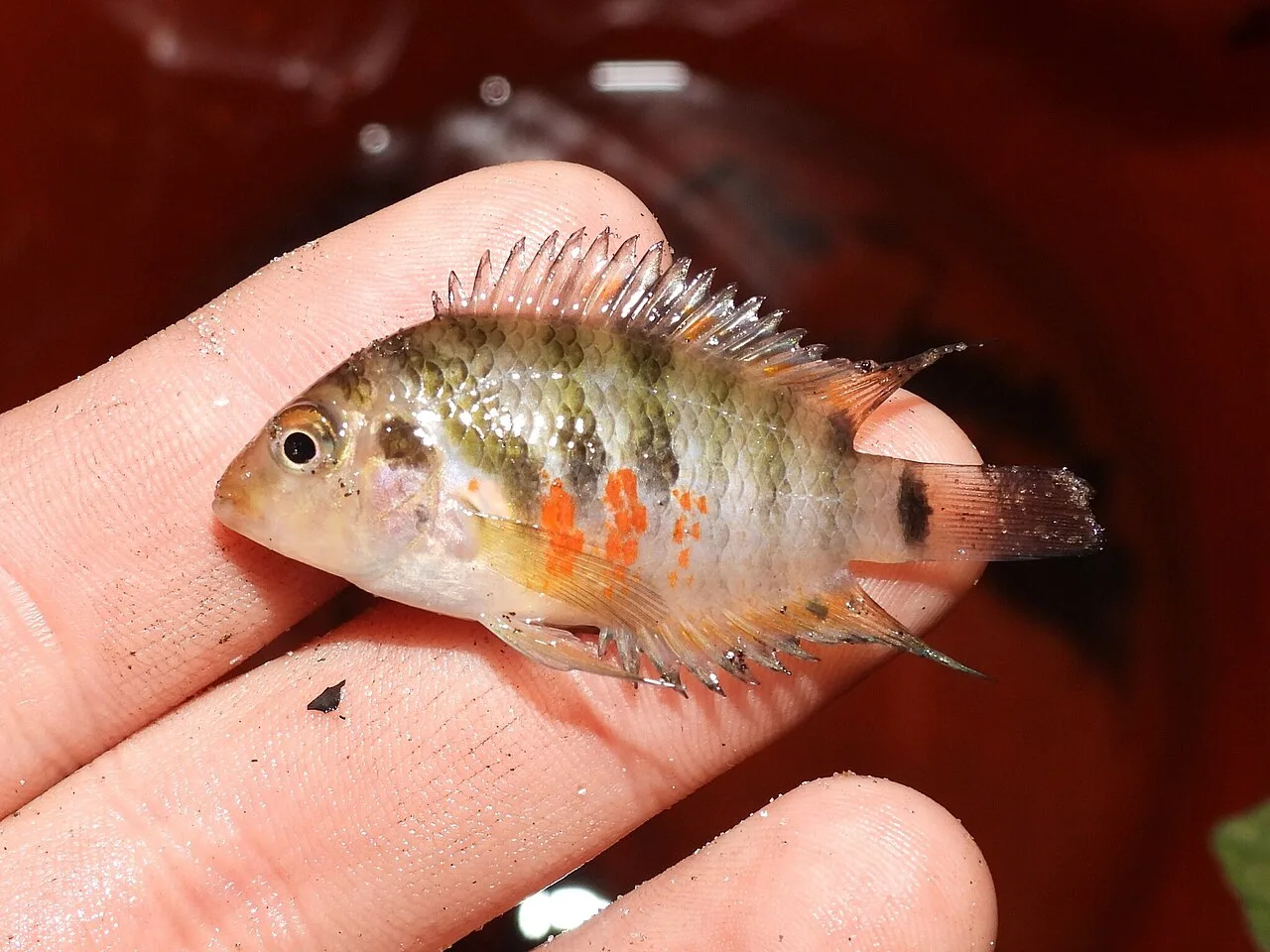
Kissing gourami
Helostoma temminckii
23 views
A large labyrinth fish with thick lips. The kissing is a trial of strength, and the species grows far beyond the pink juvenile in the sales tank.
- Temperature
- 24 – 28 °C
- pH
- 6.5 – 8 pH
- General hardness
- 5 – 30 °dH
- Maximum size
- 20 cm
- Minimum tank size
- 300 L
6 min read · 1,015 words
Fresh water
Quick facts
Further published values
- Lifespan
- 5 – 7 a
Place in the aquarium
Highlighted are the water layer and the spots where the species usually stays in the tank.
- Upper water Usually stays in the top third of the tank.
- Middle water Usually stays in the middle of the tank, between bottom and surface.
- Open swimming space Needs an open area without plants or decor to swim at length. Tank length matters more than height.
Shrimp in the tank
Shrimplets at risk
- Not shrimp safe
- Dwarf shrimp at risk
- Shrimplets at risk
- Shrimp safe
- Adult dwarf shrimp
- Safe
- Shrimplets
- Get eaten
- Safe from shrimp size
- about 2 cm
Despite its size the kissing gourami is hardly dangerous for adult dwarf shrimp. It grows to 30 cm but mainly filters plankton with its modified gills and rasps growth off surfaces. It cannot even use larger insect larvae. Shrimp from about 2 cm are therefore usually safe. Young shrimp, however, easily end up in its food while it grazes plants and glass. The large tanks this species needs offer enough refuge for the young with moss and wood.
Home & range
Hatched countries are where the species occurs. It lives in particular waters there, not across the whole country. The points name known waters for orientation, not collection sites.
- Country of origin
- Water for orientation
Native
Overview
Helostoma temminckii often reaches 20 cm in the aquarium, and more in the wild. The wild form is green-grey with dark longitudinal stripes. The pink form is cultivated and sometimes stays a little smaller, without becoming a fish for 60 litres. The lips carry fine teeth and are used to rasp aufwuchs. Two fish locking lips are measuring strength. They are not kissing.
The mouth cannot be protruded like that of many other labyrinth fish. The animals work surfaces: glass, leaves, wood. Soft plants count as a surface.
Body
The kissing gourami was the first labyrinth fish farmed in ponds as a food fish and reaches up to 30 cm total length. The body is clearly compressed. Juveniles are elongated, adults deep-bodied. Small movable teeth sit only on the thick lips, and the mouth and throat are otherwise toothless. This sets the species apart from all other labyrinth fish. Narrow dark longitudinal stripes run evenly over the silvery, grey or slightly olive base colour, and a ring of the same colour surrounds the base of the tail fin. There are no external sex differences, and ripe females can be recognised by their fullness.
The pale variety
The white to pink form probably arose in pond farming. It is xanthistic: through a recessively inherited defect it lacks the dark pigment melanin, and its colour comes from yellow and red pigments. This removes the ability to change colour. Even so the variety behaves like the wild form, interbreeds with it and even persists in natural waters.
Name and classification
Kuhl and van Hasselt mentioned the genus in 1823 from Java as Helostoma striolatum, but their letters did not meet the requirements of a species description. Helostoma temminkii Cuvier 1829, originally described only in a footnote, is therefore valid. Helostoma means hump mouth, from the Greek helos for hump or wart and stoma for mouth. The species name honours Coenraad Jacob Temminck. The spelling temminkii without c is regarded as the valid one.
Origin & habitat
This describes the origin, not how to furnish the aquarium.
Still and slow waters in Thailand, Malaysia and the Greater Sunda Islands, often turbid, warm and plant-rich, out into flooded ground. The species is also farmed as a food fish in Asia. That explains the adult size better than the aquarium trade.
The countries stay a coarse origin. The habitat is warm and low enough in oxygen that the labyrinth matters, and large enough that several fish can keep a distance.
Because the species has long been bred in village ponds and fish farms, its exact origin can hardly be traced. Today its range extends over Thailand with many islands, the Malay Peninsula and the Greater and Lesser Sunda Islands. Introduced populations also live in the Philippines, Papua New Guinea, Australia, Colombia and the Caribbean. It settles shallow banks of quiet side arms, standing waters and, after the rainy season, floodplains with high temperature, plenty of sun and abundant nutrients.
Care
Size
24 to 28 °C, pH 6.5 to 8. Tanks from about 300 litres and 140 cm for a small group of half-grown fish, more for adults. Little current, an open surface, tough plants or a deliberate choice to skip soft stems. Rock and wood as rasping surfaces. A group raised together is more peaceful than two adults combined later.
Company
Large, calm fish. Small tetras are eaten or constantly pushed by the lips. Other labyrinth fish with long fins lose those fins. The kissing gourami is a fish for a large plan of its own, not the gap-filler in a community tank.
Diet
Aufwuchs, plants and added food. Plant flakes, blanched vegetables, algae and a share of frozen food. The fish feed through the day. A single meal leaves them working on the plants even when they look full.
They are not pure vegetarians. An animal share belongs in the diet. The bulk stays plant-based.
The gills are largely useless for breathing and have become a fine filter system with which the fish strain phyto- and zooplankton. Plankton makes up most of the natural diet. With their protrusible lips they suck tiny organisms out of algae growth and rasp at leaves. Even larger insect larvae cannot be used.
Behavior
Social in a large water, keen to measure strength in a small one. The lip-lock lasts seconds to minutes. In a tank that is too small it becomes permanent stress. The fish stand with clamped fins and stop feeding. In a fitting tank it is a short ritual and then joint grazing again.
The pink form is not tamer. It is only more conspicuous.
Mutual pushing with protruded lips is a mildly aggressive ritual behaviour. Kissing the partner on the mouth, flanks and belly is, however, also part of courtship. The fish do not form pairs but larger social groups.
Reproduction
Egg scatterer with floating eggs. The parents do not guard them. A large clutch in soft plant growth, then remove the parents, or the spawn is the food. Rearing needs space and a mass of fine food. That is a matter for large tanks, not a living-room community tank.
Sexes are uncertain on the living fish. For a group that does not matter.
Spawning without brood care
In nature the fish spawn after the rainy season. Male and female bond only briefly for courtship and spawning, which can also take place in the middle of a group. The partners embrace while turning. Each spawning phase produces several thousand very small yellowish eggs, which are lighter than water, drift to the surface and stick to stems and leaves. The tiny larvae hatch within a day and live on their yolk for several days before eating the finest plankton and infusoria.
Importance as a food fish
In South-East Asia the fish is boiled, breaded, fried and baked and mostly sold alive at markets. It is raised mainly in village ponds, rice fields and fish farms. The FAO recorded almost 16,000 tonnes caught and around 4,000 tonnes farmed in 2007. For the aquarium trade tens of thousands of juveniles are bred each year in Thailand and Malaysia. Dye-injected fish and a balloon gourami with a deformed spine are produced solely for the ornamental trade.
Gallery
More species in this group
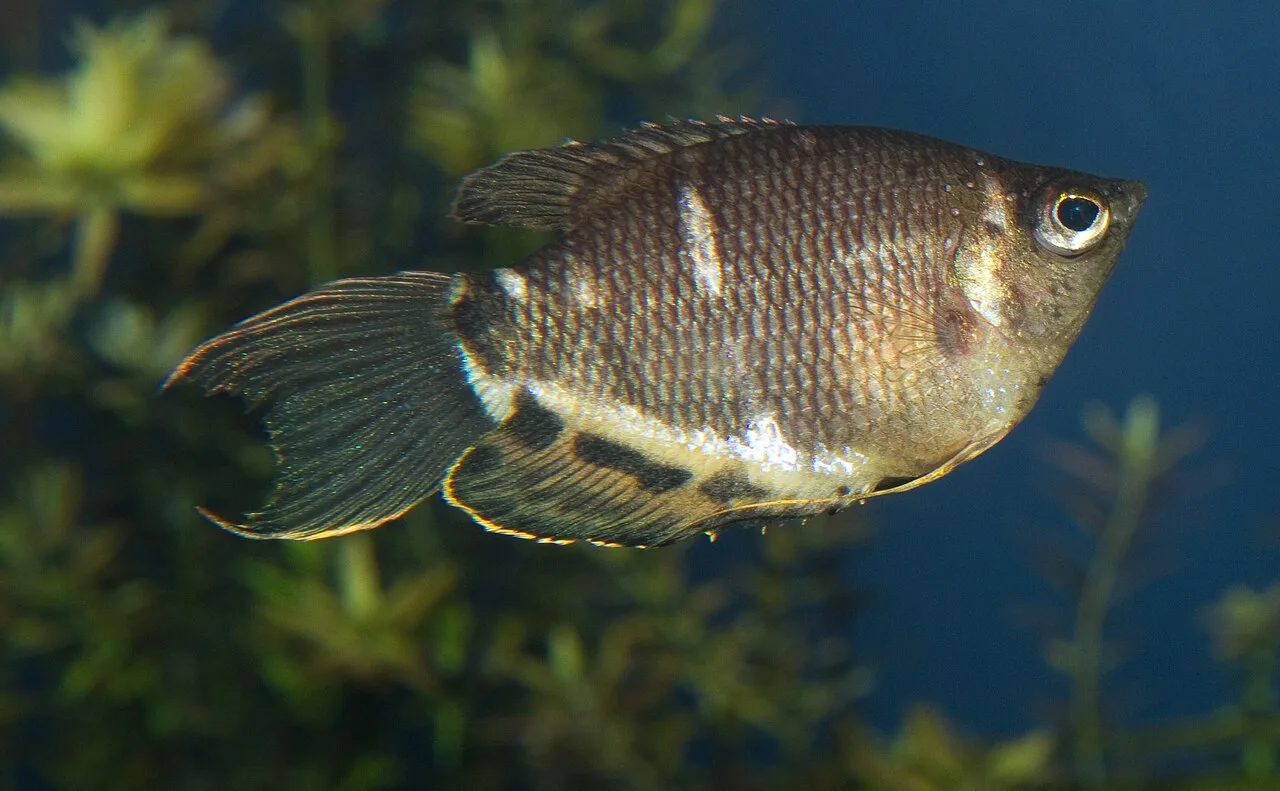
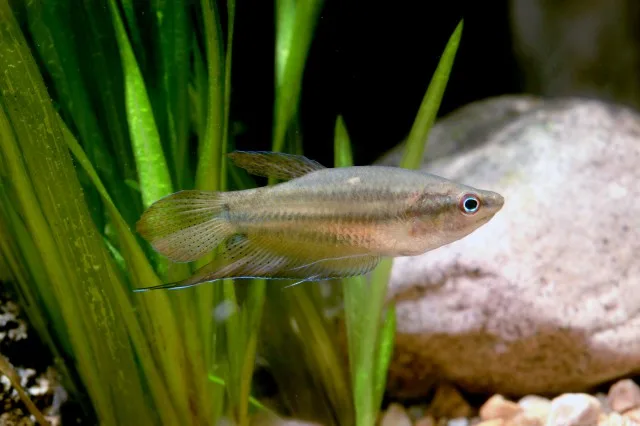
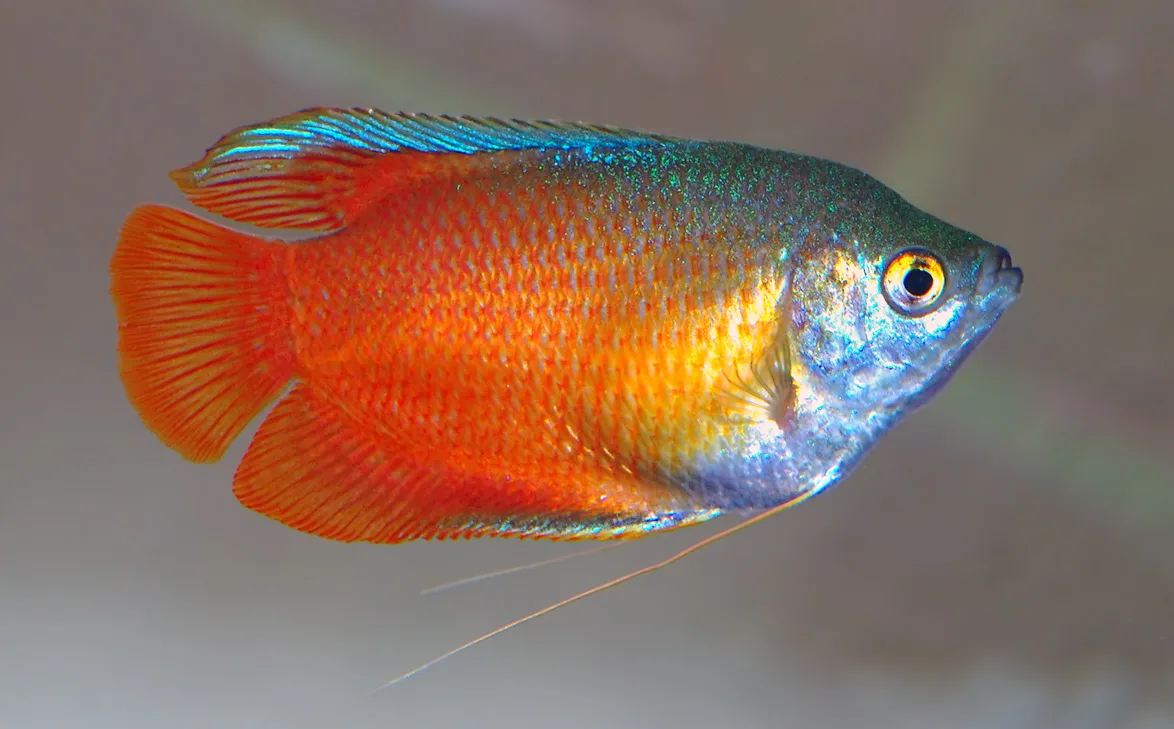

Similar water needs
Species with a similar temperature, a similar pH and a comparable adult size. Whether their behaviour fits as well is what the compatibility check is for.