
Neon dwarf rainbowfish
Melanotaenia praecox
17 views
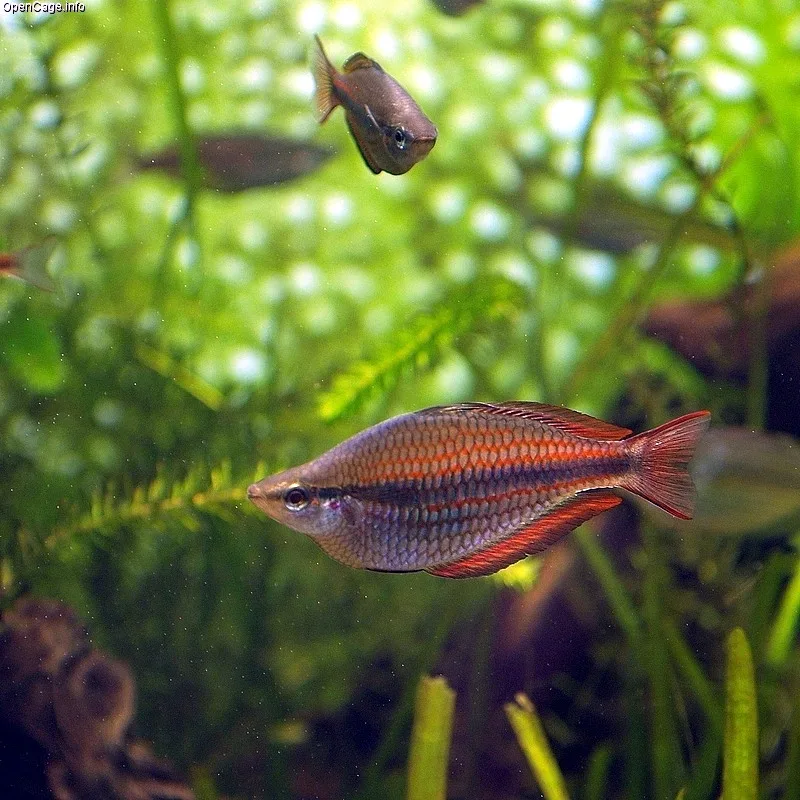
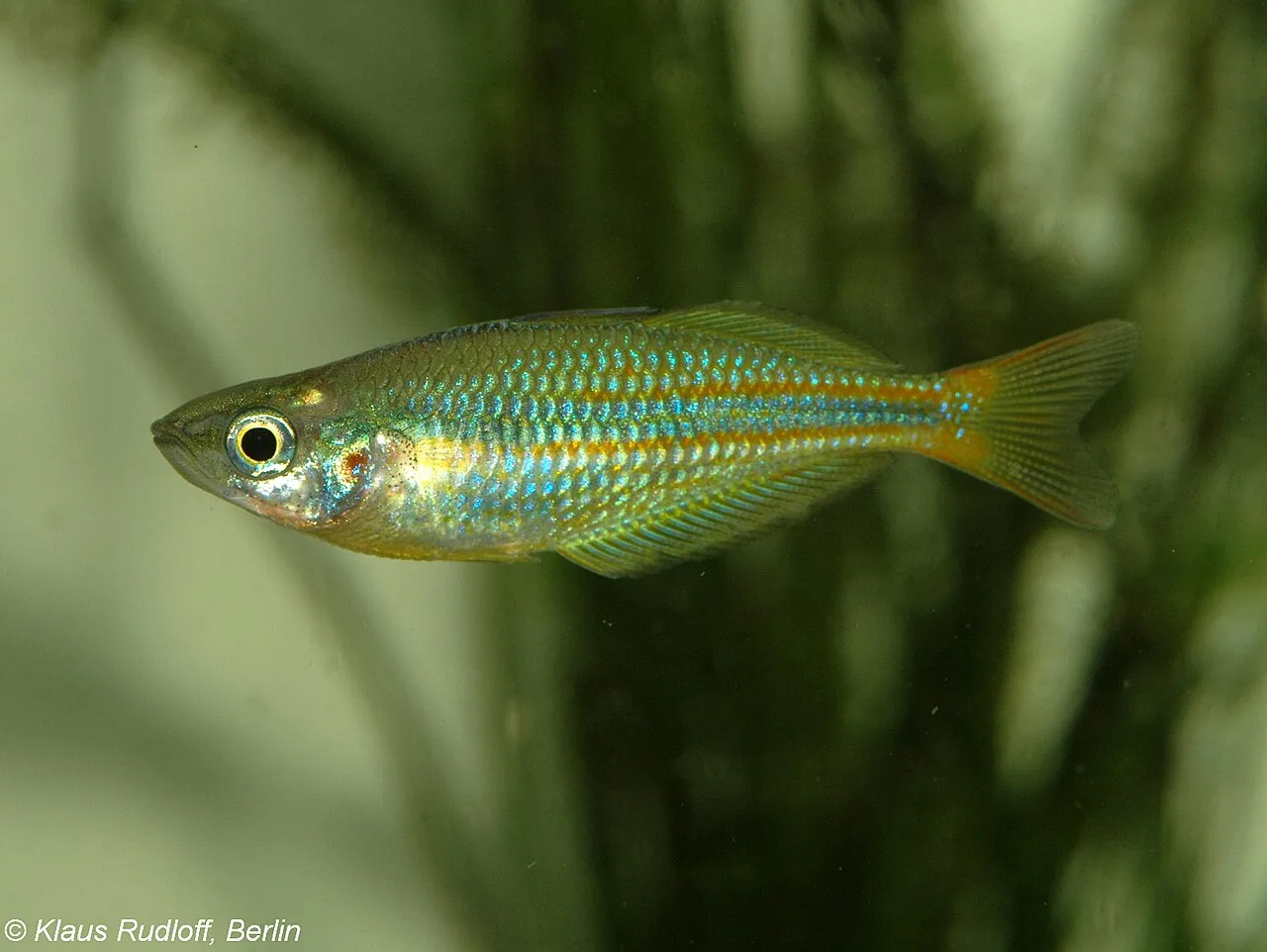
A small rainbowfish with a neon-blue body and red fins. Length is 6 cm, rarely up to 8 cm.
- Temperature
- 22 – 28 °C
- pH
- 6 – 8 pH
- General hardness
- 5 – 15 °dH
- Maximum size
- 8 cm
- Minimum group size
- 6
- Minimum tank size
- 60 L
3 min read · 489 words
Fresh water
Quick facts
Place in the aquarium
Highlighted are the water layer and the spots where the species usually stays in the tank.
- Upper water Usually stays in the top third of the tank.
- Middle water Usually stays in the middle of the tank, between bottom and surface.
- Open swimming space Needs an open area without plants or decor to swim at length. Tank length matters more than height.
Shrimp in the tank
Shrimplets at risk
- Not shrimp safe
- Dwarf shrimp at risk
- Shrimplets at risk
- Shrimp safe
- Adult dwarf shrimp
- Safe
- Shrimplets
- Get eaten
- Safe from shrimp size
- about 2 cm
Adult dwarf shrimp are usually safe from the dwarf rainbowfish. It mostly stays at 5 to 6 cm, rarely reaching 8 cm, and gets along with almost any fish that cannot eat it. Shrimp from about 2 cm are usually too large for it. As an omnivore it does pick up young shrimp, so only a few survive in a community tank.
Dense planting and floating plants, which the species likes anyway, protect the young. Anyone who wants to breed heavily keeps the shrimp separately.
Home & range
Hatched countries are where the species occurs. It lives in particular waters there, not across the whole country. The points name known waters for orientation, not collection sites.
- Country of origin
- Water for orientation
Native
- Indonesia
- Range: the Mamberamo river system in West Papua, Indonesia.
Overview
The body is neon blue. Dorsal, anal and caudal fins are red. Females stay a little smaller, their colour is paler, and the fins are usually yellowish orange.
Name and taxonomy
The dwarf rainbowfish is also called neon or diamond rainbowfish. Max Weber and Lieven Ferdinand de Beaufort described it in 1922 as Rhombatractus praecox. W. C. van Heurn had collected it in 1910 in a tributary of the Mamberamo. Males are brighter and deeper-bodied than females. The species is active and jumps out of the water.
Sister species
In 1998 very similar fish were found in small streams and swampy ponds at the Tirawiwa, a tributary of the Wapoga near Siewa, about 200 km west of the Mamberamo basin. They were later described as the sister species Melanotaenia rubrivittata. They differ from the Mamberamo fish genetically and by red stripes between the scale rows.
Origin & habitat
This describes the origin, not how to furnish the aquarium.
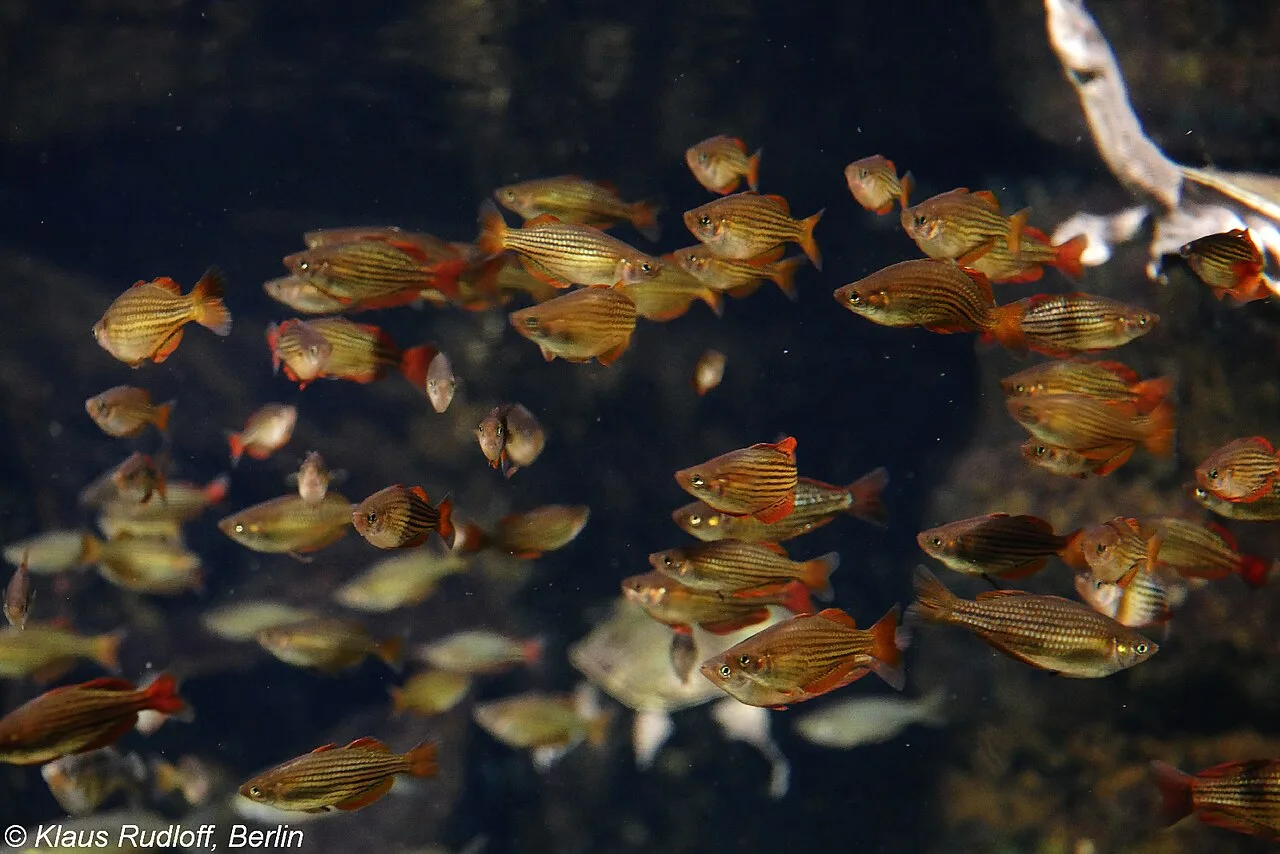
The species comes from the Mamberamo river system in Papua province on New Guinea, Indonesia. It lives in small, slow-flowing rainforest waters that are tea-coloured from rotting plants. It is a schooling fish that stays near the surface. The IUCN lists it as least concern.
Care
Body length is 6 cm, rarely up to 8 cm.
Small, but it needs length
The neon dwarf rainbowfish stays at about 6 to 7 cm and still needs a swimming run. 24 to 28 °C, pH 6.5 to 7.5, a group from eight, tanks from about 100 litres and 80 cm. The blue of the males comes with age and with rivals, not on a single juvenile. Juveniles are silvery. That is normal.
The species is on the move all day. Quiet bottom fish bother it little. Aggressive barbs and a short tank put the colour out.
Diet
A prepared food with a plant share, in portions that also reach the fish at the back. Colour comes from age, light and the chance to court, not from a single colour food.
Behavior
Recommended are at least six fish with at least as many females as males, a tank of about 60 litres or more and at least 50 to 60 cm long, 22 to 28 °C and pH 6.0 to 8.0, ideally around 25 °C and pH 7. Heavily planted tanks with floating plants are preferred. The species is generally peaceful, but males spar, especially in the morning. It gets along with almost any tropical fish not large or aggressive enough to eat it. Feeding should be varied, with finely diced leafy greens and occasional live food such as mosquito larvae and brine shrimp.
Reproduction
Sexes are separated by the paler colour and the yellowish-orange fins of the females.
The species is an egg scatterer and therefore regarded as easy to breed. Spawning takes place early in the morning. The males fight, circle and nip each other, spread their fins and intensify their sheen. Females spawn on several days in a row, and the eggs hatch within a week. Live fish reached the USA in the early 1990s and Europe through Heiko Bleher; today the species is bred commercially worldwide.
Gallery
More species in this group
Similar water needs
Species with a similar temperature, a similar pH and a comparable adult size. Whether their behaviour fits as well is what the compatibility check is for.





