Bushymouth catfish
Ancistrus dolichopterus
28 views
Armoured catfish with head tentacles.
- Temperature
- 23 – 27 °C
- pH
- 6 – 7.5 pH
- General hardness
- 5 – 17 °dH
- Maximum size
- 13 cm
- Minimum tank size
- 100 L
5 min read · 728 words
Fresh water
Quick facts
Further published values
- Lifespan
- 15 a
Place in the aquarium
Highlighted are the water layer and the spots where the species usually stays in the tank.
- Near the bottom Mostly stays just above the bottom. Food has to reach the substrate.
- Wood and roots Uses roots as shelter or grazes biofilm from them.
- Rocks and caves Needs caves, crevices or rockwork as hiding place, territory or spawning site.
Shrimp in the tank
Shrimp safe
- Not shrimp safe
- Dwarf shrimp at risk
- Shrimplets at risk
- Shrimp safe
- Adult dwarf shrimp
- Safe
- Shrimplets
- Mostly safe
- Safe from shrimp size
- Any size
The bushymouth catfish is regarded as shrimp-safe. With its sucker mouth it grazes algal and bacterial films from stones and wood and is not built to hunt moving prey. Adult shrimp and usually their young remain unharmed. It occasionally takes animal food, but targeted hunting of shrimp is not part of its behaviour.
Enough food for both matters: vegetables and catfish chips for the catfish, so it does not compete with the shrimp for food. Both like to use wood and caves.
Home & range
Hatched countries are where the species occurs. It lives in particular waters there, not across the whole country. The points name known waters for orientation, not collection sites.
- Country of origin
- Water for orientation
Native
Overview
Males carry the fleshy tentacles on the head. Females have at most smaller ones along the snout. Ancistrus species usually stay under 15 cm and are stockier and broader-headed than many other armoured catfish, often mottled brown, grey or black. For this species 13 cm is given. The trade name does not always match the species that arrives. It should not be confused with the Pimelodidae, which are also called Antennenwelse in German.
Features and identification
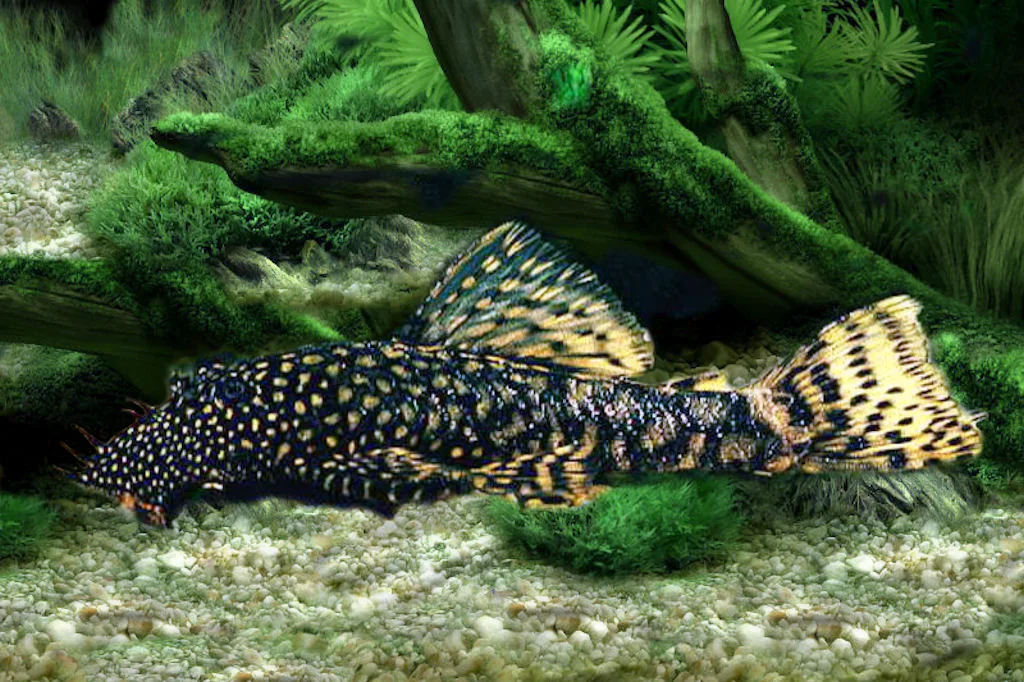
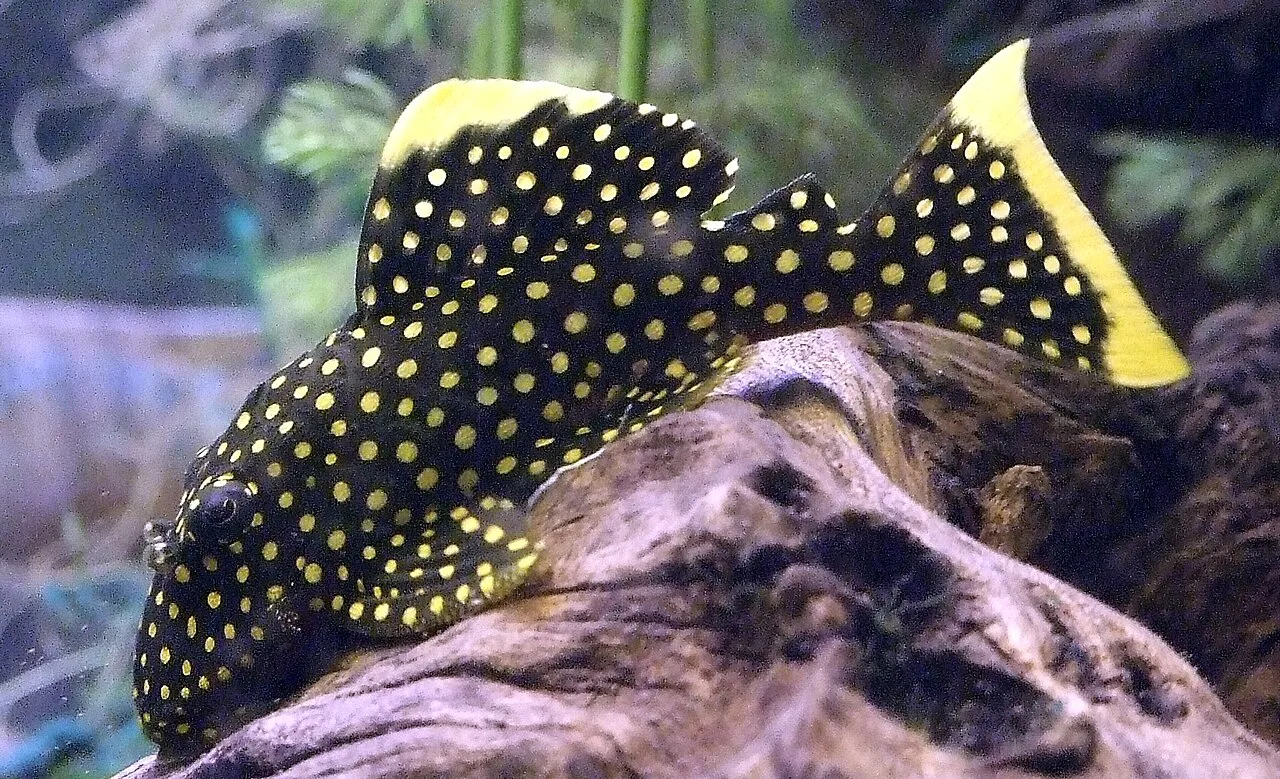
The ground colour is deep black and becomes slightly lighter with age, and the body is covered with small white dots. The dorsal and tail fins have white margins which, unlike in the similar Ancistrus sp. L181, usually do not fade. The dorsal fin also has 8 to 9 soft rays, while most other species have 7. Hybrids with L181 are suspected. Males develop antler-like skin growths at the mouth that reach onto the forehead, females much smaller ones only around the mouth. The sex can only be seen above a certain size. Reported sizes range from 14.5 cm standard length to 15 to 25 cm in captivity. Under ideal conditions up to 15 years are possible.
Name and taxonomy
Rudolf Kner described the species in 1854, with Manaus as the type locality. The genus name probably comes from Greek ágkistron, fish hook, after the hooked odontodes on the gill cover. Dolichopterus means long fin, because the dorsal fin is as high as it is long. Other names are bushymouth catfish and L183. Two Hamburg importers brought the species to Germany in 1911.
Origin & habitat
This describes the origin, not how to furnish the aquarium.
The genus lives in rivers and floodplains of the Amazon basin, other tropical South America and Trinidad, with two species in Panama. Three species in the genus are cave fish. That does not apply to the species listed here.
The species is best known from the Rio Negro. The Trombetas, Tefé, Madeira, Tapajós, Padauiri, Demini, Branco and Nhamundá are also named, including clearwater and whitewater rivers. The species is recorded from Bolivia, Brazil, Colombia, Ecuador, Guyana, Peru and Venezuela. In blackwater it lives behind stones or in dead wood and prefers very soft, acidic water at 26 to 29 °C. In Germany there are small stable populations in the warm Gillbach and in the Wassergarten Reden, in Austria in the Warmbach near Villach. The IUCN lists the species as least concern.
Care
The species is kept at 23–27 °C and pH 6–7.5 in tanks from about 100 litres. For the genus it names current, substrate rather than bare glass, and a lower size of about 95 litres that some keepers use. Caves are needed, because the fish hide when they are not feeding. Two males on a single tube stay tight for the long term.
Keeping
A small group of one dominant male and two to three females is recommended. The fish are mostly peaceful, but males compete for territories and females, and a structured layout reduces fights. Suitable are 24 to 30 °C, weakly acidic water, a dark substrate and an edge length of at least 80 cm. Leaves, alder cones, bark or Indian almond leaves are used to acidify the water. Clay tubes, stones, slate, bogwood roots and halved coconut shells serve as hiding places. Poor water, stress or missing hiding places can change the colour.
Diet
Algae, aufwuchs and detritus. Sand and gravel are taken up with them. Keepers report that they eat wood, but there is no scientific evidence for it. Vegetables and sinking tablets remain the practical supplement once the glass is clean. Food at the surface does not reach them.
As a herbivore the species grazes bacterial and algal films from stones and soft wood, which it needs for its gut flora, but it also takes animal food. In the aquarium frozen food, vegetables such as cucumber, pepper and courgette and catfish chips are fed.
Behavior
Nocturnal, not a school. Juveniles stand more in bright shallows and are reachable by birds there. Adults hide. Rivalry between males at caves is the older keeping observation, not a new measurement.
Reproduction
Cave spawner. The male guards the eggs.
Brood care by the male
Spawning takes place hidden in caves and under roots. The eggs measure about 3 mm and are distinctly orange, and a female lays up to 90 eggs in clumps. The male tends the clutch and fans fresh water over it. Under good conditions a paired female spawns every 21 days. The young hatch after about five days, and the yolk sac is used up after about 14 days.
Gallery
More species in this group

Similar water needs
Species with a similar temperature, a similar pH and a comparable adult size. Whether their behaviour fits as well is what the compatibility check is for.